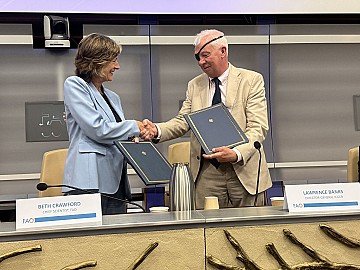
ICGEB at the 50th anniversary of the international meeting on recombinant DNA molecules, Asilomar Conference Grounds, Pacific Grove, California: promoting international collaboration in biotechnology and safe and accessible scientific progress.
23-26 February 2025: 50 years after the landmark 1975 Asilomar Conference set standards allowing geneticists to push research to its limits without endangering public health, experts from around the world gathered to reflect on its legacy and address today’s most pressing biotechnology challenges.
Director-General Dr. Lawrence Banks, together with Head of Biomanufacturing at ICGEB, Dr. Jenny Molloy, Senior Programme Assistant, Regulatory Science, Dr. Felix Moronta, contributed to key discussions alongside the Vice-President of the ICGEB Board of Governors, Prof. Kassahun Tesfaye, and Appointed Governor for South Africa, Dr. Nhlanhla Msomi.
The Spirit of Asilomar 2025 conference brought together scientists, policymakers, industry leaders, indigenous peoples, and civil society representatives to discuss and work together in the historic Asilomar State Park in California.
Exploring the Future of Biotechnology
Dr. Banks took part in the “Framing the future of biotechnology” theme, co-chaired by Dr. Molloy, which explored the narratives, perspectives, values, and worldviews of the diverse stakeholders and communities invested in this topic. Discussions focused on policy frameworks for a truly global bioeconomy, increasing biotechnology access and equity, the role of science communication in ensuring that biotechnology serve society responsibly, building indigenous biotechnology, and educating the next generation of responsible and impactful biotechnologists.
Dr. Moronta participated in the theme on Biotechnologies beyond conventional containment, which examined the governance of engineered organisms released beyond laboratory settings. The working group explored how synthetic biology and bioengineering interventions could be applied to the conservation and bioremediation or public health while ensuring ecological safety and public trust.
A key takeaway was the need for stronger collaboration between synthetic biologists, ecologists, and policymakers to align scientific advancements with ethical and societal considerations.
A Continuing Conversation
The conference reinforced the importance of transparency, collaboration, and responsible governance in biotechnology, principles that strongly resonate with ICGEB’s mandate. As discussions continue, official statements from the conference are being prepared to guide future policy and research directions.
ICGEB remains committed to fostering global cooperation in biotechnology and will continue engaging in international discussions to ensure that science advances in a way that benefits people, society, and the environment.
**
Reflecting on Asilomar: Revisiting the Legacy and Charting New Paths
In 1975, a group of pioneering scientists gathered at Asilomar to address the emerging field of recombinant DNA technology. Their discussions shaped early protocols for biosafety and sparked a global conversation about balancing innovation with public responsibility, an approach that laid the groundwork for much of modern biotechnology policy. Fifty years later, the “Spirit of Asilomar” remains as relevant as ever, reminding us of the importance of open, forward-looking debates about the implications of cutting-edge research.
At the 1975 meeting, there was no participation from the Global South. This time the conference intentionally brought together voices from a wider range of countries and disciplines to ensure a more globally inclusive conversation, with 16 ICGEB Member States represented.
Aligning Asilomar with the ICGEB Mandate
The conference reinforced the importance of collaboration, transparency, and continuous self-reflection, principles championed at the 1975 conference that remain crucial today.
The Spirit of Asilomar reminds us that biotechnology does not exist in isolation; its governance must involve scientists, policymakers, and society as a whole to ensure that emerging technologies contribute to global well-being. These reflections will serve as a foundation for future discussions on how to responsibly govern biotechnology in an era of rapid scientific advancement. Results of the discussion at Asilomar are already being incorporated into policy processes.
In a continuation of her work with the OECD Global Technology Forum Synthetic Biology Expert Group, Dr. Molloy represented ICGEB at the Hoover-OECD workshop “Pathways to Responsible Innovation and Anticipatory Governance of Synthetic Biology” at Stanford University, translating key outputs from Asilomar to build OECD policy guidance.
**
The history of Asilomar – and the connection to ICGEB
Paul Berg, Nobel prize for Chemistry, 1980, owes his fame to an experiment that showed how it was possible to insert DNA segments from different sources into the DNA of a monkey virus, creating a chimeric molecule. It was 1972 and it was the birth of genetic engineering. After his discoveries on DNA engineering, Berg also had the sensitivity to understand the scope of what he had found, and to fear its possible development. He was the organiser of a meeting that went down in history, the Asilomar Conference on Recombinant DNA, held in 1975 at Asilomar State Beach, California, where the potential dangers of genetic engineering were discussed for the first time.
Some places and moments have remained memorable in the history of science. One of these was the Department of Biochemistry at Stanford University in the 1960s. From that school, Nobel Prizewinners like Paul Berg (Chemistry) and Arthur Kornberg (Medicine) – member of the ICGEB Council of Scientific Advisers between 1995 and 2005 – hailed, as did Arturo Falaschi. Head of the ICGEB Trieste Component from 1987, Falaschi established the Headquarters and laboratories of the ICGEB in Italy, where he served as Director and Director-General from 1989 to 2004, remaining Distinguished Scientist at ICGEB Trieste until 2010.
Momentous and exciting times, when new paths were forged and the foundations lain for Biotechnology Governance.
Further reading:
G. Sturloni, JCOM 2 (2) 2003. Preventive self-governance
WIPO / UPOV 2002-2003 Proceedings: Joint Symposia Documents of the World Intellectual Property Organization (WIPO)and the International Union for the Protection of New Varieties of Plants (UPOV)