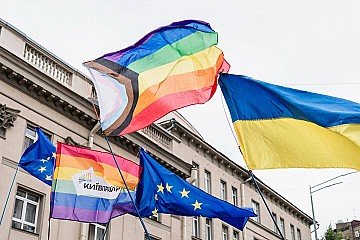
A critical legal development posing a significant threat to the rights and legal security of LGBTI people will jeopardise Ukraine’s chances of EU membership.
Brussels, January 27: The Speaker of the Ukrainian Parliament is currently preparing a new Civil Code, which will incorporate and fully replace the Family Code and constitute one of the most far-reaching reforms of private law in decades. While presented as a modernisation effort aligned with EU standards, the draft contains provisions that would, in fact, severely undermine the country’s chances of EU membership.
Rather than protecting all families in Ukraine, the provisions would significantly undermine the rights and legal security of LGBTI people, conflicting with EU non-discrimination standards and relevant EU and European Court of Human Rights case law.
The key concerns include:
Legislative Reform Without Fulfilment of EU and ECHR Obligations: Although the draft law undertakes a comprehensive revision of existing family and civil legislation, it does so without fulfilling Ukraine’s long-standing obligation to provide legal recognition for same-sex couples. This approach contradicts Ukraine’s obligations under the European Convention on Human Rights, ECtHR jurisprudence (including Maymulakhin and Markiv v. Ukraine), and EU integration commitments outlined in the 2025 Rule of Law Roadmap and Chapter 23 of the EU accession negotiations. Ukraine, in its commitments under the EU accession negotiations, should have adopted registered partnership legislation by the third quarter of 2025, but instead has stalled in progressing on the bills that would have accomplished this.
Annulment of Existing Court Recognitions: The draft defines “de facto family unions” as exclusively opposite-sex partnerships and explicitly excludes same-sex families. This approach would effectively override existing court decisions that have recognised same-sex couples as families, thereby eliminating the limited but already established legal protections they currently enjoy.
Impact on Trans Individuals: The draft automatically invalidates marriages involving individuals who have legally changed their gender, creating legal insecurity for trans people and their partners, and contravening the body of ECtHR case law regarding legal gender recognition.
For over two years now, two draft bills on civil partnerships (№9103, №12252) that would finally give recognition also to same-sex couples, are not moving forward in the Ukrainian Parliament. If the Civil Code being discussed in the Parliament now is not to hinder further advances on EU accession, it needs to incorporate proposed amendments that reflect the two civil partnership bills. But so far none of the amendments submitted to the Speaker, Mr. Ruslan Stefanchuk, were taken forward.
According to ILGA-Europe’s Advocacy Director, Katrin Hugendubel, “This version of the draft Civil Code should not pass in its current form if Ukraine is serious about its path toward EU membership. It would roll back hard-won protections under domestic case law, clash with Ukraine’s obligations under the ECHR and its EU accession commitments, and run counter to the commitments set out in the accession plan for recognising same-sex partnerships.
“Taken at face value, this draft would establish one of the most restrictive legal frameworks for same-sex couples in the EU and the EU accession region. It would be second only to Georgia, which in 2024 adopted restrictive legislation targeting LGBTI people as part of a deliberate move away from the EU acquis, making it crucial to prevent a “Georgian scenario” from taking hold in Ukraine,”
The European Commission needs to be very clear that in order to join the EU, Ukraine needs to ensure non-discrimination and not erode the legal standing of same-sex couples and LGBTI families. Ukraine should not pull away from the European human-rights standards it says it wants to uphold.” Hugendubel added.
According to Tania Kasian, Executive Director of Ukrainian NGO Fulcrum UA, “The Ukrainian LGBTI community and human rights defenders are urging the European Commission to respond publicly, as this could be a decisive factor in stopping the advancement of this dangerous initiative and protecting fundamental rights in Ukraine”.