Even then, the underlying currency wasn’t physical at all – it was trust. Every transaction, every relationship, every decision rested on it. And unlike any physical or digital currency, trust is impossible to mint, slow to build, fast to lose. In a world of accelerating growth and fragmented media, trust has become both scarcer and more essential.
By many measures, trust in critical global institutions is at an all-time low – business, government, higher education, the fourth estate, judicial systems, political parties, all have experienced steady declines. At the same time, media fragmentation makes it even harder to either build or regain trust at scale, with outside stakeholders or employees. In an era where anyone can hear about you, your company, your organization from nearly any place and any medium, how do we protect reputation, and create trust? No one organization is going to solve the trust problem, but there are some ways that we at Microsoft have found useful to address it.
1. Be consistently clear. Trust is (as always) built with consistency, transparency and authenticity, to all audiences. Externally, this means being relentlessly clear not just about what you are doing, but why, and how you are measuring it – if you don’t declare, others will pick metrics for you. And remember that (as Hobbes said) a foolish consistency is the hobgoblin of small minds – which means that it is always okay to change as the world changes, but key to that is acknowledging the change and the why behind it. Internally, this involves treating employees as a key audience – increasing the tempo of communication with them, and ensuring that what is said internally is the same as what is said externally. Any gap is dangerous.
2. Operate the channels that matter. In a world where the first version of “what happened” can come from a forum or a thread, control the means of communication – not to dominate the conversation, but to make sure your facts and context are available, accessible, and authoritative. Build the capabilities before you need them; when trust leaks, you don’t want to discover a gap. This means owned channels, inclusive of a rich investor relations and media site, but also the ability to have a company voice anywhere customers live – in online forums like Reddit, and across all social platforms.
3. Enable your people as credible voices. Finally, in a low trust environment compounded by fragmented media, your employees and those closest to the company are the ones that will be most trusted. We’ve all been in a situation where we’ve heard something about a company and then reality checked it with someone who works there. This means we need the ability (and permission!) to mobilize our employees as advocates.
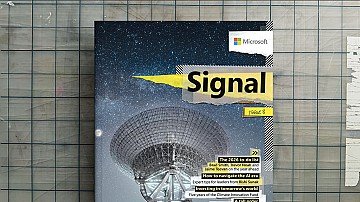
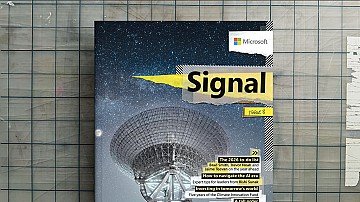
We have tried to combine all these elements in the magazine that you hold in your hands. Inside you will find clarity, authenticity and transparency from credible voices delivered in a channel we feel matters more than ever: print. Enjoy issue three of Signal.
Frank X. Shaw,
Chief Communications Officer,
Microsoft
Trevor Noah is a busy man. Since wrapping up his seven-year run as host of The Daily Show in 2022, the South African comedian, author and philanthropist has founded his own production company, released a Netflix comedy special and won the Erasmus prize, the first comic to do so since Charlie Chaplin in 1965.
In 2024, he published his first children’s book, Into the Uncut Grass, a follow-up to his bestselling memoir Born a Crime. He continues to run the Trevor Noah Foundation, a youth development initiative he founded in 2018, which partners with Microsoft to expand AI-driven learning opportunities in under-served schools across South Africa. And he’s showing no signs of slowing down. “2026 is going to be a really busy year for me,” he says. “I’m going to be launching my next world tour and doing a bunch of stuff around the World Cup with YouTube. And we’re constantly expanding the Trevor Noah Foundation.” He attributes his energy levels to his positive outlook.
“There’s always cause for optimism,” he says. “Optimism is a necessary component of the human experience… When we were hunting for animals, you had to be optimistic that you would find one, and today, if you’re going to be building technology that’s going to shape the future, you’ve got to be equally optimistic. The world always moves forward.” Here are eight things Noah is excited about in the year ahead.
1. The chance to push philanthropy further “Our mission and style of tackling problems [at the Trevor Noah Foundation] have definitely changed over the years. We have learned that the things that we thought learners and teachers would want did not necessarily line up with what they actually needed. We wanted to give people, say, fancy tech labs and many of them were just saying ‘We actually need gates that lock’ or ‘We need a fence so that wild animals can’t come in’. So we’ve gotten a lot better at listening to the needs of the community.
We’ve just launched an innovators’ fund, finding people with innovative ideas in and around Africa, and then helping fund those ideas and projects to assist with everyday problems. We’re particularly interested in ideas around education, development and construction, anything that overlaps in the Venn diagram of improving infrastructure and communities.
In terms of long-term goals, we try to pilot programs and pass along those that show success to the government [to develop further], because we can’t scale like a government can. We want to create programs and ideas that last long after we’ve left a community or enable them to do things beyond us. We ask, how do they make more money? How do they create new opportunities? How do they create entire ecosystems? The people that will have fascinating ideas on how to change the community are from the community itself.”
2. A revolution in healthcare “There’s a lot of focus on AI but, for me, we speak about it a little too broadly. There’s one side of AI that’s all speculation, and then there are others where we’ve already struck gold, and I don’t think we’re spending enough time in those departments. Healthcare is one of them. I went to Johns Hopkins University and saw how they’ve been able to improve the diagnosis and treatment of breast cancer in patients through large language models which are looking through scans and predicting whether or not somebody’s going to have breast cancer, sometimes five years sooner than a doctor would. That is also decreasing how many women have to have biopsies unnecessarily. It’s not just the missed positives [that are being addressed]; it’s all the false positives or the possible positives that lead to negative outcomes in people’s health.
There’s another AI program where doctors can dictate their notes and have them written up automatically. So much of the work that’s in healthcare right now, especially in the US, is just in administration and it’s not helping anybody, it’s just everyone covering their butts and making sure that everything is done in triplicate. If we get systems that take care of it, that improves lives here and now.
3. A return to context “People are starting to remember the value of context. If I’m in a room with people, the context is maintained and the veracity of what we’re speaking about is really held securely. It’s very hard for people to lose context. So, when I’m online, I’ve tried to pivot a little more to long-form as the context is more important than ever before. There was once a mad dash to have everything be as short as possible; our record was six seconds when it was [defunct social media app] Vine, but now for myself and for many people, there’s a new direction. We’re saying, ‘Let’s stretch this out, let’s have a longer conversation, let’s have something that breathes so that as much context is maintained as possible.’”
4. A rethink in education “Education is another one of those areas where there’s an opportunity because there is no place I’ve been where there are enough teachers for the learners. There is no world I’ve seen in which every student has an equal opportunity to as much education as they need. I think that the place that AI is already at, especially in a closed system, can provide infinite resources with an LLM that’s trained on all the textbooks and all the information that the kids and teachers need contained within it: lesson plans, marking, student-specific instruction, guidance.
I don’t see a downside, because education has been stagnant for such a long time and so many learners are coming out of school lacking the skills and the tools that they need in the modern world and teachers have borne the brunt of this. They’re up against it. They’re at school trying to teach, and they’re going home and then marking papers until midnight. Then, they’ve got to come in and do it all again. So, AI in education is a massive opportunity, and the risk is contained because you’re doing it within one sphere and always under the supervision of a teacher. It has a wonderful amplifying potential that we sorely need in education all over the world.”
5. Increased understanding of AI “I think people should learn as much as they can about the tech, and not just by reading but by doing. I’ve enjoyed building my own agents and would suggest everyone gives it a try. I’m actually shocked at how many CEOs I speak to who are shaping their entire companies in and around AI, and then when I ask them if they’ve used it personally, the answer is no. Maybe some of them have done a cursory search using one of the LLMs, but none of them have actually dug into it. And I always say to them, ‘If you don’t take the time to try to understand this thing, how can you shape your organization around it?’
Building agents has helped me understand that an LLM has its limitations. It is fantastic at processing insane amounts of data, but it really is limited when it comes to its multimodal inputs and outputs. That’s where humans still have a really interesting edge over technology, in that we’re good at collecting inconsistent, dirty information across different spheres and somehow making it make sense. Our organizations aren’t as clean as we’d like to believe in terms of information flowing from one side to another and neither is the world. And in the same way that self-driving cars have shown how difficult it actually is to drive, we take for granted how easily we transfer information and make use of it in the world.”
6. An evolving job market “There are a lot of AI evangelists who would have us believe that every job is going and everything will be taken over. From everything I’ve seen this isn’t the case – all AI has really done is promote us to being managers of our own work. Everyone still has to supervise the work. So, your legal AI is only as good as the lawyer who knows how to supervise it and understand whether or not the cases it’s citing are actually real. Your coding AI is only as good as the software engineer who looks at it and can say, ‘This is goo