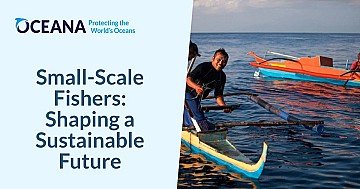
Josana Pinto da Costa guides her small fishing boat through the murky, moonlit Amazon River in northern Brazil, where she makes her living fishing. She fishes in the nighttime, not by choice, but because of new levels of daily, intense heat brought by climate change.
“Climate change has had a major impact on our fishing, which is becoming increasingly difficult,” Costa says.
Global warming is not just changing the air temperature; it’s reorganizing coastal ecosystems. “Fish that used to be caught along the coast now require going many more miles offshore, deeper into the ocean,” says Costa.
Costa is not alone. Around the world, fishers — whether from Amazonian coastlines, New England harbors, or Arctic outposts — are witnessing the ocean change beneath them.
Roughly 90% of the excess heat from human-caused carbon emissions has been absorbed by the ocean. As sea temperatures rise, fish populations are shifting. In some regions, fishers are experiencing a boom in fish — though they are different kinds of fish than they are used to catching and customers are used to eating. In other regions, fish are disappearing.
“This is the largest movement of animal life in recorded history,” says marine ecologist Dr. Malin Pinsky. The global scrambling of marine ecosystems touches every link in the seafood chain — fishers, regulators, business owners, and consumers. All must adapt.
Trouble in the tropics
Accustomed to year-round warm temperatures, tropical fish can handle the heat. But they cannot always handle more heat than they are used to.
“Fish in the tropics have a smaller range of heat tolerance,” explains Dr. Juliano Palacios Abrantes, a fisheries scientist based in Vancouver, Canada who has extensively studied the impact of climate change on fisheries and management in Latin America.
“There, our temperatures usually stay within a 10 °C [20 °F] range. In more temperate locations further north or south it might be a 40 °C [70 °F] range. Because they’re used to seasonal swings, those fish are able to withstand more warming.”
According to Palacios-Abrantes, all existing scientific models suggest that, overall, tropical fish populations that cannot tolerate the heat will shift towards the North and South poles, or to deeper water. Palacios-Abrantes recently led a study that estimates that by 2030, 23% of straddling fish populations — fish who live between various countries’ waters and the high seas — will have undergone distributional changes.
The Southwest Atlantic — bordering Brazil, Argentina, and Uruguay — is a global warming hotspot, heating faster than the global average. In Brazil, coastal fishers rely on delicate ecosystems — mangroves, estuaries, and tidal creeks — that are being hammered by storms, sea-level rise, and shifting salinity. And unlike industrial fleets, they are bound by smaller boats and community ties, unable to sail hundreds of kilometers in search of fish.
In 2025, Oceana released an audit of Brazil’s fisheries, which examined overfished populations, fishing fleets, transparency, and the public budget. The report revealed that 92% of Brazil’s fish stocks lack management plans, and half go unmonitored altogether.
“Data on these fisheries is more important than ever,” says Oceana’s Science Director in Brazil, Martin Dias. “Without it, there’s no way for the government to prepare for climate impacts, or to provide financial assistance to help fishers adapt as climate change affects their livelihoods.”
Oceana’s team is launching a new campaign to collect nationwide fisheries data, to help better secure small-scale fishers’ livelihoods in the warming years to come.
The mounting challenges to artisanal fishers in the tropics highlight the inequity at the heart of climate change. A recent study found that ocean heatwaves are linked to carbon emissions from 180 companies, most based in the Global North.
“Most countries in the Global South have contributed insignificantly to climate change, but their small-scale fishers are experiencing the worst impacts,” points out Palacios-Abrantes.
Northward bound
On the other side of the hemisphere, U.S. and Canadian fishers are feeling changes too.
Cod and lobster — once abundant off the coast of New England — have moved deeper or shifted northward. Meanwhile, southern species like black sea bass are now showing up in northern waters. Since the 1970s, American lobster, red hake, and black sea bass have moved northward by an average of 233 kilometers (145 miles). One clam processor even relocated operations from Virginia to Massachusetts.
In Canada, a 2020 survey of more than 100 commercial fish harvesters on the Pacific Coast found that the salmon fishery has been especially hard hit by climate change, while other fish, like albacore tuna, seem to be increasing in population.
“I think there will be winners and losers on a species-by-species level. Fishermen will need to be diversified,” one fish harvester noted. Another reported needing to change their fishing location almost weekly: “You have to be extremely adaptable.” Fishers also reported fishing at greater depths than before.
Adapting will not be easy, the majority said. Nearly three-quarters of the fish harvesters surveyed said that changes in fisheries had raised their stress levels, due to the uncertainty affecting their livelihoods.
Changing fish populations also bring cultural and nutritional trade-offs. For First Nations in British Columbia, for example, salmon is not just food — it is central to ceremony, identity, and community wellbeing. “It’s not just about eating tomorrow,” says Palacios-Abrantes. “These fish are part of cultural identity, and not every species can replace that.”
Scrambling the sea
Fish will not disappear overnight, and it’s important to keep the shift in perspective, scientists remind us.
“We think of a group of fish packing all their things and leaving, which isn’t how it works,” Palacios-Abrantes says. “The problem is that the abundance and type of fish in the water is going to change.”
When considering which species will be impacted more quickly, Dias points to shorter-lived species. For sardines and shrimp, for example, a heat wave during their spawning period could crash the fishery. Longer-lived species face chronic challenges due to climate change, but less immediate risk.
Over time, the shift in species will have ripple effects. When tuna, an apex predator, enters new ecosystems, for example, it may upend food chains. In the Arctic, warming and ice melt are inviting new species into formerly inaccessible areas, while species already living at the poles, with nowhere left to migrate, are especially at risk. Cold water species are projected to lose 50% of their thermal habitat by 2050.
The problem isn’t just environmental — it’s geopolitical. As fish cross international boundaries, disputes over quotas, territory, and sovereignty are expected to rise. Pinsky warns that ecosystems are being reshuffled “like a snow globe disrupting fisheries” and “driving conflict over who gets to catch what.”
Adapting to this new normal will require major shifts in monitoring and management.
Along with better monitoring, scientists are advocating for more flexible policies that can respond to the ways fish distribution around the world is changing.
“Often marine protections are very rigid and defined, in order for them to be permanent and enforceable,” says Palacios-Abrantes. “But in an age of climate change, some fish populations are moving outside the boundaries of, for example, protected areas or national jurisdictions. We need to be able to revise protections and work across national governments to respond to real-time environmental shifts.”
In visits with fishers in the Eastern Tropical Pacific, fishers told Palacios-Abrantes how they are already adapting. For example, when fishing for tuna, they change their location depending on the climate, and are seeking to change fishing gears to catch tuna at greater depths due to warming waters.
“Climate change adaptations need to come from communities that are being most affected, if they are to truly be effective,” Palacios-Abrantes says.
“As the oceans change, so must we,” says Dias. “The impacts are going to be unevenly spread across the globe. We must be quick to adapt and support fishers on the frontlines.”