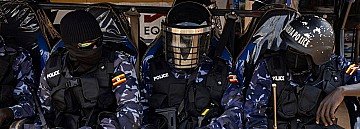
African Heads and States and Government will convene for their 39th Annual Assembly in Addis Ababa, on the 14 and 15 February 2026. Despite a tumultuous period of contested and highly volatile elections in the last few months, the AU Summit’s agenda does not include a discussion on the retrogression of Democracy, Elections and the Rule of Law, it is therefore imperative that the issue be brought to member states urging them to give prominence to the issues of democratic consolidation.
11 February 2025
H.E. João Manuel Gonçalves Lourenço
President of the Republic of Angola &
Chairperson of the African Union (AU)
Assembly of Heads of State and Government
Addis Ababa
Ethiopia
H.E. Mahamoud Ali Youssouf
Chairperson African Union Commission
Addis Ababa
Ethiopia
Subject: Urgent call to the AU Heads of State and Governments to address democratic backsliding, shrinking civic space and rule of law deterioration in Africa at the 39th AU Summit
The International Federation for Human Rights (FIDH) respectfully writes to you to urge you to act decisively on the accelerating erosion of democratic safeguards and the rule of law in Africa. We write to you in our capacity as a Federation comprising of nearly 200 civil society organisations, 40 of whom are African organisations. The 39th AU Summit comes at a critical juncture as it closely follows the recent aftermath of questionable electoral processes across the continent, notably in Cameroon, Côté d’Ivoire, Guinea Bissau, Tanzania, Guinea and Uganda.
In all these elections concerning patterns emerged. African citizens have observed the increased adoption of authoritarian tendencies and practices to retain power, and the dangerous trend of incumbent governments targeting any form of dissent. Opposition leaders are arrested, arbitrarily detained, charged with trumped-up treason charges and abductions and enforced disappearances have also become rampant. Political opposition or publicly organized citizen dissent has become treasonous. Citizens, journalists, whistleblowers and activists are increasingly being targeted with similar reprisals as those by the political opposition.
Elections that were meant to reinforce democratic governance, instead became flashpoints for instability. From disputed results and violent protests to the collapse of constitutional guarantees, the continent witnessed an all too familiar troubling pattern of democratic backsliding. In several countries, contested polls escalated into mass unrest that led to massive violations against protestors. The weakening of institutions, entrenchment of political elites, and shrinking civic space have eroded trust in elections across Africa.
In all the elections of member states cited here, the AU Observation Mission’s, save for Tanzania rubber-stamped problematic electoral outcomes, seemingly prioritizing the stability of the regimes in power over true democratic and citizen-focused electoral outcomes.
Most of these countries continue to face growing anger and frustration that has bred the rise of civil resistance against government excesses expressed through protests. Protests have become the common outlet for the people to express their frustrations about the widening gap between the people and the political elite with respect to basic rights, embodied by the rising cost of living, the failure by governments to provide essential services, lack of political freedoms, and the constant cycle of stage-managed and manipulated elections.
A significant part of the continent’s citizenry no longer trusts elections but equally critical is that the trust placed on the African Union to enforce the objectives of the Constitutive Act of the African Union, in particular “to promote the principles and the democratic institutions, popular participation and good governance; to promote and protect human and peoples’ rights in accordance with the African Charter on Human and Peoples’ Rights and other relevant human rights instruments”, has been severely eroded.
The gradual dismantling of civic space and the rule of law raises the urgent question, how can the African Union can prevent other Member States from sliding into similar authoritarianism?
This trajectory is deeply incompatible with the AU’s foundational promise under the AU Constitutive Act, further erosion of the principles of the rule of law, democracy and fundamental rights could lead to a wider disintegration of the values on which the AU is founded and put at risk the very cohesion of the Union was established to build.
The African Union has the moral obligation to act now on violations of the values of the AU Constitutive Act, and other normative frameworks. As the ultimate body tasked with safeguarding the rule of law, upholding the AU Constitutive Act, the African Charter on Human and Peoples’ Rights and the African Charter on Elections Democracy and Governance, we call on you to take your responsibility to act decisively and:
1. Make a strong and explicit requirement that the Framework of AU observer missions be reviewed to ensure that the missions strictly enforce the AU Normative Frameworks such as the African Charter on Democracy, Elections and Governance (ACDEG), and the Lomé Declaration. In addition, we urge that it be made mandatory for AU Observer missions to include human rights institutions.
2. We urge that the AU, find inspiration from observation practices in other continents, particularly, on the deployment of a long-term observation mission before the election and a subsequent short-term mission deployed for the elections.
3. Put in place a framework that ensures appropriate sanctions for member states that violate the AU’s normative frameworks on democracy, elections and governance that goes beyond unconstitutional changes of government, and that ensures recommendations of AU observer missions are implemented.
4. Recommend that the AU Commission engages in direct dialogue with member states whose where recent electoral transitions fell short of the AU normative framework and principles to ensure they guarantee fundamental freedoms for the citizens and put in place measures to address government excesses infringing on the rule of law and democratic consolidation.
5. Ensure that the African Union’s commitments for the entrenchment of democratic values and standards and to peace and security are fiercely guarded and implemented in a manner that aligns with the aspirations of African citizens.
6.Ensure that the AU implements concrete measures to combat attacks and reprisals against human rights defenders, pro-democracy activists, and whistle-blowers. The AU must work to reopen civic and democratic space on the continent, in particular by facilitating the effective participation and contribution of civil society in political consultation and negotiation processes, as well as national political debates.
We stand ready to collaborate with all African Union institutions and member states committed to advancing democracy and the rule of law, in order to build a continent where citizens thrive, democracy flourishes, and fundamental rights are protected.
Respectfully,
The International Federation for Human Rights (FIDH)