Water is the lifeblood of societies, economies, and ecosystems. Yet climate change and human activities are increasing variability, extremes, and pressures on water systems. By situating water at the core of planetary health CMCC research aims to advance a new era of systemic, cross‑scale, and transformative water governance, connecting scientific insights with policy and practice.
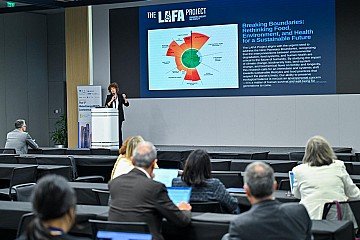
On 3–5 March 2026, CMCC and the Istituto Veneto di Scienze, Lettere ed Arti hosted the international event Water. Science and governance. Navigating safe operating spaces through research, policy, and practice in Venice, at Palazzo Loredan, bringing together leading voices in water science from around the world.
The initiative consolidated CMCC’s expertise in supporting resilience to water‑driven hazards and safeguarding water resources in a changing climate and provided an opportunity for interdisciplinary talks on the risks and opportunities embodied in water.
“Water is where science has to meet its ultimate client: society,” said Giulio Boccaletti, CMCC’s Scientific Director, during the event’s opening remarks. “How science confronts climate change is a profoundly interdisciplinary issue, and water is the sharp end of it.”
Convening leading voices from science, policy and practice to explore how water shapes our societies and future, the event assessed the robustness and actionability of planetary boundaries for water; explored the potential of nexus frameworks as authoritative operational tools; addressed mismatches of scale between planetary boundaries and governance practices; advanced planetary health as an organising principle for water policy; and fostered dialogue on synchronising short‑term operational management with long‑term transformative strategies including the intermediate scales of seasonal and decadal planning.
“The planetary boundaries and nexus approach are the two main pillars around which we want to build discussion but we also want to go beyond and see how to ensure actionable knowledge and make the topic of water truly interdisciplinary,” remarked CMCC scientist Guido Rianna. “The idea of this international event is to shape the research agenda on water, discussing with high-level experts what future directions of science should be.”
Water lies at the heart of planetary health, its resilience tightly bound to both climate and policy, and as such it demands integrated prediction, scenario building, and decision-making capacity. No where is this more evident than in Venice.
“Venice is of course a unique place to discuss water related risks and governance,” said Silvia Torresan, Senior Scientist at CMCC, when speaking at the workshop, which featured leading experts from academia, international organisations, and civil society, including:
Marc Bierkens, Utrecht University; Günter Blöschl, University of Bologna, Vienna University of Technology; Edoardo Borgomeo, University of Cambridge; Roberta Boscolo, World Meteorological Organization (WMO); Gregory W. Characklis, University of North Carolina CH; Amy E. Childress, University of Southern California; Alain Coheur, European Economic and Social Committee (EESC); Carole Dalin, Ecole normale supérieure, University College London; Ruth Meinzen-Dick, International Food Policy Research Institute (IFPRI); James S. Famiglietti, Arizona State University; Dieter Gerten, Humboldt University of Berlin, Potsdam Institute for Climate Impact Research; Joyeeta Gupta, University of Amsterdam; Jippe Hoogeveen, Food and Agriculture Organization of the United Nations (FAO); Mateo Ivanac, European Institute of Innovation & Technology (EIT) Water; Durk Krol, WaterEurope; Matti Kummu, Aalto University; Kaveh Madani, United Nations University Institute for Water, Environment & Health; Reed Maxwell, Princeton University; Dragana Mileusnic, The Nature Conservancy; Maria Cristina Rulli, Politecnico di Milano; Veena Srinivasan, WELL Labs; Lan Wang‑Erlandsson, Stockholm University; Patrick M. Reed, Cornell University; Alex Simalabwi, Global Water Partnership (GWP).