Enterprise email marketing platforms are built for teams managing very large volumes of messages each month who need governance, compliance, and cross-channel orchestration that mid-market tools cannot deliver. The right platform choice depends on your data architecture, whether email stands alone or fits into a broader engagement strategy, and your team’s ability to prove inbox placement before scaling volume.
This guide walks you through what qualifies as enterprise-grade, how to evaluate platforms against your actual operations, and how to avoid the deliverability collapse that happens when teams migrate without proper warmup protocols. You will learn the integration patterns that support real personalization, the security controls that pass legal review, and the pricing variables that can significantly increase your effective cost if you do not negotiate correctly.
Key takeaway: Platform choice should be evaluated on deliverability infrastructure, governance controls, integration depth, and cross-channel orchestration, not feature checklists or logo size.
What Qualifies as an Enterprise Email Marketing Platform?
If your team is debating whether you need an enterprise platform, you probably do. Volume alone does not make the distinction. What separates enterprise from mid-market is the operational infrastructure required to manage risk, compliance, and complexity at scale.
Threshold Criteria
- Governance controls: Single sign-on (SSO) and SAML for secure access, role-based access control (RBAC) with custom roles, audit logs, campaign approval workflows, and template versioning
- Compliance infrastructure: SOC 2 and ISO 27001 certifications, data residency options, and Data Processing Agreement (DPA) support — with GDPR, CCPA, CASL, and HIPAA coverage where applicable
- Deliverability tooling: Dedicated IP address pools, automated warmup orchestration, feedback loop (FBL) integration, and real-time inbox placement monitoring across Gmail, Microsoft, and regional providers
- Integration depth: Native connectors to your customer relationship management (CRM) system, customer data platform (CDP), and data warehouse, plus support for reverse extract, transform, load (ETL) or event streaming
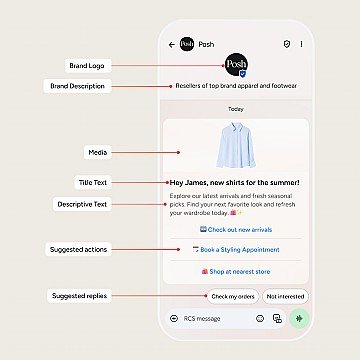
- Cross-channel orchestration: Unified journey builder spanning email, SMS, WhatsApp, push, web, and emerging channels such as RCS and TikTok — with native frequency capping across all channels
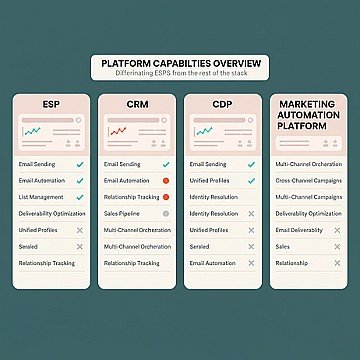
Platform categories break down simply. Enterprise email service providers (ESPs) focus on high-volume email delivery. Marketing automation platforms add lead scoring and CRM and CRM sync for B2B teams. Customer engagement platforms unify email with mobile, web, and social. Email APIs serve developers building transactional flows. The strongest enterprise platforms combine all four in one stack.
Important: ‘Enterprise’ does not mean higher pricing or bigger logos. Platforms lacking governance and compliance controls are mid-market tools with enterprise price tags.
Most teams compare feature lists, sign a contract, then discover months later that the platform cannot support their data model or compliance requirements. The demo phase is your only chance to stress-test the system against your actual operations.
| Capability | What to Validate | Demo Question | Red Flag |
| Deliverability | Dedicated IPs, warmup automation, FBL integration, inbox monitoring | Show me your IP warmup dashboard and complaint rate monitoring. | No dedicated IP option; no inbox placement data |
| Segmentation | Nested logic, behavioral events, real-time triggers, predictive audiences | Build a segment of users who viewed product X repeatedly but did not purchase recently. | Segment refresh latency over 5 minutes; no behavioral triggers |
| Automation | Multi-channel branching, frequency caps, dynamic wait, exit criteria | How do you prevent a user from receiving more than N messages within a defined window across all channels? | No native cross-channel frequency capping |
| Integration | Native CRM/CDP connectors, webhook support, event streaming, rate limits | What is the latency from event ingestion to segment availability? | No published API rate limits or SLAs |
| Analytics | Revenue attribution, holdout testing, incrementality, journey-level control groups | How do you measure incremental revenue from email vs. baseline? | Attribution limited to last-click; no holdout testing |
| Governance | Approval workflows, template versioning, RBAC, audit logs | Show me how you prevent a regional team from sending an unapproved template. | No peer approval; no template versioning controls |
The demo is the test. If the vendor cannot answer these questions live, that is a serious risk indicator for your requirements at scale.
How Enterprise Deliverability Operations Work
Your team migrates to a new platform, launches at full volume immediately, and watches inbox placement crater. This happens constantly. It’s preventable.
IP Address Warmup
Start with your most engaged segment, users who opened or clicked recently. In the initial phase, send only to a small, highly engaged subset. Increase volume gradually, gated by complaint and bounce rates staying within safe thresholds. If either threshold is breached, hold volume before resuming.
Insider One’s Email Warm Up Orchestration (currently in pipeline) automates this process end to end, removing the risk of human error during migration.
Authentication and BIMI Setup
- SPF: Ensure sending IP addresses are included; use SPF flattening if you exceed DNS lookup limits
- DKIM: Configure a strong key; rotate selectors during migration
- DMARC: Start with p=none for monitoring, move to p=quarantine after clean data, then p=reject
- BIMI: Requires DMARC at p=quarantine or p=reject; prepare your SVG logo and Verified Mark Certificate (VMC)
Inbox Placement Monitoring
Use seed lists across major mailbox providers and relevant regional providers. Run seed tests before and after major sends. Check blocklists regularly. Monitor postmaster tools for reputation signals. If open rates drop suddenly but send volume and content have not changed, you have a placement problem, not an engagement problem.
Suppression and Sunset Policy
- Hard bounces: Suppress immediately and permanently
- Soft bounces: Suppress after repeated consecutive failures within a defined period
- Complaints: Suppress immediately — a single complaint is sufficient
- Inactivity: Sunset users who have not opened or clicked in an extended period; extend the window for low-frequency senders
Microsoft Outlook and Hotmail Deliverability
Microsoft domains consistently show higher spam filtering rates than Gmail and require a distinct remediation approach.
- Check Microsoft SNDS for IP reputation (green = good, yellow = monitor, red = problem)
- Enroll in JMRP (Junk Mail Reporting Program) to receive complaint data
- Review throttling codes in bounce logs
- If reputation is red, reduce volume to Microsoft domains substantially, send only to engaged users, and wait for recovery
Microsoft’s reputation system recovers slower than Gmail’s. Plan for a sustained period of reduced volume during remediation.
What Data Architecture Supports Enterprise Email Personalization?
The right data architecture depends on your team’s technical capacity, latency requirements, and budget. Most teams overestimate their need for real-time streaming — if your cart abandonment email sends well after the triggering event, you do not need sub-second latency.
| Pattern | Latency | Maintenance | Best For |
| Native CRM Connector | Near real-time to batch | Low | Teams with CRM as source of truth; limited engineering resources |
| iPaaS | Near real-time | Medium | Teams needing custom logic between systems |
| Reverse ETL | Batch | Medium | Teams with warehouse as source of truth; analytics-driven segmentation |
| Event Streaming | Real-time | High | Cart abandonment, browse abandonment, transactional triggers |
Identity Resolution
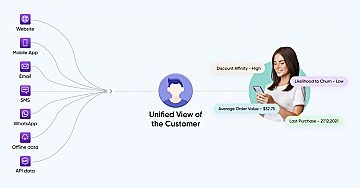
Identity resolution is a prerequisite for personalization. Deterministic matching (email, phone, user ID) is reliable but requires login. Probabilistic matching (device fingerprinting, behavioral signals) extends reach but introduces merge errors.
Insider One’s native CDP supports deterministic matching with configurable merge rules, and UCD-Powered Segments (now live) enable targeting audiences using data stored in Unified Customer Data — including offline event data for recommendation strategies.
Minimum Event Schema for Personalization
- Page view: URL, product ID (if applicable), timestamp
- Add to cart: product ID, quantity, price, timestamp
- Purchase: order ID, product IDs, total, timestamp
- Account created: user ID, email, timestamp
- Login: user ID, timestamp
If your current tracking does not capture these events, you will need to instrument them before migration. Insider One’s Web SDK Integration Wizard (in pipeline) and upgraded Testlab Tools will guide and validate each step.
Security, Compliance, and Governance Requirements
Security and legal review will add significant time to your procurement timeline if you are not prepared. Request compliance artifacts early in the vendor evaluation process.
| Regulation | Key Requirements | Vendor Artifacts to Request |
| GDPR | Consent logs, lawful basis tracking, data subject request handling, DPA | DPA, data processing records, subprocessor list |
| CCPA | Opt-out mechanism, data deletion capability, disclosure of data sales | Privacy policy, data inventory, deletion SLA |
| CASL | Express consent tracking, unsubscribe within required timeframes | Consent audit logs, unsubscribe compliance report |
| HIPAA | BAA, access controls, audit logs, encryption at rest | BAA, SOC compliance report, penetration test results |
HIPAA compliance is rare among email marketing platforms. If you are in healthcare, confirm BAA availability before shortlisting any vendor.
Security Controls Checklist
- Access control: SSO/SAML, MFA enforcement, RBAC with custom roles
- Encryption: TLS in transit, strong encryption at rest
- Audit logging: User action logs with long-term retention, exportable
- Penetration testing: Regular third-party pen testing with remediation evidence
- Certifications: SOC 2 (required), ISO 27001 (preferred)
- Domain controls: Domain allowlisting for web and mobile campaigns to prevent malicious source injection
Note: Some platforms reserve security features for higher pricing tiers. Confirm which controls are included in your quoted tier before signing.
Multi-Brand and Multi-Region Governance
Two governance models are common. Centralized: a central team controls templates, segments, and campaigns while regional teams request sends. Federated: regional teams have autonomy within guardrails — approved templates, locked brand elements, frequency caps.
Insider One’s Campaign Approval Workflows (in beta for email, in pipeline for WhatsApp and web) and Campaign Version History 2.0 (live) provide the audit trail and accountability required for both models. Template versioning ensures that regional teams cannot deploy unapproved content.
How Enterprise Email Marketing Platform Pricing Works
The quoted price is rarely the final price. Enterprise email contracts include variables that can significantly increase your effective cost.
- Per-contact: You pay for every contact in your database, whether you email them or not
- Per-email: You pay for each email sent; predictable for promotional senders, expensive for transactional
- Monthly Tracked Users (MTU): You pay for users who trigger any event, not just email recipients
Hidden Costs to Negotiate
- Overage rates: Some vendors charge significantly higher per-unit rates for volume overages
- Dedicated IP add-on: Often a recurring fee per IP, not included in base pricing
- Implementation and onboarding: Can vary widely by vendor and migration complexity
- Premium support: Around-the-clock support or a dedicated CSM typically requires an additional fee
- Data and storage fees: Watch for platforms that charge per data event, per GB stored, or per API call
- Multi-year discount: Most vendors offer meaningful discounts for multi-year commitments
Negotiation tip: If your contact list includes significant inactive users, per-contact pricing will penalize you. Negotiate for ‘marketable contacts’ or ‘active profiles’ rather than total database size. Confirm the exact metering definition and billing window before signing.
Which Enterprise Email Marketing Platforms Should You Evaluate?
The platforms below meet governance, compliance, and integration thresholds. The right choice depends on your use case, technical stack, and compliance requirements.
| Platform Type | Strengths | Considerations | Best Fit |
| CRM-led marketing automation | Tight bi-directional CRM sync, intuitive workflow builder, lead scoring | Segmentation flexibility, pricing at scale, governance depth | B2B sales-led teams using the same CRM as source of truth |
| Enterprise suite with CRM ecosystem | Broad governance features, ecosystem integration, data unification | Implementation effort, pricing transparency, migration complexity | Large organizations deeply invested in that vendor’s ecosystem |
| B2B lifecycle automation | ABM support, advanced lead routing, complex nurture flows | Reporting depth, interface usability, real-time capability | Complex B2B sales cycles with multi-stakeholder journeys |
| Real-time cross-channel engagement | Real-time event triggers, API-led orchestration, mobile-first | Profile unification approach, pricing predictability (MTU model) | Consumer brands with mobile apps and data engineering resources |
| SMB-to-enterprise automation | Accessible workflow builder, built-in CRM, fast onboarding | Governance controls, compliance depth at enterprise scale | Smaller teams scaling toward enterprise requirements |
| Multichannel messaging (cost-efficient) | Email, SMS, WhatsApp, chat in one platform, cost efficiency | Segmentation and automation depth, analytics maturity | Teams prioritizing channel breadth and cost efficiency |
| Ecommerce-focused lifecycle | Native Shopify/WooCommerce integrations, standard ecom flows | Broader use case coverage, governance controls | Ecommerce teams wanting standard cart and product rec flows |
| Insider One | Real-time CDP + journey orchestration + email in one platform; widest channel set; AI-native; no hidden data charges | Evaluate against your specific stack and compliance needs via demo | Enterprise teams wanting a unified engagement platform with transparent MTU pricing |
Which Platform Fits Your Use Case?
B2B Sales-Led Teams
Requirements: bi-directional CRM sync, lead scoring, sales alerts, closed-loop reporting. A CRM-led automation platform fits if you already use that CRM as your source of truth. A complex B2B lifecycle platform fits if you need advanced lead routing. A broad enterprise suite fits if you are deeply invested in that ecosystem.
Important: If your sales team does not use CRM consistently, no platform will deliver closed-loop reporting. Data discipline must precede platform selection.