Key takeaways
Hyper-personalization in retail means making experience decisions for each individual shopper in real time, using live behavioral signals and business constraints like inventory and margin.
- It differs from segmentation by deciding per person, per moment, not per audience group
- You need key components working together: unified data, identity resolution, real-time decisioning, omnichannel activation, and measurement
- Teams can launch a first use case with measurable lift within a quarter
Most retailers today run “personalization” that’s still segment-based. Many shoppers see the same hero banner because they share a demographic trait or browsed the same category last week. Hyper-personalization in retail works differently. It makes experience decisions at the individual level, in real time, using behavioral signals, contextual data like device and location, and business constraints like inventory and margin.
This guide explains what hyper-personalization actually is, how it differs from segmentation, and how to build a stack that delivers measurable lift. You’ll learn the components required, the use cases that matter most across the customer journey, and a roadmap to launch your first use case with proven incrementality.
Most “personalization” in retail today is still segment-based. Many shoppers see the same hero banner because they share a demographic trait or browsed the same category last week. Hyper-personalization works differently.
Hyper-personalization is the practice of making experience decisions at the individual level, in real time, using behavioral signals, contextual data like device and location, and business constraints like inventory and margin. The defining characteristic is per-request decisioning, not pre-built audience lists.
Think of it as a maturity spectrum: mass marketing sits at one extreme, then segment-based personalization, then individual personalization that refreshes daily or hourly, and finally hyper-personalization that decides in the moment.
If your catalog is small, traffic is low, or margin variance across products is negligible, segment-based personalization delivers similar lift with less complexity. Hyper-personalization earns its overhead when you have the scale and margin diversity to justify it. BCG projects a $2 trillion personalization opportunity for companies that get artificial intelligence (AI) powered experiences right.
How does hyper-personalization differ from segmentation and individual personalization?
| Dimension | Segment-based | Individual (batch) | Hyper-personalization |
| Granularity | Audience cohort | Individual | Individual |
| Timing | Pre-scheduled | Daily/hourly refresh | Per-request |
| Data inputs | Historical attributes | Historical + derived features | Live behavioral + contextual + business constraints |
| Constraint handling | None | Limited | Inventory, margin, frequency caps enforced at decision time |
| Example trigger | “Loyalty tier = Gold” | “Viewed category X recently” | “Browsing clearance on mobile, low stock, margin above threshold” |
Hyper-personalization requires infrastructure that can score and rank in milliseconds. That changes build-vs-buy decisions for teams without machine learning (ML) engineering capacity.
Why does hyper-personalization matter for retailers?
Retailers operate on thin margins, high return rates, and promotional pressure that erodes profitability. Generic personalization often increases conversion at the expense of margin, discounting customers who would have paid full price, or creates fatigue by over-messaging high-value buyers.
Hyper-personalization addresses this by factoring business constraints into every decision:
- Conversion rate: Decisions based on live intent signals like scroll depth and time on product pages catch micro-moments of purchase readiness that static segments miss
- Average order value: Cross-sell recommendations that respect margin floors and stock levels avoid promoting items that hurt profitability
- Customer lifetime value: Frequency and channel decisions that account for fatigue reduce opt-outs and preserve long-term engagement capacity
- Inventory efficiency: Surfacing slow-moving stock to price-sensitive shoppers identified in real time reduces markdown depth at end-of-season
What are the key components of a retail hyper-personalization stack?
Teams often invest in a recommendation engine or email platform expecting hyper-personalization. But without unified data, identity resolution, and measurement infrastructure, they’re still running segment-based campaigns with a fancier interface.
A complete stack requires these components:
- First-party data foundation: The event stream and catalog attributes that feed every downstream decision
- Identity resolution: The logic that stitches anonymous and known profiles across devices and channels
- Real-time decisioning engine: The system that scores, ranks, and applies constraints at request time
- Omnichannel activation: The channel adapters that deliver personalized experiences consistently
- Measurement and experimentation: The holdout and testing infrastructure that proves incrementality
What is the first-party data foundation?
Hyper-personalization fails when the event stream is incomplete or the catalog lacks attributes needed for constraint-aware ranking. Teams often have web analytics but lack point of sale (POS) integration, or have product data but no margin field.
Your minimal viable schema:
Required events:
- view_item with product ID, category, price
- add_to_cart with quantity, variant
- purchase with order ID, line items, discount applied
- search with query, results returned
Required catalog attributes:
- SKU, category hierarchy, price, margin tier, stock level, return rate if available
Derived features worth computing:
- Recency, frequency, and monetary (RFM) scores
- Category affinity based on view/purchase ratio
- Discount sensitivity based on purchase rate with vs. without promo code
Teams with limited data engineering capacity should prioritize event completeness over derived features. A complete event stream with basic catalog attributes enables most use cases, and if you want to see what “constraint-ready” data and decisioning look like across the full workflow, book a demo
How do identity resolution and the customer graph work?
Guest checkout creates fragmented profiles that inflate audience counts and break journey continuity. A shopper who browses on mobile, purchases as a guest on desktop, and returns in-store appears as separate users without identity resolution.
Common matching approaches:
- Deterministic matching: Links profiles when the same identifier like email or phone appears across sessions. High confidence, but requires login or checkout.
- Probabilistic matching: Links profiles based on device fingerprints or behavioral similarity. Lower confidence, useful for pre-login personalization but requires careful tuning.
Retail-specific considerations:
- Guest checkout: Capture email at checkout even without account creation; this becomes the stitching key for future visits
- In-store receipts: Loyalty scan at POS links offline purchases to the digital profile
- Privacy-safe hashing: Hash identifiers before sending to third-party systems; maintain raw identifiers only in the customer data platform (CDP)
How does a real-time decisioning engine work?
Teams assume a recommendation API equals a decisioning engine. But an API that returns top-ranked products without checking inventory, margin, or frequency caps will surface out-of-stock items, promote low-margin SKUs to full-price buyers, and fatigue high-value customers.
The decision pipeline:
- Retrieve context: User profile, session events, request metadata
- Score candidates: Apply ML model to rank products or content
- Apply constraints: Filter out items that violate business rules
- Re-rank if needed: Boost items based on merchandising priorities
- Return response: Serve the final ranked list within the latency service-level agreement (SLA)
Teams without ML engineering capacity should start with rule-based decisioning and layer in ML scoring incrementally. A well-tuned rule engine outperforms a poorly trained model, and you can sanity-check what “milliseconds + constraints” actually requires in your environment inside the product demo hub.
How does omnichannel activation work?
A shopper abandons cart on web, receives an email with a discount, clicks through on mobile app, and sees full price because the offer wasn’t synced. This breaks trust and wastes promotional budget.
Consistent activation requires:
- Offer/experience IDs: Every personalized experience should carry a unique ID that persists across channels for attribution and to prevent duplicate redemption
- Channel adapters: Each activation channel needs an adapter that can receive the decision payload and render it appropriately
- Frequency caps: Enforce caps at the profile level, not the channel level
Paid media like dynamic product ads should pull from the same decision engine as owned channels to maintain omnichannel personalization
How does the measurement and experimentation framework work?
Teams report that personalized emails have higher click-through rates than batch emails, but this conflates selection bias with treatment effect. Personalized emails go to more engaged users. Without holdouts, you can’t prove the personalization caused the lift.
Effective measurement requires:
- Global holdout: Reserve a small percentage of traffic that receives no personalization. Compare conversion, AOV, and LTV between holdout and treatment.
- Use-case-level holdouts: For each new use case, run a holdout test before scaling. Some use cases show negative incrementality when they cannibalize organic purchases.
- Profit-aware KPIs: Track margin per order, not just revenue. A personalization that increases conversion by discounting high-margin customers to buy low-margin products can be net negative.
Holdouts reduce the population receiving personalization, which can feel like missing short-term revenue. But without them, you’re optimizing blind.
What retail hyper-personalization use cases matter across the customer journey?
Use cases are not interchangeable. A team with strong catalog data but weak identity resolution should prioritize different use cases than a team with strong identity but sparse behavioral events.
How does personalized search and product discovery work?
When a shopper enters a search query or browses a category page, the decisioning engine adjusts the base relevance score by user affinity, filters by stock level, and boosts by margin tier if the user isn’t discount-sensitive.
The result: search results reflect individual preferences while prioritizing in-stock, higher-margin items. Measure success through search conversion rate, revenue per search, and zero-result rate.
Aggressive margin boosting can hurt relevance perception. Test with holdouts before scaling.
How do dynamic homepage and category modules work?
Each homepage slot has eligibility rules. Show a module only if the user viewed that category recently. Rank candidates by predicted engagement, then filter by recency caps so the same hero doesn’t repeat too quickly.
Measure through click-through rate on personalized modules, bounce rate, and time to first product view.
How should you handle cart and browse abandonment with inventory-aware offers?
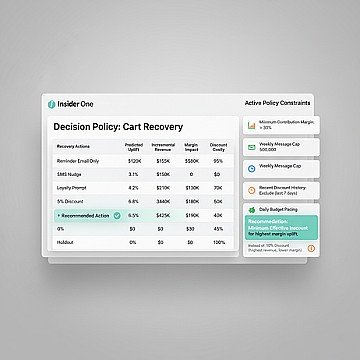
When a shopper abandons cart or views multiple product pages without adding to cart, the decisioning engine checks margin, stock level, and discount sensitivity before deciding what to send.
If margin exceeds threshold and the user is discount-sensitive, include an incentive. If not discount-sensitive, send a reminder without discount. If stock is low, add urgency messaging instead.
Blanket discounting erodes margin and trains customers to abandon. Use discount sensitivity scores to target incentives only to users who need them, and if you want to test your abandonment logic against real constraints (margin floors, stock, frequency caps), book a demo
How do in-store clienteling and associate-assisted recommendations work?
When a shopper enters a store via app or loyalty scan, surface top recommendations based on online affinity, filtered by in-store availability. Flag wishlist items that are in stock at this location.
The associate app displays personalized talking points. The shopper app shows “available here” badges.
In-store personalization requires explicit consent and clear value exchange. Shoppers who haven’t opted in should receive no personalized treatment from associates.
How do post-purchase replenishment, win-back, and loyalty programs work?
When time since last purchase exceeds the predicted replenishment cycle, or the user enters a churn risk segment, the decisioning engine determines the right message.
If within replenishment window and churn risk is low, send a reminder without incentive. If churn risk is high, include a loyalty perk. If the user has opted down from email, use push or short message service (SMS).
What data and AI requirements support hyper-personalization without surveillance?
Hyper-personalization requires rich behavioral data, but aggressive data collection erodes trust and creates compliance risk. The goal is minimum viable data for maximum personalization.
How should retailers structure event taxonomy and feature engineering?
Derived features unlock advanced use cases:
| Feature | Derivation | Use case enabled |
| Category affinity score | View/purchase ratio per category over a recent period | Personalized search re-ranking |
| Discount sensitivity | Conversion rate with promo vs. without | Conditional incentive in abandonment |
| Session intent score | Scroll depth + time on product detail page (PDP) + add-to-cart in session | Real-time exit intent targeting |
| Replenishment cycle | Median days between repeat purchases of same SKU | Post-purchase reminder timing |
Derived features require sufficient event volume to be statistically meaningful. For low-traffic categories, fall back to rule-based logic.