The Age of Disconnected Experiences: Why Your Customers are Frustrated
In 2026, your customers interact with your brand across a vast digital ecosystem. They browse your website on a laptop, engage with your app on the go, ask questions via WhatsApp, and receive updates in their mobile wallet. Yet, for many, this multi-channel reality feels less like a seamless conversation and more like a series of disjointed, frustrating monologues.
Each department—marketing, sales, customer support—operates in its own silo, using different tools and seeing only a sliver of the customer’s story. This internal fragmentation leads directly to a broken external experience, eroding customer trust and damaging lifetime value.
Consider this all-too-common scenario: A customer sees a targeted marketing email for a new banking service. Intrigued, they initiate a conversation with a support agent on WhatsApp to clarify the terms. Moments later, while that chat is still active, they receive a generic push notification from the mobile app urging them to “Learn More!” about the exact same service, completely oblivious to their high-intent, ongoing conversation.
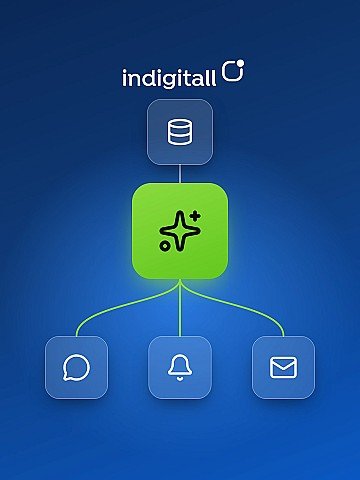
This is the core problem that Customer Journey orchestration is built to solve. It’s the strategy and technology of transforming those isolated touchpoints into a single, intelligent, and cohesive conversation that spans your entire Global Omnichannel Strategy. The goal is to make every customer feel seen, heard, and valued, regardless of how or where they choose to engage.
However, many platforms available today only solve half the problem, focusing purely on marketing automation while ignoring the crucial signals coming from sales and support. True orchestration requires a unified approach that connects the entire customer lifecycle, a concept we will explore in-depth throughout this guide, revealing how indigitall powers this complete, end-to-end vision.
What is a Customer Journey Orchestration Platform?
In 2026, a Customer Journey Orchestration platform is the central nervous system of a modern digital enterprise. It is a sophisticated technology ecosystem that empowers businesses to design, execute, measure, and optimize personalized, real-time customer experiences across every conceivable digital touchpoint.
Think of it as the evolution of traditional marketing automation. While older automation tools focused on linear, pre-scheduled campaigns—like a simple email drip sequence—journey orchestration is dynamic, adaptive, and customer-led. It’s the critical difference between broadcasting a monologue and engaging in a meaningful, two-way conversation.
The core of orchestration lies in its ability to listen for customer signals in real-time. These signals can be anything: a user browsing a specific product page, abandoning a shopping cart, entering a physical store’s geofence, or asking a question to an AI Agent. The platform instantly processes this event and adapts the Customer Journey on the fly, delivering the most relevant message on the most effective channel at that exact moment.
This is where a Global Omnichannel Strategy comes to life. A true orchestration platform doesn’t operate in silos. It seamlessly coordinates communications across App Push, Web Push, WhatsApp Business, Mobile Wallet, SMS, and more, ensuring the customer receives a consistent and context-aware experience, regardless of how they choose to interact with your brand.
Having these capabilities unified within a single console is a strategic game-changer. It eliminates the data friction and delays caused by stitching together disparate tools, providing a single source of truth for every customer interaction. This allows marketing and product teams to build incredibly sophisticated, yet seamless, Customer Journeys that drive real business outcomes.
Ultimately, a journey orchestration platform allows you to move beyond fragmented campaigns. It enables you to build cohesive, long-term relationships that boost engagement, foster loyalty, and maximize customer lifetime value (LTV).
Core Capabilities: What to Look for in a Journey Orchestration Platform
The market for customer engagement tools is more dynamic than ever in 2026. To cut through the noise, it’s crucial to focus on the core capabilities that truly differentiate a powerful journey orchestration platform from a simple messaging tool. Think of this as your essential checklist for evaluating solutions that will drive meaningful business outcomes.
Leading industry analyses, like the Forrester Wave reports, consistently evolve their criteria, now placing heavy emphasis on real-time data unification, AI-driven decisioning, and true omnichannel execution. These are no longer “nice-to-haves” but foundational pillars for modern customer engagement.
1. Unified Real-Time Data Ingestion
Effective orchestration begins with data. A top-tier platform must seamlessly integrate with your existing tech stack, including your CRM, CDP, and analytics tools. The goal is to create a single, dynamic customer profile that updates in real-time based on behavioral events, transactional data, and user attributes.
Look for platforms that offer flexible APIs and pre-built connectors. This capability ensures your Customer Journeys are triggered by actual customer behavior as it happens, not by data that is hours or days old.
2. An Intuitive Visual Journey Builder
Your marketing and product teams need the power to design, build, and launch a sophisticated Customer Journey without writing a single line of code. A visual, drag-and-drop canvas is non-negotiable. This interface should allow for complex logic, including if/then/else branching, A/B/n testing of different paths, and multi-step sequences.
The ability to easily visualize the flow of communication, set delays, and define conversion goals directly within the builder empowers teams to be agile and responsive to customer needs.
3. True Omnichannel Delivery and Orchestration
A Global Omnichannel Strategy requires more than just supporting multiple channels; it demands the ability to orchestrate them intelligently. The platform must connect with customers wherever they are, moving conversations seamlessly between channels like App Push Notifications, Web Push, In-App Messages, WhatsApp Business, SMS, and Mobile Wallet.
A key advantage of a unified platform is its ability to avoid channel silos. It should know not to send a push notification about an abandoned cart if the customer has already completed the purchase after a WhatsApp reminder. This cross-channel awareness is the hallmark of sophisticated orchestration.
4. Integrated AI and Predictive Intelligence
In 2026, AI is the engine of personalization at scale. Your chosen platform should embed AI across the entire lifecycle of a Customer Journey. This includes generative AI for crafting hyper-personalized message copy, predictive models to identify users at risk of churn, and machine learning algorithms for send-time and channel-of-choice optimization.
Furthermore, look for the integration of AI Agents that can manage two-way conversations on channels like WhatsApp, handling customer queries and driving conversions autonomously within the journey flow.
5. Comprehensive Analytics and Business Insights
Orchestration without measurement is just guesswork. A robust platform provides clear, actionable analytics that tie journey performance directly to business KPIs. This means going beyond simple open and click rates.
Your checklist should include:
- Funnel Analysis: Visualize where users drop off within a Customer Journey.
- Attribution Reporting: Understand which touchpoints and channels contribute most to conversions.
- Cohort Analysis: Track the long-term behavior and lifetime value (LTV) of users who enter specific journeys.
- Goal Tracking: Define and monitor custom conversion events that matter to your business.
Choosing a platform with these five core capabilities ensures you’re not just sending messages, but building an intelligent, adaptive, and results-driven customer engagement ecosystem.
Unified Customer Profile & Real-Time Data
The entire architecture of a successful Customer Journey in 2026 is built upon a single, non-negotiable foundation: data. Not just fragmented data points, but a cohesive, living, and breathing Unified Customer Profile. This profile acts as the central intelligence hub, aggregating every interaction and attribute to form a true 360-degree view of each individual.
To achieve this, a modern journey orchestration platform must ingest data from an ever-expanding ecosystem of sources. This includes your CRM, analytics platforms, e-commerce transaction logs, customer support tickets, and in-app or website behavioral data. By unifying these disparate streams, you move beyond basic segmentation to a deep, contextual understanding of your customer’s needs and intent.
However, simply collecting data is a solved problem. The competitive advantage in 2026 lies in the platform’s ability to process and act on this data in real-time. Latency is the enemy of relevance; a customer’s context can change in seconds, and your engagement strategy must be agile enough to react instantly.
- Instant Event Triggering: A user abandons a shopping cart and immediately receives a personalized Web Push notification with a unique offer to complete the purchase.
- Contextual Onboarding: A new user registers in your app, and a welcome journey is triggered across WhatsApp Business and email, tailored to the acquisition source.
- Behavior-Driven Personalization: A customer browses a specific product category on your website, and their next app session begins with a banner highlighting those very items.
This real-time capability is what powers a genuine Global Omnichannel Strategy. A unified profile ensures that an action taken on the web can instantly inform the next message sent via App Push or a message on WhatsApp. The conversation is seamless and continuous, because the underlying data is singular and always current.
Platforms that offer an all-in-one solution, like the indigitall console, inherently simplify this challenge. By natively connecting communication channels to a central data core, they eliminate the complex integrations and data silos that hinder real-time orchestration, allowing marketing and product teams to design and deploy more effective Customer Journeys at speed.
Visual Journey Builder & AI-Powered Decisioning
In 2026, the speed of marketing is non-negotiable. The days of relying on development cycles to launch or modify a Customer Journey are over. Modern orchestration platforms have democratized this process, placing the power of creation directly into the hands of marketing and CRM teams through intuitive, visual journey builders.
A drag-and-drop interface is now the industry standard, allowing strategists to map out complex, multi-step, and multi-channel workflows as easily as drawing a flowchart. This visual approach not only accelerates time-to-market but also fosters greater collaboration and agility, enabling teams to respond to customer behavior in real time.
However, a visual canvas is only half the equation. The true transformation lies in embedding artificial intelligence directly into the orchestration layer. This is where a simple automated flow evolves into a predictive, self-optimizing Customer Journey. At indigitall, we call this intelligent engine Indigitall AI.
Instead of relying on static rules, AI-powered decisioning introduces dynamic, data-driven logic that maximizes the impact of every interaction. Key capabilities that are now essential for a competitive Global Omnichannel Strategy include:
- Predictive Splits: Go beyond traditional A/B testing. The AI analyzes each user’s historical data and behavioral patterns to automatically send them down the journey path where they have the highest probability of conversion, whether that’s via a WhatsApp message, an App Push, or a web notification.
- Send-Time Optimization (STO): The platform learns the precise moments each individual user is most likely to engage. Messages are automatically held and delivered at that peak engagement window, dramatically increasing open rates and conversions without any manual analysis.
- Churn Prediction & Propensity Modeling: The AI engine continuously scores your user base, identifying customers who are at risk of churning or, conversely, those most likely to make a purchase. This allows the journey to proactively trigger retention offers or targeted promotions to the right audience at the right time.
The brilliance of an all-in-one platform is that these sophisticated AI models are not black boxes requiring a team of data scientists to operate. Within the indigitall console, these capabilities are presented as simple, configurable nodes that a marketer can drag directly into their Customer Journey, making advanced predictive marketing accessible to everyone.
True Cross-Channel Execution
In 2026, the distinction between “multichannel” and “omnichannel” is sharper than ever. A multichannel approach simply means you use more than one channel; a true omnichannel strategy ensures those channels work in a unified, intelligent ecosystem. It’s the difference between shouting from multiple disconnected platforms and having a single, coherent conversation with your customer, wherever they are.
A modern journey orchestration platform must provide native integration across the complete digital communication stack. Simply having APIs is no longer enough; seamless, out-of-the-box control is the new standard. Your foundational toolkit should include:
- Mobile App Push Notifications: For high-impact, timely alerts to your most loyal users.
- In-App Messages: To guide, inform, and upsell users while they are actively engaged in your app.
- Web Push Notifications: To re-engage users on their desktop or mobile browser, even when they aren’t on your site.
- Email: The workhorse for detailed content, formal communication, and reaching broader segments.
- SMS & RCS: For urgent, high-deliverability messages and richer, interactive mobile experiences.
- WhatsApp Business: The conversational cornerstone for high-engagement, two-way dialogue and support.
The real power isn’t in the length of this list; it’s in the intelligent orchestration that connects them. A truly effective Customer Journey doesn’t just send a message; it makes a decision. For instance, imagine a journey designed to recover an abandoned cart.
The system first sends a Mobile App Push notification. If the user doesn’t engage with the push within 60 minutes, the journey shouldn’t just end—it should automatically pivot. The platform can then check if the user has a WhatsApp opt-in and, if so, send a friendly reminder via that channel. If not, it defaults to a compelling email, creating a resilient, multi-layered communication strategy that maximizes the chance of conversion.
This level of dynamic, real-time decisioning is what defines a Global Omnichannel Strategy. It ensures your message is delivered through the most effective channel available for each individual user, at that specific moment. This is only achievable when all your channels are managed from a single, unified solution like the indigitall console, eliminating data silos and enabling the seamless flow of information required for sophisticated journey orchestration.
The Critical Gap Most Platforms Ignore: Inbound vs. Outbound Journeys
In the landscape of customer engagement for 2026, platforms are often evaluated on their ability to design and execute complex, multi-step campaigns. However, most of these tools only address one half of the customer conversation, creating a critical and often jarring gap in the overall e