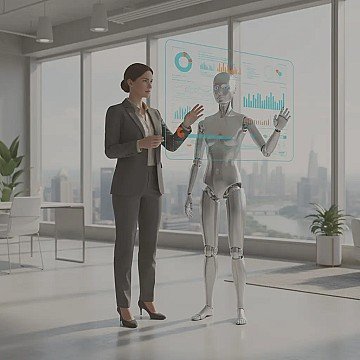
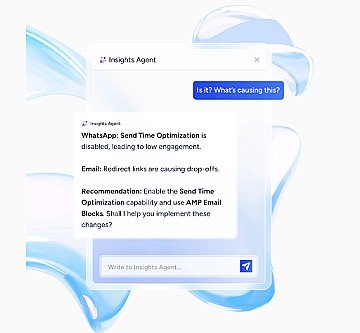
Introduction: Marketing is Overwhelmed, It’s Time for AI to Do More Than Just Write
In 2026, the modern marketing team is stretched thinner than ever. You orchestrate complex campaigns across a sprawling ecosystem of tools, analyze mountains of data, and constantly pivot to meet ever-rising customer expectations. The promise of automation was to simplify, yet many teams feel like they’re just managing more complexity, not less.
The rise of generative AI over the past few years has been a lifeline for content creation. It drafts emails, generates ad copy, and brainstorms campaign ideas, acting as a powerful creative co-pilot. But here lies its fundamental limitation: it’s a brilliant assistant that can suggest, but it cannot execute. It still relies on you to build the segment, launch the campaign, and connect the dots.
This is where the next paradigm shift begins: Agentic AI. Imagine an AI that doesn’t just write the push notification but also identifies the optimal audience segment, schedules the send for maximum impact, A/B tests the messaging, and adjusts the Customer Journey in real-time based on performance. This is AI that doesn’t just suggest, it acts—autonomous agents designed to achieve specific business goals with minimal human intervention.
Successfully deploying these agents requires a deeply integrated technical foundation. An agent can’t orchestrate a true Global Omnichannel Strategy if it has to navigate siloed platforms for App Push, WhatsApp Business, and web messaging. Its autonomy and effectiveness depend on a unified environment where it can seamlessly access and control all channels from a single point.
This article is your practical guide to this new frontier. We will demystify agentic AI, moving beyond the hype to show you how it can be implemented today to build a more efficient, intelligent, and autonomous marketing engine. It’s time to evolve from simply creating content to orchestrating outcomes.
What is Agentic AI Marketing (and Why Should You Care)?
In 2026, the marketing landscape is defined by one dominant force: autonomy. Agentic AI Marketing is the culmination of years of AI development, moving beyond simple automation to enable a new paradigm of self-directed marketing operations.
At its core, Agentic AI involves deploying autonomous AI systems—or “agents”—that can independently plan, execute, learn from, and optimize complex marketing tasks from start to finish. Think of it not as a tool you command, but as a strategic partner you assign a high-level goal, such as “Increase Q3 conversion rates for our new product line by 15%.”
This represents a quantum leap from the AI marketing tools that became mainstream in the early 2020s. To truly grasp its impact, it’s crucial to differentiate it from its predecessors:
- Predictive AI: This foundational layer analyzes historical data to forecast future outcomes. It answers the question, “Which customers are most likely to churn?” but requires a marketer to act on that insight.
- Generative AI: This layer creates content based on prompts. It answers the command, “Write three push notification variants for our summer sale,” but it doesn’t know which variant will perform best or who should receive it.
- Agentic AI: This is the strategic layer that orchestrates the others. It takes a goal, uses predictive AI to identify the audience, tasks generative AI to create personalized messaging, deploys it across the ideal channels, and optimizes the entire Customer Journey in real-time to achieve the objective.
Why should you care? Because Agentic AI is the engine for hyper-personalization at a scale previously unimaginable. An agent can manage thousands of individual Customer Journeys simultaneously, making real-time decisions across your entire omnichannel ecosystem—from App Push and Web Push to WhatsApp Business and Mobile Wallet.
To unlock this power, the agent requires a unified playground. It cannot orchestrate a seamless experience if your channels are siloed. This is where an integrated platform like indigitall becomes essential, providing the connected data and communication channels an AI agent needs to autonomously drive real business results.
Generative AI vs. Agentic AI: The Intern vs. The Project Manager
In the marketing landscape of 2026, most teams are fluent in the language of Generative AI. We can think of these powerful models as the ultimate brilliant intern—incredibly fast, creative, and capable of executing specific, well-defined tasks.
Your Generative AI intern can draft compelling email copy, generate stunning visuals for a campaign, or brainstorm a dozen catchy push notification headlines in seconds. However, it requires constant supervision and explicit instructions. You have to tell it precisely what to do, take its output, and then manually plug it into your various systems to launch, monitor, and analyze the results.
Agentic AI, on the other hand, is the experienced project manager. Instead of giving it a task, you give it a strategic objective. It’s the leap from “write an abandoned cart email” to “reduce our cart abandonment rate by 15% this quarter.”
This “AI Agent” then operates autonomously to achieve that goal. It doesn’t just execute one task; it orchestrates the entire project from start to finish:
- Strategic Planning: It designs a complete, multi-step Customer Journey, determining the best sequence of touchpoints to re-engage the user.
- Asset Coordination: It leverages generative models to create all the necessary assets—the copy, the personalized offer, the visual—for each step of the journey.
- Omnichannel Orchestration: The agent autonomously deploys the campaign across the most effective channels within your ecosystem, sending a timely App Push, followed by a richer WhatsApp message, and a final In-App reminder, all tailored to user behavior.
- Autonomous Optimization: It analyzes performance data in real-time, A/B testing messages, adjusting timing, and even reallocating promotional budgets to the highest-performing channels without human intervention.
The fundamental difference is one of agency. Generative AI is a powerful tool you wield; an AI Agent is a strategic partner that manages the tools for you. This transition from task-based execution to goal-oriented orchestration is the core of autonomous marketing, and it requires a truly unified platform where data, channels, and AI can work in seamless concert.
The Core Capabilities of a Marketing AI Agent
By 2026, the distinction between a marketing tool and a marketing team member has blurred significantly. Modern AI agents are not just automation scripts; they are autonomous entities designed to manage the entire campaign lifecycle. Their core capabilities can be understood across three fundamental pillars: strategic planning, seamless execution, and continuous optimization.
These pillars work in a continuous, intelligent loop, transforming marketing from a series of disjointed actions into a cohesive, self-improving ecosystem. Let’s explore each capability in detail.
- Strategic Planning & PredictionAn AI agent’s first task is to think like a master strategist. It ingests and analyzes vast datasets—historical engagement, real-time user behavior, market trends, and inventory levels—to build a predictive model of the customer landscape. It moves beyond simple segmentation to identify micro-audiences with the highest conversion potential, defining not just who to target, but with what message and on which channel.
The agent then autonomously allocates budget and resources, recommending an optimal Omnichannel mix. It might determine that a high-value segment responds best to an interactive App Push, while a newly acquired user needs a nurturing sequence via WhatsApp Business, all as part of a single, coherent strategy.
- Omnichannel Execution & PersonalizationOnce the plan is set, the AI agent executes with a level of precision and scale previously unimaginable. It doesn’t just launch campaigns; it orchestrates dynamic, 1:1 Customer Journeys across your entire digital footprint. This includes web, mobile app, email, SMS, and crucial conversational channels like WhatsApp.
Leveraging generative AI, the agent crafts and delivers hyper-personalized content for each individual in real time. A message’s content, timing, and even tone can be adjusted based on the user’s immediate context, ensuring every interaction feels relevant and drives the desired action. This unified execution is where having an all-in-one platform becomes a critical advantage, providing the agent with a complete view and control over every touchpoint.
- Real-Time Analysis & Autonomous OptimizationPerhaps the most transformative capability is the agent’s ability to learn and adapt on the fly. It constantly monitors campaign performance against predefined KPIs, analyzing open rates, click-throughs, conversions, and impact on Lifetime Value (LTV). It runs thousands of micro A/B/n tests simultaneously to identify the most effective variables.
When the agent detects an underperforming tactic, it doesn’t just report it; it acts. It can automatically reallocate budget from a low-performing channel to a high-performing one, tweak message copy to improve engagement, or adjust the timing of a push notification, all without human intervention. This continuous feedback loop ensures your marketing spend is always being optimized for maximum ROI.
Practical Use Cases: How Agentic AI Manages the Entire Customer Journey
While the concept of agentic AI can seem abstract, its practical application in 2026 has moved far beyond theoretical discussions. It’s no longer about isolated AI-powered chatbots or simple automation rules. Today, it’s about autonomous systems that manage and optimize the complete Customer Journey from first touch to final conversion and beyond.
Let’s explore concrete use cases across the customer lifecycle, demonstrating how a single, coherent AI agent ecosystem can drive unprecedented results.
- Acquisition & Awareness: Predictive ProspectingAn AI agent autonomously analyzes market trends and first-party data to identify high-potential audience segments. It then generates and A/B tests ad creatives and landing page copy in real-time, optimizing for engagement and reallocating budget to the best-performing combinations without human intervention. This ensures your acquisition spend is always focused on attracting the most valuable users.
- Consideration & Nurturing: Omnichannel OrchestrationOnce a user shows interest—perhaps by visiting a product page or downloading an app—the agentic AI takes over their onboarding. It analyzes initial behavior to determine the optimal channel and message for the next interaction. For a retail customer, this might mean a helpful WhatsApp message with a style guide, while a new banking app user might receive a feature-tour via a rich push notification, creating a truly personalized, omnichannel nurturing flow.
- Conversion: Proactive Friction RemovalAgentic AI excels at identifying and acting on conversion intent. If a user adds an item to their cart but hesitates on the checkout page, the system can autonomously intervene. It might trigger a web push notification with a limited-time shipping offer or deploy a generative AI agent via a web chat to proactively answer common questions about returns or payment security, resolving doubt at the most critical moment to secure the conversion.
- Loyalty & Retention: Autonomous Engagement CyclesThe journey doesn’t end at the purchase. The AI agent manages the entire post-purchase experience, from sending order updates via the customer’s preferred channel to soliciting reviews at the optimal time. More importantly, it continuously monitors user engagement patterns to predict churn risk and can autonomously launch a re-engagement campaign with personalized offers to maximize customer lifetime value (LTV).
- Advocacy: Identifying & Mobilizing ChampionsFinally, the agent identifies your most loyal customers based on purchase frequency, positive feedback, and high engagement scores. It can then automatically invite them to an exclusive VIP program, or send a personalized request via app push to join a referral program. This turns your best customers into an autonomous growth engine for your brand.
In each of these stages, the power lies in having a single, integrated platform like indigitall. This allows the AI agent to operate seamlessly across every touchpoint—App, Web, WhatsApp, and more—making decisions based on a complete, 360-degree view of the customer.
Acquisition & Onboarding: The Autonomous Welcome
The first impression is more critical than ever, and in 2026, a static, one-size-fits-all onboarding sequence no longer meets customer expectations. Agentic AI has revolutionized this initial touchpoint, transforming it from a rigid funnel into a dynamic, autonomous welcoming experience that maximizes user activation from the very first second.
Imagine an AI agent within the indigitall platform identifying a new user who has just downloaded your retail app. This is where modern marketing begins. The agent doesn’t just see a “new install”; it analyzes the acquisition source, initial device data, and real-time in-app behavior to build an instant micro-profile.
This process is entirely autonomous and happens in milliseconds:
- Real-Time Analysis: The agent observes the user’s first few interactions. Did they immediately search for a specific product? Did they browse a particular category? Or did they stall on the profile creation screen? Each action provides a crucial data point.
- Dynamic Journey Orchestration: Based on this analysis, the agent autonomously triggers a personalized Customer Journey. For a user who lingered on running shoes, it might deploy an in-app message showcasing a “Gear Finder” tool, followed by a rich push notification featuring a video of your top-rated model.
- Conversational Engagement: If a user provides their phone number but abandons the app, the agent can pivot the strategy. It can initiate a conversation via WhatsApp Business, offering to help complete their profile or answer questions, creating a personal, one-to-one dialogue.
This level of intelligent orchestration ensures the user is guided directly to their “aha!” moment—the point where they truly understand your app’s value. It’s a core component of a Global Omnichannel Strategy, where the conversation flows seamlessly between app, web, and conversational channels, all managed by a single intelligent agent.
Executing this with separate, disconnected tools would be impossible due to data latency and channel friction. By operating from a unified platform like the indigitall console, the AI agent has the immediate, holistic data access required to make intelligent decisions and drive new users toward long-term loyalty and higher lifetime value.
Conversion: The Proactive Sales Assistant
By 2026, the era of static, one-size-fits-all recovery campaigns is definitively over. Modern conversion strategies rely on Agentic AI acting as a proactive and autonomous sales assistant. This AI doesn’t just follow a pre-written script; it analyzes situations in real-time and executes hyper-personalized actions to rescue revenue.
Consider the classic challenge: shopping cart abandonment. Instead of simply triggering a generic reminder email 24 hours later, an AI agent integrated into your digital ecosystem operates with a new level of intelligence and autonomy. Its goal is singular and clear: drive the conversion.
Here’s how this autonomous agent orchestrates a recovery within the indigitall platform:
- Instant Detection & Analysis: The moment a user abandons a cart, the agent activates. It immediately synthesizes data far beyond the abandoned items, accessing real-time inventory levels, the user’s past purchase history, and their loyalty status.
- Intelligent Channel Selection: The agent then