A new wave of research is reshaping how biofertilisers and biostimulants are evaluated, beyond traditional yield measurements to focus on what really happens inside plants.
Scientists are now combining plant physiology and ecophysiology to detect early changes in photosynthesis, nutrient uptake, and plant health, long before visible growth differences appear. Using tools such as chlorophyll fluorescence and non-destructive measurements, researchers can assess plant performance faster and more accurately, even under varying environmental conditions.
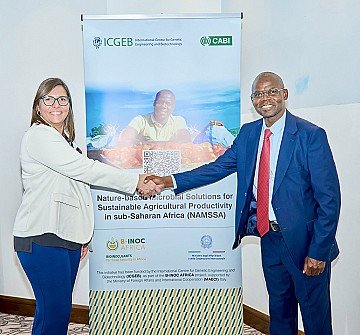
This integrated approach is already being applied globally. Through initiatives like B-INOC Africa and NAMSSA, researchers and institutions across Africa are receiving hands-on training, bridging lab science in real-world field trials in Kenya, Benin, and Zambia.
At the forefront of this movement is agronomist Dr. Fernando Cantao, whose interdisciplinary work blends advanced genomics, bioinformatics, and plant physiology to understand plant–microbe interactions and drive sustainable agricultural innovation.
With global food demand rising, this shift toward predictive, science-driven evaluation could accelerate the development of more effective biological solutions—bringing us one step closer to resilient, sustainable agriculture. His latest mission to Kenya took place between 4-9 April 2026.
Dr. Fernando Cantão works in the ICGEB Technology Transfer, Cooperation & Innovation office, and is an agronomist and plant scientist specialising in plant-microbe interactions and sustainable agriculture.
With dual PhDs and international research experience across Brazil, the US, and Italy, his work combines genomics, bioinformatics, and plant physiology to advance innovative, real-world agricultural solutions.
He also brings more than 15 years of industry experience translating science into practice across the Americas.