As manufacturers face mounting pressure to reduce lead times, cut material waste, and localize production, automated large-scale 3D printing is emerging as a critical enabler of more flexible and resilient manufacturing models. Large-format additive manufacturing (LFAM) enables the direct manufacturing of large, complex components from digital designs, providing the option to either transform how molds and tooling are made or skip the mold-making step entirely by printing the end product directly. With applications ranging from shipbuilding to distributed microfactory manufacturing models, LFAM is redefining how and where production takes place. This shift enables more flexible, distributed production models that respond faster to demand while strengthening supply-chain responsiveness.
A clear example of this transformation is found in the naval sector, where LFAM is already used to produce full-scale structures. Recent footage of CEAD’s Faber Navalis system, a dedicated, application-specific solution shows the CEAD printing system, powered by a Comau robotic arm printing a 12 meter, single piece boat hull layer by layer. The process, which takes approximately eight days, delivers substantial reductions in manual labor requirements and material waste compared to traditional shipbuilding methods.
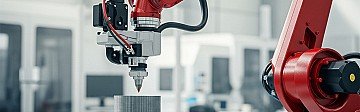
The technology behind CEAD’s broader LFAM offering is the Flexbot platform, a modular, industrial-scale manufacturing system built around Comau’s high-payload robotic arms. Flexbot integrates multiple processes such as large-scale printing and milling within a single automated cell, ensuring continuous material flow, precise multi-axis motion, and integrated finishing operations.
Comau’s robotic systems provide the accuracy, repeatability, and reliability, all of which are required for stable, production-ready LFAM, while CEAD’s system-level engineering ensures structural continuity and process control. The platform is inherently scalable, allowing manufacturers to expand build volumes, add capabilities, or transition from standalone cells to fully integrated microfactory environments.
From an operational perspective, the integration of Siemens SINUMERIK Run MyRobot / Direct Control enables direct CNC control of the robot, replacing traditional robot programming. CNC-based control is industry standard, familiar to operators, and easier to integrate into existing production facilities. Combined with Comau’s robotic systems, this results in enhanced path accuracy, smoother motion control, and improved process stability ensuring consistent part quality and predictable, repeatable production performance.
Flexbot’s combination of multi-axis robotic motion and extrusion -based thermoplastic composite printing enables the production of complex geometries and large -scale structures that exceed the limitations of conventional systems. The platform operates without a dedicated build chamber, allowing the Comau robot to work in an open environment defined by safety parameters while maintaining high positional accuracy along complex toolpaths.
This same core technology is already used in compact, robot-driven microfactories, where production is executed on demand and close to the point of use. These modular systems allow manufacturers to replicate advanced production capabilities anywhere in the world. Comau and CEAD are enabling customers to shift from centralized, traditional production to distributed manufacturing models capable of delivering large, complex components with reduced lead times, optimized material usage, and greater responsiveness to local demand. One example is Haddy in St. Petersburg, Florida, where eight Flexbots run production at scale.
Both CEAD and Comau maintain a strong presence in the United States, actively supporting the industrial deployment and scaling of LFAM solutions across key sectors. CEAD has delivered over 250 machines worldwide with strong traction in the United States specifically delivering several dozens of machines annually in the United States which exemplifies the shift toward distributed, flexible manufacturing enabled by LFAM.
Large-format thermoplastic composite printing introduces specific technical challenges: maintaining consistent material flow over long durations, ensuring precise thermal management for interlayer adhesion, and preserving structural stability as geometries grow. The integrated CEAD-Comau-Siemens architecture manages both robotic motion and extrusion parameters, ensuring synchronized multi-axis movement and consistent material deposition while maintaining tight tolerances. This synchronization is essential for achieving high-quality output and guaranteeing repeatability across both short and long production cycles.
Another key aspect of the Flexbot solution is the flexibility of Comau’s high-payload robotic arm compared to traditional gantry-based systems. Its extended reach and multi-axis articulation enable the production of complex geometries, including curved and non-planar surfaces. The same robotic platform can also perform subtractive finishing using integrated milling tools, ensuring that critical surfaces meet dimensional and quality requirements without transferring the part. The result is a closed-loop manufacturing system that combines additive and subtractive processes within one architecture.
The strong collaboration between CEAD and Comau leaders in their respective fields is helping end users adopt LFAM as a practical alternative to conventional processes. This shift is significant: it reduces manual labor, increases repeatability and precision, and enables on-demand production worldwide. Because microfactories decentralize production while maintaining consistency and quality, LFAM also addresses structural and supply-chain challenges. Digital design files can be shared across multiple microfactories, ensuring that the same component can be produced when and where it is needed.
Ultimately, the industrial relevance of large-format additive manufacturing lies in the ability to deliver complete, application-driven solutions. By developing configurable platforms aligned with real production needs, CEAD and Comau are translating advanced robotics and LFAM technology into scalable manufacturing models that bridge the gap between innovation and industrialization. The result is a more flexible production paradigm that increases efficiency, supports localized manufacturing, and expands design freedom across multiple sectors.
CONTACTS
Giuseppe Costabile
giuseppe.costabile@comau.com | Mob. +39 338 7130885
Monica Cavaliere
monica.cavaliere@comau.com | Mob. +39 3386684221