Summary
- AI feature ROI in email marketing platforms only means something when you isolate AI-driven lift from the lift your baseline automation already produced
- Holdout groups, not vendor-reported multiples, are the only replicable way to prove an AI feature moved revenue
- Fragmented customer data across your CRM system, email service provider (ESP), and analytics stack quietly caps how much lift any AI feature can generate
- Convert engagement gains into cost-per-incremental-conversion and payback period before you bring numbers to your CFO
- Evaluate platforms on whether they support native incrementality testing, not on how large their headline ROI multiple is
You turned on AI-generated subject lines or send-time optimization, open rates climbed, and now you’re stuck explaining to your CFO whether that lift came from the AI feature or simply from sending more emails to more people.
This article is for chief marketing officers (CMOs) and VPs of marketing at mid-market and enterprise companies who are evaluating or scaling AI features inside their email marketing platform and need a number that survives scrutiny.
Proving AI feature ROI in email marketing platforms means separating the incremental lift an AI capability generates above what standard automation would have delivered anyway, then translating that lift into finance-ready terms.
You’ll learn a vendor-agnostic framework built on holdout testing, a way to identify where the data layer breaks incrementality measurement, and the criteria that actually predict whether a platform’s AI features will pay back at scale.
What AI feature ROI in email marketing platforms looks like when it actually works
Real AI feature ROI is the revenue difference between a group exposed to the AI capability and a matched control group running your existing automation logic, not the raw lift over a “no email” baseline.
Any campaign will outperform silence. The question that matters is whether the AI feature outperforms the automated send you already had running.
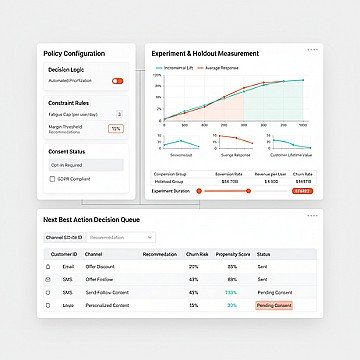
The execution standard is a holdout group, typically five to ten percent of an eligible send, that receives your standard rule-based email while the rest receives the AI-driven version.
You compare open rate, click rate, and conversion rate between the two groups over the same period, using the same offer and audience segment, so the only variable is the AI feature itself.
This is the same discipline used in journey orchestration testing, applied specifically to AI decisioning rather than send timing or channel mix.
Where execution breaks down for AI feature ROI email marketing platforms
Execution breaks down when marketers treat vendor-reported multiples as proof and when internal reporting blends AI lift with baseline automation lift into a single, unverifiable number. Both problems are structural, and both show up before a CMO ever presents a business case.
The self-reported multiple problem
Vendor case studies across the category frequently cite large multiples, sometimes described as 63x return, without disclosing a control group, a measurement window, or the methodology behind the number.
Without a holdout comparison, that figure could reflect seasonality, list growth, or a promotional calendar as easily as the AI feature itself.
A CMO presenting an unverified multiple to finance is presenting a claim, not a result, and finance teams increasingly know the difference.
The attribution collapse
Most reporting dashboards attribute an entire campaign’s performance to “AI-powered” sends without isolating what the automation layer would have produced on its own. That collapses two distinct sources of lift into one line item.
The fix is not more dashboards; it’s a testing structure that never lets AI and non-AI sends share the same measurement bucket in the first place.
The data and orchestration layer teams usually miss
The AI feature is rarely the bottleneck. The customer data feeding it usually is.
When purchase history sits in one system, browsing behavior sits in an analytics tool, and email engagement sits in the email service provider (ESP), the AI model works from a partial profile and produces smaller, less consistent lift than it would with a unified view of the customer.
This is why incrementality testing and data unification have to happen together. A Customer Data Management layer that consolidates behavioral, transactional, and engagement data gives the AI feature a complete signal to personalize against, which raises the ceiling on how much incremental lift is even possible.
Without that layer, teams often test an AI feature, see modest results, and wrongly conclude the AI itself is underperforming.
The connection between data completeness and measurable lift shows up in practice.
OTTO increased average order value by five percent using onsite personalization built on a unified customer data view, a result that depended on the personalization engine seeing the full customer relationship rather than a single channel’s slice of it.
The same principle applies to AI features inside email: fragmented data caps the lift before the model ever runs.
How to fix AI feature ROI email marketing platforms without adding more channel chaos
Fix the data dependency first, then run the holdout test, then calculate payback. Adding another point solution or a second AI vendor on top of fragmented data compounds the chaos instead of resolving it, so the sequence matters more than the tooling.
Start by unifying the customer signals your AI feature depends on inside a single data layer, so personalization, send-time decisions, and subject-line generation all draw from the same profile.
Then structure every AI feature rollout as a controlled test with a defined holdout group before you scale it to a full list. Finally, convert the lift into two numbers finance will recognize:
- Cost-per-incremental-conversion: total AI feature cost divided by the number of conversions the AI group produced beyond the holdout group
- Payback period: the number of months until incremental revenue from the AI feature exceeds its implementation and subscription cost
- Incremental revenue per send: the revenue difference between AI and holdout groups, normalized per thousand emails sent
Avon improved conversion rates by up to 78% using Insider One’s personalization capabilities, a result built on this same structure of testing personalized experiences against a defined baseline rather than reporting engagement lift in isolation.
That’s the model to replicate internally: test against a baseline, then translate the delta into a number your finance team can independently verify.
What to evaluate before choosing a platform
Evaluate a platform on whether it supports native incrementality testing and transparent reporting, not on the size of its headline ROI claim.
Any vendor can publish a large multiple. Far fewer can show you a holdout group, a control methodology, and a payback calculation you can reproduce with your own data.
Before selecting or renewing an AI email marketing platform, confirm these criteria:
- Native support for holdout or control groups at the campaign and feature level, not just at the list level
- Reporting that separates AI-driven lift from baseline automation lift by default, rather than blending them into one metric
- Access to raw engagement and conversion data for your own incrementality calculations, not just vendor-summarized dashboards
- A Customer Data Management layer that unifies behavioral and transactional data before AI models run against it
- Benchmarking context across industries and send types, similar to how the 2026 Email Marketing Benchmarks and Performance Metrics frame open and click performance by sector
These criteria scale differently than a single impressive case study does. A platform that supports rigorous, replicable testing at 50,000 subscribers will hold up at 5 million, because the methodology doesn’t change with list size, only the sample size behind each holdout group does.
Explore Insider One’s Platform and AI Overview to see how customer data, orchestration, and AI decisioning connect inside one system rather than three disconnected tools.
Conclusion
Proving AI feature ROI in email marketing platforms comes down to discipline, not a bigger multiple. Isolate lift with holdout groups, unify the customer data feeding the AI model, and translate every result into cost-per-incremental-conversion and payback period before it reaches finance.
That’s the difference between a defensible business case and a vendor claim repeated in a board deck.
See how Insider One’s Customer Data Management and AI-driven personalization work together by exploring the AI personalization capabilities inside the platform, then request a demo to walk through a holdout-based ROI calculation using your own send data and see a projected payback period before you commit a budget.
FAQs
What is AI feature ROI in email marketing platforms?
It’s the incremental revenue an AI capability, such as send-time optimization or AI-generated subject lines, produces above what your existing rule-based automation would have delivered on its own. You measure it with a holdout group, not with total campaign performance, so the AI feature’s contribution is isolated and verifiable.
How do you measure AI ROI in email marketing without vendor bias?
Run a controlled test where a small percentage of your eligible audience receives the standard automated send while the rest receives the AI-driven version. Compare conversion and revenue outcomes between the two groups over the same window, then calculate cost-per-incremental-conversion instead of relying on a vendor’s reported multiple.
Why do open and click rates fail as ROI proof for AI email features?
Open and click rates measure engagement, not incremental revenue, and they don’t account for what baseline automation would have produced without the AI feature. A CFO needs payback period and cost-per-incremental-conversion, figures that connect engagement lift to actual financial return.
What data problems limit AI personalization ROI?
Fragmented customer data across your CRM, ESP, and analytics tools gives the AI model a partial view of each customer, which caps the lift it can generate. Unifying behavioral, transactional, and engagement data in one layer raises the ceiling on how much incremental lift the AI feature can realistically produce.
What should CMOs ask vendors before scaling an AI email feature?
Ask whether the platform supports native holdout testing at the feature level, whether reporting separates AI lift from baseline automation lift, and whether you can access raw data to run your own incrementality calculations rather than relying solely on vendor-summarized dashboards.