Summary
- One-to-one marketing treats each customer as an individual with their own data profile, not a member of a lookalike segment wearing a first name
- Segment-based personalization dressed up as “1:1” can backfire, making customers feel watched rather than served
- Real 1:1 programs run on unified profiles built from zero-party and first-party data, not just browsing behavior
- A workable framework has four stages: unify the data, find high-impact moments, orchestrate across channels, and test with control groups before scaling
- Guardrail metrics like opt-out rate and repeat-purchase rate matter as much as click-through rate
Your product recommendations use the customer’s first name, reference their last order, and still get ignored. That’s a definition problem: many “personalized” campaigns are segment-level guesses dressed up in the language of individual relevance.
If you’re a customer relationship management (CRM), lifecycle, or growth marketer evaluating personalization or customer data platform (CDP) investments, you need a clear answer to a deceptively simple question: what actually separates true “one-to-one marketing” from personalization that only feels individual?
One-to-one marketing means building a message, offer, or product experience around a single customer’s actual data, not the average behavior of people who look like them.
This guide draws a clear line between segment personalization and true 1:1 targeting, walks through a four-step framework for building a program, shows a business-to-consumer (B2C) and business-to-business (B2B) example, and covers the guardrails that keep personalization from tipping into something customers resent.
One-to-one marketing vs. mass and segment marketing
One-to-one marketing means tailoring an offer, message, or experience to a specific individual based on their own data, rather than to a broad audience or a demographic segment.
The idea traces back to Don Peppers and Martha Rogers’ 1993 book The One-to-One Future, which argued that businesses should compete for share of customers, not just share of market, by building a relationship with each buyer over time.
Mass marketing sends the same message to everyone, while segment marketing narrows that to a group defined by shared traits, such as age, location, or purchase category, and personalizes within the group. Both approaches scale easily, which is exactly why so many platforms label segment output as “one-to-one.”
The label is misleading: a segment of ten thousand people who bought running shoes last month is still a cohort, no matter how personalized the subject line sounds.
True 1:1 marketing responds to what one specific customer did, prefers, and said, not what their segment tends to do on average.
A customer who bought a gift for someone else looks, statistically, like a loyal repeat category buyer, and segment logic keeps recommending that category. Individual-level logic recognizes the anomaly and adjusts instead of repeating the average pattern.
The data foundation behind effective 1:1 marketing
Real one-to-one marketing depends on a unified customer profile: one record per person that combines behavioral, transactional, and engagement data in real time, rather than several disconnected reports.
Without that unification, “personalization” is really segment targeting with better copywriting, because no single system can see the whole customer clearly enough to act on their specific situation.
Building that profile has shifted from a nice-to-have to the actual foundation of individual-level marketing. Customer Data Management pulls together on-site behavior, purchase history, and channel engagement into a single view, so a marketer can see one customer’s full context instead of stitching together exports from several systems.
The bigger shift is from remembering a name to collecting zero-party data: information a customer volunteers directly, such as stated preferences, size, budget, or intent, alongside first-party data gathered with consent. A CRM field that says “prefers email over SMS” or “buying for a toddler” is worth more to a 1:1 program than months of inferred browsing, because it removes the guesswork.
That combination, zero-party intent plus first-party behavior, separates a program that adapts to the individual from one that applies a segment’s average to everyone in it.
A 4-step framework for launching a one-to-one marketing program
Step 1: Unify fragmented data into a single customer view
Before targeting a single individual, a team needs one place where that individual’s data actually lives. Fragmented data across an email service provider (ESP), a point-of-sale (POS) system, and an ad platform makes true 1:1 targeting very difficult, regardless of how good the personalization logic is.
This is the step most guides skip, and it determines whether everything downstream works.
Step 2: Identify high-impact moments worth personalizing
Not every touchpoint deserves individual-level treatment. Prioritize moments with real revenue or retention weight, such as the first purchase, a cart abandonment, a subscription renewal window, or a support interaction that signals frustration.
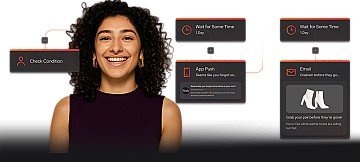
Journey orchestration tools are built for mapping these moments, so a marketer defines them once and the system triggers a response automatically as each customer reaches that point in their own timeline.
Step 3: Orchestrate across channels based on individual context
A single customer’s preferred channel, timing, and message should follow them, whether they’re on email, WhatsApp, or your website. Individual-level orchestration means the next message reflects what that specific person did last, not a scheduled batch send.
AI can help determine the right channel and timing per customer based on their own engagement history rather than a segment average.
Step 4: Test with control groups before scaling
Hold back a control group before rolling any 1:1 tactic out to a full customer base. This step catches personalization that looks smart in a dashboard but performs no better, or worse, than a simple segment message. Without a control group, teams can’t tell whether individual-level targeting earned its added complexity or just added cost.
One-to-one marketing examples in B2C and B2B
B2C: Individualized recommendations and behavior-triggered messaging
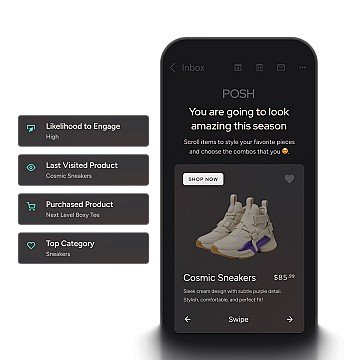
In B2C retail, one-to-one marketing shows up as product recommendations built from a specific shopper’s browsing and purchase history rather than a category best-seller list. It’s paired with lifecycle messages triggered by that shopper’s own behavior, such as a restock alert for the exact item they viewed twice.
Braun used AI personalization to match recommendations to individual browsing intent instead of broad product categories, a shift detailed in the Braun case study.
Puma took a similar approach with individualized on-site targeting, responding to each visitor’s specific signals rather than applying one layout to an entire traffic segment, as outlined in the Puma case study.
B2B: Account-based outreach tailored to a single buyer
In B2B, one-to-one marketing takes the form of account-based outreach built around one named account or buyer, using that account’s specific usage data, deal stage, and stated priorities rather than a generic industry template. A sales and marketing team might reference a prospect’s exact feature usage in a renewal conversation, or tailor a case study to the buyer’s stated priority instead of sending the same deck to every account in the pipeline.
The mechanics differ from B2C, since timelines are longer and the “customer” is often a buying committee. The underlying principle still holds: the message reflects one account’s actual data, not a segment’s average profile.
Avoiding the personalization backfire: metrics and guardrails
Personalization can create the opposite of its intended effect when it relies on inferred data that feels intrusive rather than helpful.
When customers sense a brand knows more about them than the relationship justifies, or when timing feels invasive rather than useful, engagement can suffer instead of improving.
That risk hides inside every “we personalized it” claim that’s actually built on segment-level inference dressed up as individual insight.
Better guardrails, not less personalization, keep a 1:1 program from crossing into surveillance territory. A few metrics belong on every 1:1 marketing dashboard alongside click-through rate and conversion rate:
- Opt-out and unsubscribe rate on personalized sends, tracked separately from generic campaigns
- Purchase regret signals, such as return rate on recommended items versus self-selected items
- Repeat-purchase rate segmented by whether the customer engaged with personalized content
- Explicit preference conflicts, where a customer’s stated zero-party data contradicts what the system inferred from behavior
Pairing these guardrails with clear privacy controls, visible opt-in choices, and a simple way to correct or update stated preferences keeps a 1:1 program grounded in consent rather than inference. A program that respects the line between what a customer told you and what a model guessed will generally outperform one that blurs it, even if the blurred version looks more sophisticated in a slide deck.
Conclusion
One-to-one marketing works when it’s built on what a customer actually told you and did, not on what their segment tends to do.
The gap between those two approaches is where personalization backfire lives, and it’s the gap most vendor guides skip.
Start with unified data, prioritize a few high-impact moments, and test before scaling rather than assuming individual-level logic automatically beats a good segment.
To evaluate how AI personalization, journey orchestration, and customer data management fit your use case, request a demo to review your goals, data requirements, and implementation constraints with the Insider One team.
FAQs
What is one-to-one marketing in simple terms?
One-to-one marketing means tailoring a message, offer, or product recommendation to one specific customer’s own data, such as what they bought, said, or browsed, rather than to a demographic group or segment. It’s the most individualized point on the spectrum that runs from mass marketing to segment marketing to true 1:1 targeting.
What’s the difference between personalized marketing and one-to-one marketing?
Personalized marketing often means segment-level customization, like inserting a first name or showing category-based recommendations to everyone in an age bracket. One-to-one marketing goes further: it responds to a single customer’s specific, current behavior and stated preferences, not the average pattern of people who resemble them.
What are the main benefits of one-to-one marketing?
Done well, 1:1 marketing improves relevance, which tends to lift conversion and retention because customers respond to offers that reflect their actual situation rather than a generic guess. It also reduces wasted spend on broad segment campaigns and builds loyalty by treating repeat customers as known individuals with a history, not new leads.
Can one-to-one marketing backfire?
Yes. When personalization relies on inferred or overly broad behavioral data, customers can feel like they’re being watched rather than served, especially when timing feels invasive or recommendations misread their intent. Tracking guardrail metrics like opt-out rate and purchase regret helps catch this before it damages the relationship.
What data do you need to start a 1:1 marketing program?
You need a unified customer profile combining behavioral data, transactional data, and zero-party data, meaning preferences customers state directly, with consent. Fragmented data across separate systems makes genuine individual-level targeting difficult, regardless of how advanced the personalization logic is.
Is one-to-one marketing only for large enterprises?
No. The principle scales down as well as up, and what matters is not company size but whether the underlying data is unified enough to see one customer clearly. Mid-market teams building personalized marketing programs can create genuine 1:1 experiences once they consolidate scattered data into a single, actionable view.