August 12, 2026
Updated August 12, 2026
Introduction: Beyond a Buzzword – What Are Client Engagement Tools, Really?
TL;DR
Unified client engagement platforms like indigitall eliminate data silos, enhance customer experience, and drive growth by integrating communication tools into a single ecosystem.
Client engagement tools are essential for creating coherent conversations across multiple channels. In 2026, brands face a hyper-competitive landscape where customers interact through a variety of platforms, including mobile apps, websites, and messaging services like WhatsApp. When these touchpoints fail to integrate, the customer experience becomes fragmented, eroding trust and diminishing lifetime value.
Client engagement tools are more than just software; they are strategic ecosystems designed to orchestrate meaningful, two-way conversations at every stage of the customer lifecycle. This approach transcends simple notifications, focusing on delivering the right message on the right channel at the right moment.
Historically, brands have used a patchwork of siloed tools for different communication channels, leading to data islands and fragmented customer journeys. The most effective strategy now is a unified platform that consolidates all client communication and data into a single source of truth, enabling true omnichannel orchestration.
This is where Client Engagement Tools come in, but we need to think beyond the software. They represent a strategic ecosystem designed to orchestrate meaningful, two-way conversations with your audience at every stage of their lifecycle. It’s not just about sending a notification; it’s about delivering the right message, on the right channel, at the precise moment it matters most.
For too long, the common approach has been to stitch together a patchwork of separate, siloed tools. A platform for email marketing, another for app push notifications, a different one for AI-powered chatbots, and yet another for SMS. This outdated model creates data islands and makes a truly seamless Customer Journey nearly impossible to execute.
Key Takeaways
- Unified Platforms: Consolidating communication tools into a single platform eliminates data silos and enhances customer experience.
- Silo Effect: Disconnected tools lead to fragmented customer journeys and missed revenue opportunities.
- Core Pillars: Modern engagement platforms must include omnichannel orchestration, journey mapping, and AI-driven personalization.
- Real-World Impact: Unified platforms drive significant improvements in customer engagement and operational efficiency.
The most effective and forward-thinking strategy is a unified platform that consolidates all client communication and data into a single source of truth. This is the key to unlocking true Omnichannel orchestration. In this guide, we’ll explore the essential tools for modern engagement and demonstrate why an integrated, all-in-one approach is no longer a luxury—it’s the critical foundation for sustainable growth. Learn more about Top Customer Data Platform Examples for Unified Engagement.
Why Most Client Engagement Strategies Fail: The Silo Effect
The silo effect is a critical barrier to successful client engagement strategies. Despite advances in generative AI and marketing automation, many brands in 2026 still struggle with engagement due to structural flaws. The silo effect, akin to organizational deafness, occurs when different departments and tools operate in isolation, leading to disjointed customer experiences.
For example, a marketing team might send a personalized push notification about a sale, but if a customer reaches out to support via WhatsApp, the support team may lack visibility into the promotion. This disconnect forces customers to repeat themselves, creating frustration and diminishing trust.
In the digital realm, this results in a broken customer journey. Channels and teams operating in silos deliver disconnected micro-experiences rather than a unified brand experience. Overcoming these barriers is essential for delivering a seamless customer journey and requires a platform that provides a 360-degree, real-time view of every interaction.
The silo effect is the digital equivalent of organizational deafness. Imagine your marketing team orchestrates a brilliant outbound campaign, sending a personalized push notification to a user about a flash sale. The user clicks, has a question, and reaches out to your support team via WhatsApp. But the support agent—working from a separate platform—has zero visibility into that promotion, forcing the customer to start from scratch. This disconnect is the silo effect in action.
Think of it like a restaurant where the host, waiter, and chef never speak to each other. The host promises a window seat, the waiter takes an order for a dish the kitchen ran out of an hour ago, and the chef prepares something else entirely. The result is a confusing, frustrating, and ultimately disappointing experience for the diner, no matter how good the individual ingredients are.
In the digital world, this fractured process translates directly into a broken Customer Journey. When your channels and teams operate in isolation, you are not delivering one unified brand experience; you are delivering dozens of disconnected micro-experiences. This operational friction inevitably leads to severe consequences.
- Inconsistent Customer Experience: A customer might see one offer on a web push notification and a completely different message in an in-app banner. This erodes trust and makes your brand feel unreliable.
- Missed Revenue Opportunities: Without a unified view, your sales team can’t see that a high-value client just filed a support ticket, missing the context needed to personalize an upsell or prevent churn. A holistic Omnichannel strategy requires this data to flow freely.
- Increased Customer Frustration: Nothing alienates a customer faster than having to repeat their problem to multiple agents across different channels. This friction is a primary driver of churn and negative sentiment.
- Internal Inefficiency: Your teams waste valuable time and resources hunting for information that should be readily available. This leads to slower response times, duplicated effort, and employee burnout.
Breaking down these walls is no longer optional; it’s essential for survival and growth. The only way to orchestrate a truly seamless Customer Journey is to build it on a foundation that provides a 360-degree, real-time view of every interaction, on every channel. The solution lies in a single platform that acts as the central nervous system for all your customer engagement efforts.
Why indigitall Leads in Modern Client Engagement
indigitall’s platform is built on essential pillars that redefine client engagement: Intelligent Omnichannel Orchestration, Visual Customer Journey Mapping, AI-Powered Personalization, Rich Interactive Channels, and Unified Data Analytics. These components ensure seamless, personalized interactions that drive growth and maximize lifetime value.
Navigating the fragmented digital landscape of 2026 requires more than just a collection of disparate tools. To truly connect with customers, brands need a unified, intelligent ecosystem built on a foundation of core capabilities. These pillars are no longer optional; they are the essential architecture for driving growth and maximizing lifetime value.
An effective client engagement platform moves beyond siloed channels and static campaigns. It acts as a central nervous system for all customer interactions, ensuring every message is coherent, contextual, and valuable. Let’s break down the non-negotiable components that define a best-in-class solution today.
1. Intelligent Omnichannel Orchestration
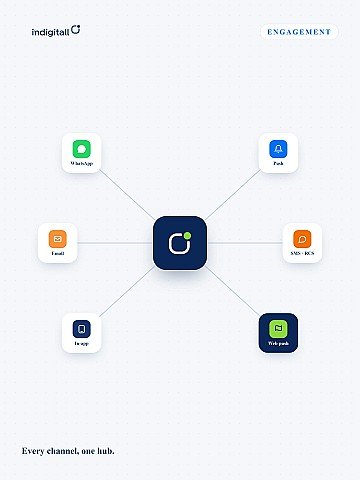
The modern customer journey is fluid, moving seamlessly between your app, website, physical store, and conversational channels like WhatsApp. A leading platform must not only support these channels but intelligently orchestrate them as part of a Global Omnichannel Strategy. This means a single platform can manage App Push, Web Push, SMS, Email, and Mobile Wallet passes.
The goal is to deliver the right message on the right channel at the optimal time, based on user behavior and stated preferences. This prevents channel fatigue and ensures your communications feel like a helpful, personalized dialogue rather than a disjointed monologue.
2. Visual Customer Journey Mapping
Manual, one-off campaigns are a relic of the past. The ability to design, visualize, and automate complex Customer Journeys is now a fundamental requirement. Marketers and CRM managers need a powerful, yet intuitive, drag-and-drop interface within their console to map out every step of the user experience.
From onboarding sequences to abandoned cart reminders and loyalty programs, a visual journey builder empowers teams to create dynamic, responsive pathways that adapt to user actions in real-time. This democratizes the creation of sophisticated engagement flows, removing the reliance on development resources for every change.
3. AI-Powered Personalization and Automation
Discover how AI chatbots can enhance customer engagement and streamline operations by watching this insightful video on the value of AI-driven chatbots.
AI accessibility is transforming personalization in marketing. In 2026, AI is an essential tool for marketing, no longer confined to data science teams. It automates complex tasks and enables personalization at an unprecedented scale. The challenge now is to make AI accessible and actionable for marketing teams directly involved in customer engagement.
indigitall’s integrated AI engine exemplifies this shift by acting as an intelligent assistant within the console. It simplifies campaign decisions, removing guesswork and manual effort. The focus is on empowering teams to achieve superior results quickly, without needing to understand complex algorithms.
AI-driven tools within the platform enhance key metrics through predictive sending, generative content assistance, and smart audience segmentation. By embedding AI in a unified platform, indigitall democratizes enterprise-grade personalization, allowing teams to orchestrate sophisticated, one-to-one interactions that drive loyalty and lifetime value.
In 2026, Artificial Intelligence is the engine of relevance at scale. A modern platform must integrate AI at its core, from generative AI that assists in crafting compelling, personalized message copy to AI agents that provide instant, 24/7 support via channels like WhatsApp.
Beyond content and support, AI drives predictive segmentation and marketing automation. It analyzes user data to anticipate needs, identify churn risks, and trigger proactive communications, transforming your strategy from reactive to predictive and boosting engagement with hyper-relevant content.
“indigitall excels in sending segmented push notifications, boosting engagement with its intuitive interface and advanced segmentation. It’s a robust tool for managing digital audiences across marketing and media.” – Carmen T. on G2
4. Rich, Interactive Communication Channels
Text-only messages have limited impact. Top-tier platforms leverage rich, interactive formats to capture attention and drive action. This includes push notifications with high-resolution images, videos, carousels, and interactive buttons that enable users to engage directly from the notification itself.
Crucially, this extends to conversational channels. The integration of WhatsApp Business allows for rich media sharing, product catalogs, and quick-reply buttons, turning a simple support channel into a powerful engine for conversational commerce and deeper relationship building.
5. Unified Data and Actionable Analytics
To better understand the role of a Customer Data Platform, check out this insightful explanation on how it integrates analytics and customer insights.
None of these pillars can stand without a solid foundation of data. The critical advantage of a unified platform is its ability to centralize all interaction data into a single customer view. This eliminates the data silos that plague multi-tool strategies, providing a holistic understanding of every customer.
This unified data powers a robust analytics suite that goes beyond vanity metrics. It must deliver actionable insights into conversion rates, user segment performance, and the overall ROI of your Customer Journey strategies, enabling continuous optimization and proving the value of your efforts to key stakeholders.
“indigitall secures data while managing push notifications effectively, increasing open rates. Their well-trained support team and AI functionalities add value, making it a promising tool for future campaigns.” – Leslie M. on G2
Pillar 1: Unifying Inbound & Outbound Communication
Unifying inbound and outbound communication is crucial for seamless customer engagement. Traditionally, marketing and customer service have operated separately, with marketing focusing on outbound campaigns and service handling inbound queries. This siloed approach is outdated in 2026, as customers expect a continuous conversation with your brand.
A unified platform enables seamless transitions between proactive marketing and reactive support within the same channel. For instance, a customer might receive a personalized WhatsApp message about a sale and respond with a query about loyalty discounts. A unified system ensures that this interaction is handled smoothly, with AI or human agents providing immediate, context-aware responses.
This approach creates a single, persistent conversation thread, enhancing the customer experience and driving conversions. Platforms like indigitall facilitate this by integrating outbound campaign automation with inbound AI and agent routing, transforming disparate touchpoints into a cohesive dialogue.
For years, marketing and customer service operated in separate universes. Marketing focused on outbound campaigns—pushing promotions, announcements, and content out to a wide audience. Service, on the other hand, was purely inbound, reactively handling questions and complaints that came in through disconnected channels.
In 2026, this siloed approach is a relic. Today’s customers don’t see a distinction between a marketing message and a support query; they see one continuous conversation with your brand. True engagement means orchestrating a seamless flow between proactive outreach and reactive support within the very same channel.
Imagine this scenario, powered by a unified platform:
- Outbound Trigger: A customer receives a personalized WhatsApp message about an upcoming flash sale for a product they previously viewed. This is a targeted, outbound marketing action designed to drive urgency and conversion.
- Inbound Response: The customer replies directly to that same WhatsApp message: “This is great, but will my loyalty discount apply to this sale?” This is an inbound service query, but it’s directly tied to a sales-focused interaction.
- Unified Resolution: Instead of being routed to a generic queue, the message is handled seamlessly. An AI Agent might instantly confirm the discount applies, or a human agent can step in with the full context of the original promotion, answering the question and guiding the user to complete their purchase within the chat.
This creates a single, persistent conversation thread, much like a chat with a friend. The context is never lost, the customer never has to repeat themselves, and the journey from promotion to purchase to support is entirely frictionless. This is the cornerstone of a modern Global Omnichannel Strategy.
Platforms like indigitall are built on this principle. By natively managing both outbound campaign automation and inbound conversational AI and agent routing, you eliminate the friction that kills conversions and erodes loyalty. It transforms separate touchpoints into a single, intelligent, and profitable dialogue.
“indigitall’s WhatsApp chat service enhances client communication with immediate responses and easy management of multiple conversations. Its intuitive interface and effective support make it a standout tool.” – Alexis G. on G2
Pillar 2: Meeting Clients on Their Preferred Channels (Especially WhatsApp)
The digital landscape of 2026 is defined by choice and immediacy. The era of relying solely on broadcast email campaigns is decisively over; today’s consumers live in real-time messaging apps, and that’s where brands must earn their attention and build relationships.
This fundamental shift from crowded inboxes to personal, conversational platforms is the most significant evolution in customer engagement this decade. Success is no longer about just sending a message, but about starting a valuable dialogue on the channel your customer already uses and trusts.
The Unrivaled Power of a Native WhatsApp Integration
At the forefront of this conversational revolution is WhatsApp. It has become the de facto channel for high-trust, personal interactions. Recognizing this, many platforms claim to offer WhatsApp integration, but the technical reality varies dra