24 September 2026
Scientific images by Human Technopole researchers will be displayed in six Milan metro stations until 27 September as part of TALES – The Art of the Life Sciences, a competition organised by BION – Lombardy Life Sciences Cluster. An invitation to discover the structures and mechanisms of life through the meeting of art and science.
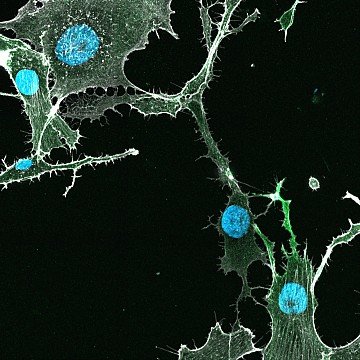
A network of filaments resembling metro lines. Developing brain cells evoking a forest. These scientific images, created by Laura Bonanomi (Erdmann Group) and Emanuele Capra (Kalebic Group), two young researchers at Human Technopole, are on display until 27 September on screens at Duomo, San Babila, Centrale, Cadorna, Garibaldi and Porta Genova metro stations.
The two images are among 30 selected from over 140 entries to TALES – The Art of the Life Sciences, a competition organised by BION – Lombardy Life Sciences Cluster with a contribution from the Lombardy Region and support from Fondazione Cariplo. Open to researchers aged 18 to 40, the competition aims to showcase talent, innovation and the impact of STEM disciplines, giving a voice to the next generation of researchers. The final awards ceremony for the winning images is scheduled for 25 September, as part of European Researchers’ Night.
Behind the shapes and colours lie scientific questions: how can we observe the internal structures of cells more precisely? How does the cerebral cortex form? The images offer a glimpse into researchers’ daily work and a principle that guides research at Human Technopole: understanding the mechanisms of life is the starting point for understanding disease and helping to improve human health. Displayed in places that residents and tourists pass through every day, they offer an opportunity to engage with research and discover what is normally invisible to the naked eye.
“Initiatives such as TALES show how research can connect with society through the universal language of images, revealing the extraordinary complexity of life and its beauty,” explains Marino Zerial, Director of Human Technopole. “We are particularly proud that two young Human Technopole researchers are featured in this exhibition. Supporting the talent of new generations and bringing the public closer to research are integral to our mission to advance knowledge and innovation for people’s health and well-being. Bringing these images into the everyday spaces of the city is also a reminder that research is a shared resource: it begins in laboratories, but its impact reaches across society and helps shape the future for generations to come.”
The selected images
The cytoskeleton: a Metro network within the city of the cell (image on the right)
Laura Bonanomi (Erdmann Group) – Structural Biology Research Centre, Human Technopole
A network of filaments runs through the cell, much like Metro lines connecting a city’s neighbourhoods. The image shows fibroblasts, cells essential for regenerating the body’s tissues, prepared with a technique known as expansion microscopy and viewed under a fluorescence microscope. The filaments shown in red provide structural support to the cell and transport cellular components. The nucleus, shown in blue, contains the genome: the instruction manual for making all the cell’s components.
The forest of the mind (image on the left)
Emanuele Capra (Kalebic Group) – Neurogenomics Research Centre, Human Technopole
During development, the shapes of cells in the cerebral cortex evoke a forest. The image shows the cortex of a ferret embryo: neural progenitors, the cells that give rise to neurons, are highlighted in green. Their nuclei appear in magenta. The study investigates how neural progenitors multiply and differentiate as the cerebral cortex forms.