Summary
- A CDP for retail fails when it treats point-of-sale (POS), ecommerce, loyalty, and app data as one clean stream instead of four systems that were never designed to talk to each other
- Stock-blind personalization, recommending or discounting items that are already sold out, is one of the fastest ways to erode trust and lower conversion
- Real-time identity resolution and inventory-aware segmentation are non-negotiable capabilities, not add-ons, for any retail customer data platform
- Bundled vendor suites and composable, warehouse-native architectures carry different total cost of ownership and lock-in tradeoffs, and the two are no longer mutually exclusive
- Rolling out a customer data platform during Q4 freeze windows is an operational risk most guides never mention, and a phased timeline avoids it
Retailers can segment customers by loyalty tier, purchase history, and browsing behavior, but rarely by whether the product being shown is actually in stock. That gap is why many retail personalization projects quietly underperform.
A customer data platform (CDP) for retail unifies transactional, behavioral, and identity data from point-of-sale (POS), ecommerce, loyalty, and mobile app sources into a single customer record that engagement tools can act on.
This guide is for vice president and director-level ecommerce and customer relationship management (CRM) leaders evaluating or implementing a CDP at a mid-market or enterprise retail brand. It works as a vendor-neutral operational playbook built around the specific ways retail data breaks generic CDPs, covering inventory-blind personalization, fragmented identity, and peak-season rollout risk.
By the end, you will have a framework for evaluating core capabilities, weighing build-versus-buy tradeoffs, prioritizing use cases by revenue impact, and sequencing implementation around your busiest quarter.
Why retail data breaks generic CDPs
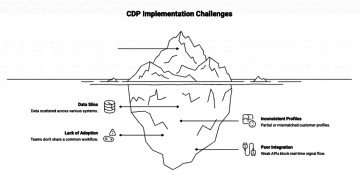
Retail customer data does not arrive in one stream. It comes from a POS system at checkout, an ecommerce platform online, a loyalty database that predates both, and a mobile app that may or may not sync in real time.
Each system was built for its own transaction, not a shared customer record, so the same shopper often exists as three or four unlinked profiles before anyone tries to unify them.
Generic CDPs, especially those built for software or media companies, assume a cleaner data environment than retail actually has. They handle web and email events well but were never stress-tested against a POS terminal that logs a purchase without an email address, or a loyalty card scanned at checkout with no link to the online account that earned the points weeks earlier.
The out-of-stock dead end
Stock-blind personalization is where this fragmentation becomes visible to customers. A shopper gets an email recommending a jacket that sold out days ago, or a push notification about a discount on an item no longer available in their size.
Repeated across a campaign calendar, these moments teach customers that your personalization is not trustworthy, and it shows up as lower click-through and higher unsubscribe rates.
The fix is not better creative or smarter send-time optimization. It is connecting inventory and product availability data directly into the segmentation and recommendation layer, so an offer is never generated for something that cannot be fulfilled. That is an architectural requirement, not a campaign tweak, and it is the first test worth running against any CDP shortlist.
Core capabilities a retail CDP must have
A retail CDP earns its budget by solving two problems: fragmented identity and inventory-blind targeting. Dashboards, integrations, and reporting polish matter less if these two capabilities are weak.
Real-time identity resolution across online and in-store behavior
Identity resolution matches disparate customer signals, an email, a loyalty card number, a device ID, a POS transaction, to a single unified profile. In retail, this has to happen close to real time, because a customer who buys in-store on Saturday and browses online on Sunday expects the brand to remember both. Look for:
- Deterministic matching using loyalty IDs, phone numbers, or account logins, with probabilistic matching as a fallback for anonymous traffic
- Sub-minute profile updates rather than batch syncs that run once a day
- Native support for POS transaction feeds instead of a custom-built connector for every implementation
- Cross-device and cross-channel stitching that survives app reinstalls and browser changes
A properly unified Customer Data Management layer turns these fragmented touchpoints into one profile that both marketing and store operations can query, which is the foundation everything downstream depends on.
Inventory-aware and margin-aware segmentation
Segmentation in retail needs to filter by more than demographics and behavior. It needs live product availability and margin data folded into the same rules engine, so a segment like “high-value customer, browsed category X, hasn’t purchased in 30 days” automatically excludes offers on out-of-stock or low-margin items.
Without this, personalization and merchandising work against each other instead of together. Platforms that handle this well treat inventory feeds as a first-class data source alongside behavioral and transactional data, refreshed frequently enough to reflect intraday stock changes rather than a static overnight snapshot.
Build vs buy: bundled suites vs composable architecture
The build-versus-buy decision usually gets framed as a technology question when it is really a tradeoff between speed and control. Bundled vendor suites, where the CDP and the engagement layer (email, SMS, push, web personalization) come from the same provider, get you to a working system faster because the data model and activation tools are designed to fit together from the start.
Composable, warehouse-native architectures, where the CDP sits on top of your existing data warehouse and connects to a separate engagement stack, give you more control over data ownership and let you swap components without re-platforming everything at once. The tradeoff is integration complexity: someone on your team, or an implementation partner, has to maintain the connective tissue between systems that were not built to be one product.
What to weigh before committing
- Total cost of ownership across licensing, integration maintenance, and the engineering time needed to keep a composable stack running
- Vendor lock-in risk if a bundled suite makes your customer data difficult to export or query outside its own activation tools
- Time to first value, since bundled suites typically activate use cases faster while composable setups offer more long-term flexibility
- Existing data warehouse investment, since composable fits better if data is already centralized than if you are starting from scratch
Neither model is universally better. A retailer with a mature data engineering team and heavy warehouse investment may get more long-term value from composable architecture, while a retailer that needs to move fast without adding engineering headcount often gets there sooner with a platform that unifies data and activation in one system.
Our Platform and its native Integrations are built to reduce that maintenance burden without asking you to give up ownership of your underlying data.
High-impact retail CDP use cases that drive revenue
The clearest way to prioritize a CDP roadmap is by revenue impact, not feature novelty. Two use case categories consistently deliver the fastest measurable return in retail environments.
Cart and browse abandonment recovery informed by live stock and location
Generic abandonment flows send the same reminder regardless of whether the item is still available or which store location has stock nearest the customer. A retail-aware CDP checks live inventory before triggering the message and can route the customer toward buy-online-pickup-in-store options when that is the fastest path to purchase.
Avon used this kind of connected data approach to improve conversion rates by up to 78% by making recovery messaging responsive to real customer context rather than generic timing rules.
Loyalty-driven segmentation and dynamic pricing personalization
Loyalty tier data is one of the highest-value signals a retail CDP can activate, but only if it is connected across every channel a member shops. Segmenting by tier, purchase frequency, and category affinity lets a brand personalize pricing, early access, and recommendations consistently whether the customer is on the app, the website, or in-store.
LC Waikiki used this kind of cross-channel segmentation to lift conversion rate by 11.31%, and retailers layering artificial intelligence (AI)-driven shopping assistance on top of loyalty data are extending this further with tools like AI shopping agents that guide product discovery using the same unified profile.
Rolling out a CDP without disrupting peak season
Most CDP implementation guides skip the calendar entirely, but retail operates on one that other industries do not: a Q4 freeze window where marketing, IT, and merchandising teams stop touching production systems to protect Black Friday and holiday revenue. Launching or migrating a CDP into that window is one of the most preventable mistakes a retail team can make.
A phased timeline that respects the freeze window
- Q1 to Q2: vendor evaluation, technical discovery, and identity resolution mapping against real POS, ecommerce, and loyalty data
- Q2 to Q3: integration build, data migration, and internal testing well ahead of any freeze period, with buffer for data quality issues
- Early Q3: launch a limited pilot covering one or two use cases, so the team validates the system under real traffic before scaling
- Late Q3: expand to full use case coverage and lock configuration changes before the freeze window begins
- Q4: operate in monitoring mode only, with no structural changes, new integrations, or schema updates
This sequencing protects revenue during the highest-stakes quarter of the year. It also gives the team enough runway to prove value before the following year’s planning cycle begins.
A key performance indicator (KPI) framework to prove return on investment
Retail leadership will want proof the platform earns its cost, and the strongest evidence comes from metrics tied directly to unified data rather than vanity engagement numbers.
Track conversion lift on personalized versus generic campaigns, retention rate changes within loyalty segments, customer lifetime value trends for cohorts exposed to inventory-aware personalization, and the reduction in wasted send volume on out-of-stock offers.
El Corte Inglés Portugal used this kind of connected measurement approach to grow average order value by 37% after unifying customer data and personalization efforts. That result is easier to trace when every metric ties back to the same customer record instead of siloed channel reports.
Conclusion
A retail CDP earns its place by solving the two problems generic platforms miss: identity fragmentation across POS, ecommerce, loyalty, and app data, and inventory-blind targeting that erodes customer trust.
Choose architecture based on your team’s engineering capacity and existing data investment, not vendor marketing, and sequence implementation around your operational calendar instead of a rushed sprint into Q4.
To evaluate the fit of Customer Data Management for your use case, book a personalized demo to review your goals, data requirements, and implementation constraints with the Insider One team.
Frequently Asked Questions
What is a CDP for retail, exactly?
A retail customer data platform unifies transactional, behavioral, and identity data from POS systems, ecommerce platforms, loyalty programs, and mobile apps into one customer record. That unified profile feeds segmentation, personalization, and reporting tools so marketing and store teams act on the same customer view.
How is a retail CDP different from a general-purpose CDP?
General-purpose customer data platforms are often built for cleaner digital-only environments like software or media. A retail CDP has to natively handle POS transaction feeds, inventory availability, and loyalty identity resolution, three data sources generic platforms typically require custom connectors to support.
What is inventory-aware personalization and why does it matter?
Inventory-aware personalization checks live product availability before a recommendation or promotion is generated, so a customer is never shown something that cannot be fulfilled. It matters because the damage is cumulative: a single sold-out recommendation is an annoyance, but a pattern of them teaches customers that your personalization is unreliable, which suppresses engagement across every campaign that follows.
What’s the biggest mistake retailers make when implementing a CDP?
Launching or migrating during Q4 freeze windows is one of the most common and costly mistakes. Retail teams also frequently underweight inventory-aware segmentation, building personalization that ignores real-time stock, which damages trust even when the targeting logic itself is sound.
Should we buy a bundled CDP suite or build a composable architecture?
It depends on your engineering capacity and existing data investment. Bundled suites typically activate use cases faster with lower integration overhead. Composable, warehouse-native setups offer more control and flexibility but have historically required sustained engineering resources. That tradeoff has narrowed: a warehouse-native platform with zero-copy segmentation and bi-directional connectivity can read from and write back to Snowflake, Databricks, BigQuery, or Redshift while still providing a unified activation layer.
How does a retail CDP handle in-store and offline data?
Through offline event ingestion and identifier prioritization. In-store views, add-to-cart actions, and purchases can be sent as first-class events rather than a nightly batch file, and a loyalty ID scanned at the till can be prioritized above a shared household email so the transaction attaches to the right person. Without both, in-store behavior arrives too late and too ambiguously to drive next-day personalization.
Which retail CDP use cases deliver the fastest return?
Inventory-aware cart and browse abandonment recovery, and loyalty-driven segmentation with cross-channel pricing personalization, consistently produce the fastest measurable revenue impact. Both directly address stock-blind targeting and fragmented loyalty identity, the two failure points generic personalization programs run into most often. Discount affinity scoring is often the fastest to show in the P&L, because the saving appears in margin rather than in an attribution model.