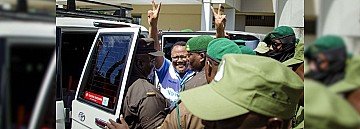
UN photo_CC BY-NC-ND 2.0
In a joint letter, human rights organisations, including FIDH and OMCT within the framework of the Observatory for the Protection of Human Rights Defenders, alert the Member and Observer States of the UN Human Rights Council to the post-election crackdown in Tanzania.
To Permanent Representatives of Member and Observer States of the United Nations (UN) Human Rights Council (Geneva, Switzerland)
5 December 2025
Tanzania: multilateral engagement is key to preventing a further deterioration of the human rights situation and ensuring accountability for the post-election crackdown
Your Excellencies,
Following the Tanzanian authorities’ brutal response to widespread protests that took place in the aftermath of the 29 October 2025 presidential and legislative elections, and in light of the ongoing crackdown on dissenting voices and of risks of further violence, we, the undersigned civil society organisations, urge Member and Observer States of the UN Human Rights Council to enhance their engagement with the United Republic of Tanzania and take action to prevent further abuses.
In line with the Council’s prevention mandate, as expressed in particular in Council resolution 45/31, the Council should hold a debate following a public briefing by the UN High Commissioner for Human Rights. If needed, stronger action could follow, including the convening of a special session of the Council to address the deteriorating human rights situation in Tanzania.
On and in the aftermath of the 29 October 2025 elections, which, according to the Southern African Development Community (SADC) Electoral Observation Mission (SEOM), took place in conditions that “fell short of the requirements of the SADC Principles and Guidelines Governing Democratic Elections” and in which “voters could not express their democratic will,” [1] and saw the incumbent President, Samia Suluhu Hassan, of the ruling Chama Cha Mapinduzi (CCM) party, secure 97.66% of the votes, [2] widespread protests broke out across Tanzania. In its preliminary report, the African Union Election Observer Mission (AUEOM) noted that the Tanzania elections “did not comply with AU principles, normative frameworks, and other international obligations and standards for democratic elections.”
Despite challenges in verifying the number of people affected, including because of a government-imposed lockdown, media restrictions, and internet and electricity shutdowns, regional and international bodies have raised concerns about the large number of fatalities. Credible reports point to hundreds of people killed by police and unidentified security personnel in the economic capital, Dar es Salaam, and several Tanzanian regions from 29 October to 2 November 2025. [3] The actual figures could be higher. Authorities have deliberately prevented journalists from reporting on elections and protests.
In late October and early November 2025, Tanzanian police and security forces and individuals in plain clothes assaulted, tear-gassed, and arbitrarily arrested people, including children, leading to hundreds being charged with treason. They used excessive and lethal force, including live ammunition, to disperse protests and target people they regarded as violating “stay-at-home” orders. In some cases, victims appear to have been shot in the back or in the head despite posing no threat to public order or the security of others. Some victims were also shot and killed in their homes. There have been reports of enforced disappearances and of security forces “removing bodies from streets and hospitals and taking them to undisclosed locations in an apparent attempt to conceal evidence.” [4] A CNN investigation suggested the existence of mass graves. [5] While some protesters engaged in violence, and authorities have a responsibility to maintain security, under no circumstances may State authorities subject protesters to excessive force or indiscriminately use firearms against protesters. [6]
In addition to the UN High Commissioner for Human Rights and SADC, who have expressed deep concerns over the loss of life and injuries in Tanzania, the African Commission on Human and Peoples’ Rights (ACHPR) underscored that acts attributable to the Tanzanian authorities, if confirmed, “would constitute very grave violations of the African Charter on Human and Peoples’ Rights […].” It condemned the “deteriorating human rights situation in Tanzania” and called on the government to “prioritise de-escalating the […] situation [and] ensuring that security forces refrain from using disproportionate force […]." [7]
Civil society organisations have also highlighted that the use of live ammunition against protesters is unacceptable and that Tanzanian authorities should end the use of excessive and lethal force against protests and ensure justice and accountability for the violations, including election-related killings. [8] As of 18 November 2025, preliminary findings following a fact-finding mission conducted by the Tanzania Human Rights Defenders Coalition (THRDC), the Tanganyika Law Society (TLS) and the Legal and Human Rights Centre (LHRC) showed that over 700 people had been taken to court from at least nine regions. The organisations documented serious procedural irregularities, including arbitrary arrests, individuals rounded up while conducting normal income-earning activities, and the presence of children among those detained. [9]
These violations took place in the context of a broader crackdown on civic space and the rule of law, which intensified in the run-up to the October 2025 elections. The electoral campaign was marred by arbitrary arrests, enforced disappearances and other violations against dissenting voices and opposition members and supporters. In April 2025, the authorities arrested Tundu Lissu, the leader of the main opposition party, CHADEMA, during a rally. He has been on trial on fabricated charges, including treason, which is non-bailable and carries the death penalty. Authorities barred CHADEMA and presidential candidate Luhaga Mpina of Alliance for Change and Transparency (ACT-Wazalendo) from participating in the elections. [10]
In a joint communication by UN special procedures, in July 2025, several mandate-holders raised concerns over the escalating human rights crisis with the reported disappearance of over 200 people in Tanzania, including the violent abduction of activists and opposition leaders. [11] The communication made reference to the growing transnational repression, which saw the abduction and reported sexual torture of a Kenyan activist, Boniface Mwangi, and a Ugandan journalist, Agather Atuhaire, as they were visiting the country to attend the treason trial of Tundu Lissu.
In a resolution released in August 2025, the ACHPR expressed deep concerns about human rights violations occurring in the election context, the violent repression of rallies and other public assemblies, and restrictions on access to information. It also condemned the deportation of the former Minister of Justice and former Chief Justice of Kenya, and the arbitrary detention and mistreatment of human rights activists. [12]
During the Human Rights Council’s 59th and 60th regular sessions, DefendDefenders raised the alarm over the situation in Tanzania. It condemned enforced disappearances and attacks on civic space; the arrests, detentions and deportations of former officials and activists (and attacks on the latter) who had travelled to Tanzania to attend a court case; as well as abuses against Tanzanians who attempted to attend court hearings in Tundu Lissu’s case. The organisation warned: “With elections approaching, risk factors of violations are multiplying. […] Tanzania is too big to fail, and East Africa cannot afford another major human rights crisis.” [13]
In a briefing published in October 2025, Amnesty International highlighted how Tanzania’s legal system lacked safeguards to protect political actors and other people from state abuse. In the run up to the elections, Amnesty International noted, authorities in Tanzania had passed laws and regulations that, while framed as administrative or protective reforms, collectively served to constrain political opposition, suppress peaceful dissent, and expand restrictions on human rights, including the rights to freedom of expression, association and peaceful assembly. [14]
Analysts and observers also raised concerns over the environment in which the 2025 elections were about to take place, pointing to flaws in the 2024 electoral reform against a backdrop of unaddressed grievances related to the absence of a level playing field – which led the main opposition party, CHADEMA, to refuse to recognise results of elections that took place since 2005. [15] In the November 2024 local elections, the ruling CCM party won 98% of the seats.
In fact, after an initial period of opening that followed President Hassan’s assumption of office, in 2021, during which she issued public signals in favour of freedom of expression, freedom of the media, and civil society, concerns had been mounting over the repression of independent and opposition voices and escalating authoritarian practices. In addition to grave restrictions on civic space, intimidation of dissenting voices and patterns of assault and enforced disappearances targeting opposition members and supporters and journalists, civil society organisations denounced the forced evictions of Maasai Indigenous communities from their ancestral lands in Ngorongoro district. [16]
These concerns echoed those previously expressed by civil society, under President John Pombe Magufuli’s first term (2015-2020), with regard to restrictions on civic space and the rule of law, including the adoption of draconian legislation that unduly restricted the exercise of human rights and the use of legal and extrajudicial methods to harass human rights defenders, activists, journalists and other independent actors. [17]
In February 2019, during a “conversation” with the Human Rights Council President and States, former UN High Commissioner for Human Rights Michelle Bachelet asked Council Members to “engage Tanzania bilaterally on its rights situation” and urged the country to “accept visits of the Special Rapporteurs to advise on measures to protect public freedoms and other human rights concerns.” She mentioned legislative curbs on freedom of opinion and expression, attacks on several prominent civil society members and opposition figures, and an overall “climate [that] denies Tanzanians their rights.” [18] None of these visits took place.
The current human rights crisis is of unprecedented magnitude. Beyond Tanzania, a country of 67 million people whose reputation as a beacon of stability is now at risk, the stability of the whole region, including East Africa and the Great Lakes, is at stake.
Major protests are planned for 9 December (Independence Day for mainland Tanganyika), with risks of further violence and as treason charges have been brought against hundreds of Tanzanians, [19] including children, for their participation in peaceful protests. We remain concerned that the authorities’ response to further demonstrations be in accordance with Tanzania’s international legal obligations. With many civil society members and opposition supporters having fled the country out of fear for their physical integrity, authorities are now propagating an aggressive and stigmatising rhetoric according to which protesters and non-governmental organisations (NGOs) were allegedly “paid” to hold protests.
The Human Rights Council should act urgently to prevent a further deterioration of Tanzania’s human rights situation and ensure justice and accountability for these serious human rights violations. The UN High Commissioner for Human Rights issued an important call for prompt, impartial, effective, full and transparent investigations into the killings and other violations committed in the context of the 29 October elections, and for those suspected to be responsible to be held to account.
Serious concerns exist, however, about the national commission of inquiry announced on 18 November 2025 by President Hassan. The commission’s mandate or terms of reference remain unclear, as the wording of the presidential statement that launched it suggests that the scope of its mandate is to “investigate events that led to ‘breaches of peace’ during and after the general elections held on 29 October 2025.” The commission does not seem to have a mandate to address the root causes of the human rights crisis or to include representation of civil society, international observers, religious leaders, or survivors and victims’ families. Rather, the commission includes former state officials and retired civil servants, including a former Inspector General of Police and the Minister of Defence who was in office at the time of the violence. The commission has been rejected by opposition political parties [20] and civil society organisations and does not enjoy consensus. Moreover, on 20 November 2025, President Hassan delivered remarks interfering with the commission’s independence, asking it to investigate how protesters and NGOs had been “paid” to hold protests.
Against this backdrop, in line with the Council’s prevention mandate and with provisions of Council resolution 45/31, in particular its operative paragraphs 6 and 7, we urge States to hold a debate foll