The military-backed polls, scheduled to begin on 28 December 2025, are an illegitimate process that fails to meet all relevant international standards for elections. The International Federation for Human Rights (FIDH) and its member organizations Alternative ASEAN Network on Burma (ALTSEAN-Burma), Women’s Peace Network (WPN), and Info Birmanie urge states, intergovernmental organizations, and international development and cooperation partners to explicitly and unequivocally reject the polls, press the junta to end attacks against civilians, release all political prisoners, surrender power, and allow for the swift return of a democratically elected civilian government without delay.
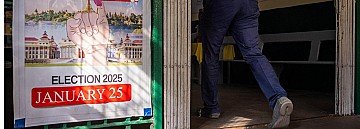
Bangkok, Paris, 24 December 2025. The polls are expected to be held in at least two phases, on 28 December 2025 and 11 January 2026, with the dates of subsequent phases yet to be announced. This illegitimate process, conceived by the junta that illegally seized power in the February 2021 military coup d’état, occurs amid intense armed conflict and widespread and systematic violations of fundamental civil and political rights and complete disregard for democratic principles.
“No one should be under the illusion that this non-election will be a step forward from Myanmar’s current situation. These polls are a recipe for disaster that will inevitably lead to more conflict and human rights violations, including serious international crimes,” said FIDH Vice-President Teppei Ono.
FIDH, ALTSEAN-Burma, WPN, and Info Birmanie urge states, intergovernmental organizations, and international development and cooperation partners to denounce the upcoming polls as illegitimate and not to recognize their results. The four organizations also urge any relevant stakeholders to refrain from conducting any monitoring of the polls or providing any form of election-related technical or financial assistance to the junta, the Union Election Commission (UEC), and other junta-controlled bodies involved in the organization and administration of the polls.
“The lead-up to this non-election has seen ongoing atrocity crimes and massacres. It will only increase instability in Myanmar, with serious implications for the country’s regional neighbors, particularly Bangladesh, China, and Thailand. Governments in the region and beyond must reject General Min Aung Hlaing’s fake polls, impose an arms embargo, and work to facilitate the return of power to the people of Myanmar,” said ALTSEAN-Burma Coordinator Debbie Stothard.
Attacks against civilians, arbitrary detentions surge
The polls are held amid an intensification of repression and attacks against civilians by Myanmar’s military, which have resulted in extraordinarily high numbers of victims.
Between 18 August 2025 - the date in which the junta announced it would hold the polls - and 12 December 2025, there were at least 3,493 armed clashes and attacks against civilians which killed 1,057 civilians, according to figures from the independent conflict monitor Armed Conflict Location & Event Data Project (ACLED). This included 862 airstrikes in a total of 121 township across seven states and six regions, which killed at least 650 civilians.
“Any state or international organization that considers itself democratic would lose credibility if it supported the junta’s scam election, including in the eyes of its own people. The focus should not be on the non-election, but on the role that multilateral bodies, notably the UN Security Council and General Assembly, must play in depriving Min Aung Hlaing of the material resources that enable him to perpetuate serious international crimes,” said Info Birmanie Coordinator Johanna Chardonnieras.
Between 18 August and 12 December 2025, the junta arbitrarily arrested and detained at least 1,932 individuals, according to figures from the independent NGO Assistance Association for Political Prisoners (AAPP). As of 22 December 2025, 22,668 political prisoners remained behind bars, according to AAPP. These include peaceful protesters and members of the Civil Disobedience Movement (CDM), politicians, members and supporters of the National League for Democracy (NLD), human rights defenders, activists, and journalists.
On 29 July 2025, the junta enacted the Law on the Protection of Multiparty Democratic Elections from Obstruction, Disruption and Destruction, which includes severe penalties for criticism or acts deemed to obstruct, disrupt, or sabotage any part of the polls. Capital punishment is prescribed for any such actions if they result in the death of an individual. According to AAPP, as of 19 December, the enforcement of this law had led to the arrest of at least 122 individuals and jail terms of up to 49 years for their peaceful criticism of the polls.
In addition, martial law remains in force in 63 townships across nine regions and states, resulting in severe restrictions of fundamental rights, including the rights to freedom of movement, freedom of peaceful assembly, and freedom of association.
Massive voter disenfranchisement
The polls effectively disenfranchise a sizeable percentage of Myanmar’s population, including Rohingya in and out of the country, internally displaced persons (IDPs), voters residing in areas where the polls will not be held, and individuals deprived of their liberty.
The Rohingya population remains subjected to systematic disenfranchisement as a result of discriminatory laws that deny them full citizenship in Myanmar. Voters residing in 56 townships are also excluded from the process, as the UEC announced polls would not be held in those constituencies. In addition, voters among the estimated 3.6 million IDPs who have fled the junta’s violence and conflict are unable to participate in the polls. Lastly, inmates, including political prisoners, are barred from exercising their right to vote.
“Instead of focusing on this non-election, states should increase efforts to hold perpetrators of serious international crimes accountable – including by referring the situation of Myanmar to the International Criminal Court. It must not be forgotten that over one million Rohingya have been disenfranchised as a direct result of the genocidal campaign waged against them by General Min Aung Hlaing,” said WPN Executive Director Wai Wai Nu.
Key parties excluded amid junta’s suppression of political participation
The polls are being held under several new laws unilaterally enacted by the junta, which have cemented its suppression of political participation and repression of political dissent. In addition, the UEC, the body responsible for organizing and administering the polls, lacks independence and impartiality, as its current members were appointed by the junta.
On 26 January 2023, the junta passed the Political Party Registration Law, requiring all existing political parties to re-register with the UEC within 60 days of the law’s enactment or face dissolution. The law also prohibits anyone previously convicted of a crime or serving a prison term from joining a political party, effectively disqualifying many pro-democracy leaders who are serving lengthy prison sentences on politically motivated charges. Under the law, political groups designated as illegal or “terrorist” by the junta, and those found to be engaging with such groups, are prohibited from registering. The law was subsequently amended multiple times, including on 28 July 2025, introducing provisions that allowed for the dissolution of political parties accused of committing electoral fraud.
In March 2023, the UEC announced the dissolution of 40 political parties, including the ousted NLD, for failing to meet the registration deadline under the new Political Party Registration Law. This has resulted in the exclusion of political parties that won more than 90% of the parliamentary seats in the 2020 general election, including the NLD. In September 2025, the UEC dissolved four other political parties for failing to meet the law’s onerous requirements on the minimum number of members and offices.
Fifty-seven political parties, including the military-backed Union Solidarity and Development Party (USDP), have registered to participate in the polls. Most of them are junta proxy and/or supporters. In addition to the USDP, which is fielding more candidates than any other party, including 20 generals and senior junta officials, only five other parties - the National Unity Party (NUP), the People’s Pioneer Party (PPP), the Myanmar Farmers Development Party (MFDP), the Shan and Nationalities Democratic Party (SNDP), and the People’s Party (PP) - have the necessary resources to contest nationwide, while the rest will only field candidates in polls at the state or regional level.