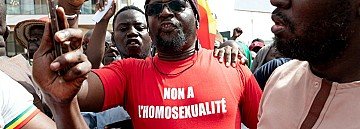
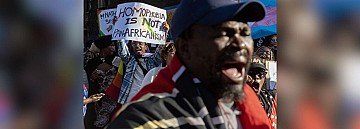
- A recent draft bill aims to create significantly harsher punishment for same-sex relations and to criminalise "the promotion of LGBT ideology."
- Amid a worrying rise in homophobia, 27 men have been arrested since 9 February 2026.
- The draft legislation is in breach of Senegal’s international and regional human rights commitments.
Paris, Dakar, 24 February 2026. On 18 February 2026, the Senegalese Council of Ministers approved draft legislation to increase sanctions for same-sex relations in the criminal code. This marks a new phase in the repression of LGBTIQ+ persons in Senegal, against a backdrop of stigmatising rhetoric and rising tensions.
In recent years, the criminalisation of homosexuality has been a source of concern. In December 2021, several members of Parliament, with the support from the collective And Sam Djiko Yi ("Together, let’s protect our values"), submitted for adoption draft legislation to strengthen the repressive measures. The bill was not approved. The President of Senegal, Bassirou Diomaye Faye, subsequently made the passing of harsher laws part of his election campaign. The current situation is also being used to discredit the broader efforts being made to promote gender equality in Senegal.
According to media reports, since 9 February 2026, at least 27 men have been detained on various charges, including "unnatural acts" and "intentional transmission" of HIV. Under Article 319 of the Criminal Code, homosexual relations are already punishable sentences of up to five years in prison and fines ranging from 100,000 to 1,500,000 CFA francs. The "intentional transmission of HIV" can carry a sentence of up to ten years in prison.
The most recent draft bill aims to double prison sentences for "unnatural acts"—up to ten years—and to increase fines to a maximum of 10 million CFA francs. Most importantly, it would introduce the offense of "apology" or defence made for homosexual relations, this would place at risk of prosecution anyone expressing support, defending, or expressing a favourable opinion regarding the rights of LGBTIQ+.
A serious attack on the freedoms of expression and association
The envisioned changes to the law constitute a serious infringement of the freedoms of expression and association and would apply to relationships that fall strictly within the realm of private life. Senegal has been a party to the International Covenant on Civil and Political Rights since 1978. Article 17 guarantees that "no one shall be subjected to arbitrary or unlawful interference with his or her privacy." The proposed reform also contravenes the African Charter on Human and Peoples’ Rights, Article 3 which enshrines the principle of equality of all before the law.
"Further tightening repression will only fuel violence, fear, and impunity. Senegalese authorities have an obligation to protect all persons without discrimination, not to designate scapegoats", stated Drissa Traoré, Secretary General of the International Federation for Human Rights (FIDH).
The decision to prosecute persons for "intentional transmission" or who are HIV-positive or have tested positive of HIV also raises great concern. Numerous studies and international bodies have demonstrated that harsher laws, often outdated and poorly enforced, serve to further stigmatise of people living with HIV, spread misinformation about HIV, discourage testing and access to care, and undermine public health policies.
The proposed law would wipe out two decades of public health policies, designed in collaboration with the National Council for the Fight Against HIV/AIDS, to meet the specific needs of LGBTIQ+ people in Senegal. Making public the HIV status of defendants and the practice of forced testing are a violation of fundamental rights. Prosecutions based on real or perceived HIV status exacerbate marginalisation and isolation and undermine the efforts made to combat HIV and to protect human rights. The adoption of such a bill will enshrine discrimination and inequality before the law and place a sword of Damocles over the heads of all Senegalese LGBTIQ+ citizens, their families, organisations supporting people living with HIV, and more broadly, everyone who stands up for their rights.
The criminalisation of LGBTIQ+ people: a colonial legacy
The draft bill is part of a broader resurgence of discourse hostile to the rights of LGBTIQ+ people that extends beyond Senegal and is often justified in the name of cultural or religious values. Yet, in many African countries, the laws that criminalise homosexuality were often inherited from colonial criminal codes. The colonial legacy is too often overlooked or denied making it possible to promote the idea that there exists a "Western agenda" that is imposing respect for the rights of LGBTIQ+ persons when in reality criminalisation per se is very often a colonial legacy and not an ancestral tradition.
FIDH calls on the Senegalese authorities to drop the draft legislation, to end arbitrary arrests, and to engage in an inclusive dialogue based on respect for universal human rights.
FIDH urges the Senegalese authorities to:
– guarantee the effective protection of all people against of all forms of discrimination and violence, regardless of their sexual orientation;
– investigate rights violations suffered by LGBTIQ+ persons and prosecute the perpetrators; and
– strongly condemn the stigmatisation and hate campaigns openly disseminated via the media and social networks that target LGBTIQ+ persons.
Senegal’s regional and international partners must also firmly reiterate that the protection of fundamental rights cannot be conditional or selective.