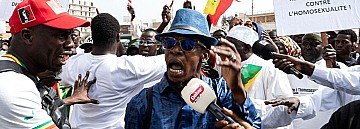
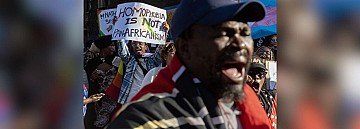
- The adoption by the Senegalese National Assembly of a law doubling prison sentences for homosexual relations marks a worrying tightening of the law.
- The legislation now sets these sentences at five and ten years’ imprisonment and extends criminalisation to acts deemed to "promote" homosexuality.
- This legislation violates Senegal’s international obligations and further exposes LGBTIQ+ people, or those perceived as such, to stigmatisation, violence and arbitrary arrest.
- The International Federation for Human Rights (FIDH) calls on Bassirou Diomaye Faye, President of the Republic of Senegal, not to enact a law that is deeply discriminatory against a section of his population.
Paris, Dakar, 17 March 2026. A new law passed on 11 March 2026 by the Senegalese National Assembly drastically tightens the crackdown on LGBTIQ+ people. By increasing the prison sentences provided for in the Criminal Code for "unnatural acts" to five and ten years, and by introducing penalties for any supposed form of "promotion" of homosexuality, the legislature has crossed yet another threshold in the criminalisation of homosexuality. In a context already marked by arrests and violence against people "accused" of being homosexual, this legislative development can only fuel a stifling climate of hostility.
"Senegal has today chosen to tighten legislation that targets and stigmatises a section of its population. By extending repression to those who defend the rights of LGBTIQ+ people, the Senegalese authorities are clearly violating their international commitments", said Drissa Traoré, Secretary-General of the FIDH. "Such a law protects no one: it further exposes individuals who are already vulnerable to violence, arbitrary arrest and humiliation."
This law also poses a serious threat to freedom of expression and association, as well as to human rights defenders, civil society organisations, journalists and lawyers working to protect fundamental rights. By prohibiting, in vague terms, any action or support aimed at "promoting homosexuality, bisexuality, transsexuality", the text risks criminalising legitimate human rights activities. By referring to "practices akin to bestiality or necrophilia", the wording of this text clearly demonstrates the influence of conservative groups with a conspiracy-theory-based rhetoric, who have been trying for years to get such a law passed, not hesitating, as in this case, to level accusations that are as absurd as they are violent.
At a time when civic space is already under pressure, such a provision exposes these individuals to legal proceedings, acts of intimidation and campaigns of stigmatisation, in violation of the safeguards recognised by the United Nations Declaration on Human Rights Defenders. Yet the protection of those who work peacefully for the rights and dignity of all is a duty of the State.
Senegal is bound by several international and regional instruments that guarantee the right to privacy, non-discrimination and protection against cruel, inhuman or degrading treatment. By intensifying the crackdown on same-sex relationships and targeting any form of support or expression relating to the rights of LGBTIQ+ people, this legislation directly contradicts these commitments.
The political rhetoric put forward by several deputies, as well as a number of prominent Senegalese figures, which portrays homosexuality as a "Western and neo-colonial cultural attack" in order to justify this persecution, reflects a narrative that has been skilfully manipulated to embed homophobia within a sovereigntist narrative. The colonial legacy of anti-LGBT+ legislation is well established.
Furthermore, the passing of this law represents a victory for the anti-rights and anti-gender movements in Senegal, some of whom are calling for the establishment of a society governed by conservative norms. It also foreshadows future attacks on the fundamental rights of other minority groups.
The repeal of this law and the alignment of Senegalese law with the country’s regional and international obligations are now an urgent necessity to ensure the protection of everyone’s fundamental rights.