CONCLAVE 2025 – A STRATEGIC COMMUNITY SHAPING EUROPE’S FUTURE
Brussels, January 21, 2025
For its second edition in Brussels, as President Trump takes office, the Conclave brought together community of transdisciplinary and transgenerational European personalities and becomes the reference European meeting before the Davos World Economic Forum. At the heart of the Conclave exchanges is the European strategy to avoid the risk linked to the stranglehold of China and the United States.
The Conclave took place in several stages:
- A working meeting with NATO Secretary General Mark Rutte, Thursday, January 16, which focused on the articulation between the development of a European defense industry and the commitments of EU Member States with the strengthening of NATO ;
- A public intercontinental conference on Friday, January 17, in the presence of speakers from American, Chinese, Indian and Moroccan think tanks, entitled “What relations should we envisage with Europe by 2040?” », concluded by the Belgian Prime Minister Alexander De Croo ; an opening discussion dinner followed hosted by Ilham Kadri, CEO of Syensqo, at Maison Solvay ;
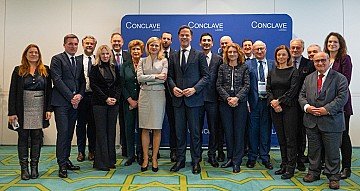
- The seminar was held on January 18 and 19 at the Royal Palace (BELvue Museum) with the Conclavers (forty high-ranking participants), including the President of the European Council, Antonio Costa, coming from the business, science & tech, cultural, civil society and politics.
Antonio Costa, new President of the European Council, who hosted the first Conclave in Portugal in November 2023, engaged the discussion on Saturday morning alongside Guillaume Klossa, founding president of the Conclave and president of EuropaNova, on the theme: “Geopolitics, including Defense and Security”. Two other major themes were then addressed: “Science and Technology as key drivers of Competitiveness” and “Funding European ambitions, Narrative and Leadership”. These key topics had been previously defined with Antonio Costa, in order to be useful to the European Council, in particular in view of its seminar work next February. Likewise, the recommendations of the Conclave, which will give rise to a public report and briefing notes (primarily on Defence and Security), are also intended to already feed the work of the European Commissioners with a view to the strategic agenda of the European Commission currently being developed.
High-level discussions behind closed doors
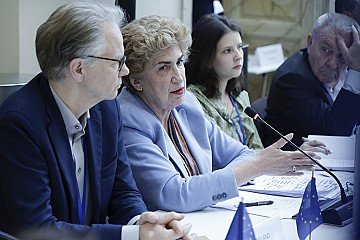
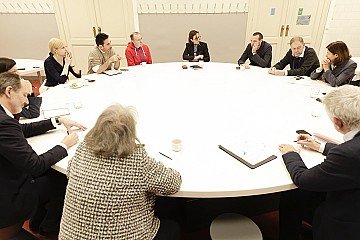
Taking place according to the Chatham House rules, the debates were held in plenary assemblies, then were divided into thematic workshops. This was in accordance with the methodology desired by the members of the Conclave Board in order to deepen the reflection, but also to identify the right questions to ask about the challenges for the future of Europe, both in terms of defense, competitiveness and new resources, and to identify the « game-changers » as so many actors are to restore the sovereignty of Europe in a multipolar, uncertain world. Europe must develop new partnerships at the dawn of a new international situation, particularly in transatlantic relations at the time of the inauguration of the president Trump.
Why the Conclave matters
Beyond being an event, the Conclave marks the birth of a community of European leaders committed to advancing European sovereignty, a mission challenged by the recent U.S. elections and Russia’s war in Europe. The Conclave stands apart by fostering deep, interdisciplinary dialogue, ensuring open, candid exchanges among participants. Unlike conventional forums, the Conclave is grounded in pragmatism and field-tested expertise, enabling it to provide precise, actionable proposals that resonate with EU institutions and leaders.
The Conclave distinguishes itself as a unique space where high-level decision-makers, such as EU Commissioners, engage directly with scientists, industrial leaders, and practitioners. Here, the realities of complex negotiations, such as those with global powers, are shared candidly—not in the filtered, polished narratives often seen in public discourse. In turn, those directly affected by these decisions provide grounded insights into the tangible impacts on their industries, research, and production.
“The Conclave is not just a discussion space—it is a strategic community,” remarked Guillaume Klossa, Executive President of EuropaNova and co-founder of the Conclave. “Through transdisciplinary collaboration, we address Europe’s pressing challenges and ensure the EU evolves from a reactive to a forward-thinking force.”
The Conclave draws its strength from its diverse, high-level membership, which includes leading experts in defense, diplomacy, technology, and sustainable development.
What’s Next:
Conclave’s proposals will feed directly into:
- European Commission seminar series starting in February, addressing defense policy, innovation funding, and EU-global relations.
- EU-UK talks on defense and trade, where the Conclave’s recommendations will shape discussions on joint strategic autonomy and post-Brexit collaboration.
- Broader multilateral reform initiatives to be championed at the G20 and other global forums in 2025.
These discussions underscore the Conclave’s role as a trusted resource for the EU’s highest decision-makers, ensuring Europe remains proactive and resilient.
The Conclave is co-built with the main European foundations: King Baudouin Foundation, Bertelsmann Stiftung, Bled Strategic Forum, Calouste Gulbenkian, Champalimaud, Stiftung Mercator.
The Conclave Board
The Conclave is convened under the supervision of its distinguished Board, ensuring collaboration, continuity, and relevance. Members include: Guillaume Klossa, Chairman of the Board of the Conclave and Executive President of EuropaNova, former Sherpa of the European Council Reflection Group on the Future of the EU ; Piero Benassi, former Italian Permanent Representative to the EU ; Jean-Pierre Bourguignon, mathematician and former Chair of the European Research Council ; Etienne Davignon, Belgian industrialist and long-time presider over Bilderberg ; Philippe Etienne, former Sherpa to President Macron and Ambassador to the EU, Germany, and the US ; Mariya Gabriel (invited Member), President of Robert Schuman Institute and European Commissioner (2017-2023) ; Aart Jan de Geus, former Minister for Social Affairs and Employment of Netherlands and Deputy Secretary-General of the OECD ; Peter Grk, Secretary General of the Bled Strategic Forum ; Maria João Rodrigues, former Minister of Employment of Portugal, former member of the European Parliament and negotiator of the Lisbon Strategy and the European Pillar of Social Rights ; Grégoire Roos, Head of Political Dialogue and Policy Innovationat the BMW Foundation ; Daniela Schwarzer, political scientist and expert on EU treaty reform ; Erika Staël von Holstein, Director General of Reimagine Europa ; Loukas Tsoukalis, President of ELIAMEP Athens and Professor at Sciences Po, Paris ; António Vitorino, former Director-General of the International Organization for Migration and former European Commissioner.
© Marijo Zupan
EuropaNova and the Conclave: Driving Europe’s transformation through vision, expertise, and action!