You’re asking the wrong question if you’re evaluating conversational AI platforms based on the number of features they offer.
Enterprise teams operate at a scale where stability, consistency, and outcomes matter more than any long list of capabilities.
Most large organizations now rely on conversational AI platforms to handle heavy request volumes, guide customers through complex journeys, and keep response times tight across web, app, and messaging channels.
This shift is happening fast.
However, many conversational AI platforms look impressive in controlled demos.
Yet very few stay reliable when traffic surges, regions expand, data loads grow, and internal teams depend on the system throughout the day.
This guide focuses on that single factor (enterprise-grade stability) and evaluates ten conversational AI platforms through that lens.
Let’s get started.
What makes a conversational AI platform enterprise-ready?
Enterprise teams need a platform that can fit into their existing systems, works across regions, and carries real customer demand without performance dips.
Here’s what to look for:
- Look for stability at scale: Choose a platform that maintains response integrity during peak load. If latency rises or output quality drifts when volumes surge, the system cannot support enterprise operations.
- Prioritize depth of integration: Select a platform with a proven bi-directional CRM integration. If this single connection is unreliable, every downstream workflow (routing, personalization, reporting) loses accuracy.
- Ensure strong security and compliance: Adopt a platform with verified adherence to your regional compliance requirement. This is the only way to reduce exposure when handling sensitive customer data at scale.
- Consolidate channel coverage: Use a platform that orchestrates all conversations through one operational layer. Fragmented channel setups introduce workflow duplication and uneven customer experiences.
- Demand consistent AI performance: Rely on a system that delivers stable intent recognition across languages and high-volume environments. Variability at this level can increase service cost and erode customer trust.
- Track real measurable outcomes: Choose a platform that provides real-time impact reporting. Without immediate visibility into resolution speed, conversion lift, or workload reduction, you cannot guide performance or justify investment.
This framework is the baseline before reviewing any vendor. It ensures the comparison stays grounded in what enterprises actually need, not what vendors like to showcase.
Top 10 enterprise conversational AI platforms
Here’s a curated list of platforms built to support real enterprise load, multi-region operations, and measurable business outcomes:
1. Insider One: Best for enterprises that need AI-native customer engagement across every channel
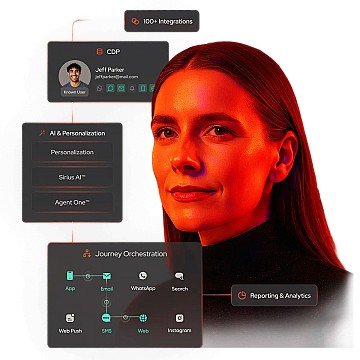
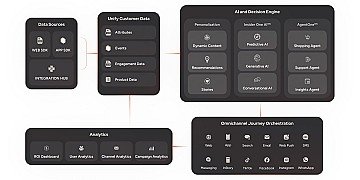
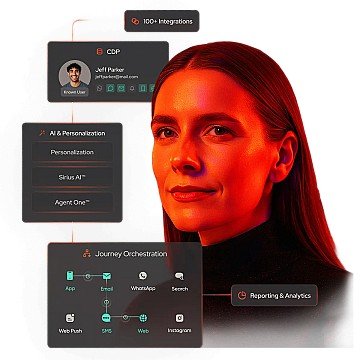
Insider One is built for enterprises that want customer engagement, personalization, and journey orchestration unified in a single AI-native platform. The platform combines a real-time CDP, AI-driven personalization, journey orchestration, and reporting across web, app, email, SMS, RCS, WhatsApp, search, and conversational experiences.
Rather than stitching together multiple tools, teams operate from one centralized layer that activates customer data consistently across channels.
At the core of the platform is Sirius AI, which brings together agentic, predictive, and generative AI to drive real-time decisioning. Agent One extends this with autonomous AI agents that manage high-intent moments and two-way conversational journeys across channels.
Key features:
- Agent One with three purpose-built AI agents: Shopping, Support, and Insights
- Unified customer data is activated across every engagement channel
- AI-native personalization powered by agentic, predictive, and generative AI
- Journey orchestration across multiple touchpoints and lifecycles
- Built-in conversational CX for WhatsApp and two-way messaging
- Real-time reporting and behavioral analytics for ongoing optimization
- Broad native channel coverage without external orchestration layers
Enterprise use cases:
- Watsons Malaysia increased repeat purchases by over 30% through WhatsApp by deploying conversational flows that guided shoppers with product selection and replenishment prompts.
- L’Oréal improved conversions across web and app by using Insider One to adapt experiences in real time based on browsing behavior and predicted purchase intent.
Best for:
Enterprises that want a single AI-native platform to run customer engagement across channels without relying on fragmented tools or external orchestration.
ROI impact:
Insider One improves ROI through higher conversion from real-time personalization, faster execution via autonomous AI agents, reduced operational complexity, and consistent engagement across every customer touchpoint.
2. Braze: Best for cross-channel messaging and AI personalization
Braze is built to handle large-scale cross-channel engagement with AI-driven personalization.
Its core strength is high-volume execution paired with real-time intelligence.
Braze brings together cross-channel messaging, predictive decisioning, and a powerful data activation layer so enterprise teams can deliver the right message at the exact moment of intent.
Key features:
- Cross-channel campaign execution across email, app, web messaging, SMS, and WhatsApp
- BrazeAI Decisioning Studio for predictive and rules-based personalization
- AI agents that support content generation, segmentation suggestions, and optimization
- Real-time data activation through the Braze Data Platform
- Canvas journey builder for testing and iterating multi-step campaigns
Enterprise use cases:
- Kayo Sports transformed subscriber engagement by enabling 1:1 personalization with BrazeAI Decisioning Studio. This delivered 14% subscription growth, an 8% lift in annual occupancy, and a 105% increase in cross-sells, while raising average subscription prices by 20%.
- Rightmove rebuilt its email infrastructure using Braze Deliverability Services, completing a full migration and IP warming in under a month. The result was a 50% reduction in bounce rates, a 10% increase in clickthrough rates, and the ability to send 6 million emails in 30 minutes instead of four hours.
Best for:
Enterprises running large message-heavy engagement programs that rely on constant experimentation, A/B testing, and cross-channel orchestration.
ROI impact:
Braze improves ROI by increasing conversion through stronger personalization and reducing manual operational workload for campaign teams.
3. Bloomreach: Best for commerce-driven personalisation across search, discovery, and lifecycle marketing
Bloomreach is built for enterprises where revenue growth depends on how effectively customers discover products, navigate complex catalogs, and receive personalized engagement across digital touchpoints.
The platform combines a real-time commerce data engine with AI-native search, merchandising, and marketing automation to personalize interactions across email, web, mobile, ads, and on-site discovery.
Instead of treating search, recommendations, and campaigns as separate systems, Bloomreach runs them on a shared intelligence layer that blends customer behavior with deep product data.
At the core of the platform is Loomi AI, a real-time engine that connects product attributes with behavioral signals to optimize discovery and conversion at scale.
Key features:
- AI-native commerce search and merchandising powered by Loomi AI
- Unified customer and product data driving real-time personalization
- Marketing automation across email, SMS, mobile app, web, and ads
- Conversational shopping agents for guided product discovery
- Autonomous marketing capabilities that continuously improve campaign performance
- Sub-millisecond activation for real-time decisioning at scale
Enterprise use case:
- Benefit Cosmetics used Bloomreach Engagement to run a coordinated, three-stage launch across email, on-site, and lead-capture channels. The campaign delivered a 40% increase in revenue per email, a 50% higher click-through rate, and a 1.7-point lift over global retail benchmarks.
- TFG (The Foschini Group) deployed Bloomreach Clarity to support complex product discovery during Black Friday. The AI shopping assistant drove a 35.2% increase in conversion rate, a 39.8% lift in revenue per visit, and a 28.1% reduction in exit rate by resolving decision friction in real time.
Best for:
Retail and ecommerce enterprises where search, discovery, and product-led personalization directly impact revenue.
ROI impact:
Bloomreach improves ROI by increasing revenue per visit through AI-driven discovery, improving conversion by reducing decision friction, and lowering operational effort through autonomous optimization across search and marketing workflows.
4. Iterable: Best for real-time moments-based customer engagement at global scale
Iterable is built for enterprises that need consistent cross-channel engagement driven by real-time data activation and predictive decisioning.
The platform replaces static campaigns with real-time moments that respond instantly to customer behavior. Teams use live event data to trigger journeys across email, push, in-app, SMS, web, and paid channels, ensuring messages are delivered when intent is highest.
Iterable layers predictive models on top of this execution engine to prioritize users based on their likelihood to convert, churn, or upgrade.
Native integrations with data warehouses, CDPs, and CRM systems allow teams to activate data quickly without rebuilding their stack, making the platform well suited for high-velocity, multi-region environments.
Key features:
- Predictive Goals that prioritize users based on likelihood to convert, lapse, or adopt a product
- Smart Ingest to unify warehouse, CRM, and third-party data with minimal engineering effort
- Cross-channel orchestration across email, mobile push, in-app messages, web, SMS, and WhatsApp
- Large integration ecosystem including Snowflake, Hightouch, Salesforce, attribution platforms, and commerce systems
- Journey Builder for rapid deployment of multi-step workflows that adapt to real-time behavior
Enterprise use case:
- Wolt reduced campaign creation time from one hour to five minutes per market by replacing manual localization with Iterable’s Catalog and AI-powered content automation. The team also achieved a 97% increase in first-time supermarket users and a 60% revenue lift in key regions by using Predictive Goals to prioritize high-intent audiences.
- Redfin shifted 99% of engagement to automated, moments-based journeys by unifying website behavior, app activity, and CRM attributes in Iterable. This enabled more timely property recommendations and improved conversion from browsing to agent contact.
Best for:
Enterprises that want real-time engagement at scale, predictive targeting, and unified orchestration across channels without rebuilding their data foundation.
ROI impact:
Iterable improves ROI by reducing manual campaign production time, increasing message relevance through predictive targeting, and driving higher conversion across key lifecycle moments.
5. Salesforce Marketing Cloud: Best for enterprise-scale personalization unified with CRM, Data Cloud, and agentic AI
Salesforce Marketing Cloud is built for enterprises that need marketing execution fully connected to CRM, service, commerce, and customer data.
The platform operates as the activation layer on top of Salesforce’s customer intelligence stack. It turns unified customer data into real-time journeys, messages, and experiences across channels, all within Salesforce’s security and compliance framework.
Its strength comes from three tightly integrated layers working together in production.
- Data Cloud unifies data from CRM records, transactions, product systems, digital behavior, and offline sources into a single, continuously updated customer profile. Every message, trigger, and decision runs on this shared source of truth.
- Journey Builder uses that profile to orchestrate lifecycle automation across email, SMS, WhatsApp, push, web, and paid channels. Journeys respond to live customer actions rather than batch updates.
- Agentforce Marketing adds agentic AI into the workflow, supporting segmentation, content variation, predictive scoring, and optimization while operating inside Salesforce’s governance model.
Together, this stack supports organizations where marketing must stay aligned with sales, service, and commerce workflows without compromising data integrity or operational control.
Key features:
- Real-time customer profiles powered by Data Cloud
- Event-driven lifecycle automation with Journey Builder
- Agentforce Marketing for AI-assisted segmentation and optimization
- Real-time web and app personalization based on live behavior
- Einstein AI models for churn risk, affinity, and send-time optimization
- Native integrations across Sales Cloud, Service Cloud, and Commerce Cloud
- Enterprise governance with consent management, audit trails, and role-based controls
Enterprise use case:
- Tata Motors CV unified more than 60 million customer personas across dealerships, service systems, telematics, and digital channels using Data Cloud and Marketing Cloud. This enabled context-driven lifecycle journeys across lead generation, onboarding, service reminders, and renewals, driving WhatsApp open rates above 70%, engagement rates near 5%, a 25% reduction in campaign deployment time, and over 25% of monthly commercial vehicle sales from digital leads.
- SiriusXM consolidated listener data from its data lake into live customer profiles using Data Cloud, then activated those profiles through Marketing Cloud to personalize content recommendations at scale. This allowed SiriusXM to deliver relevant listening experiences to tens of millions of users in real time, strengthening retention by aligning content with evolving listener preferences.
Best for:
Enterprises that want marketing, CRM, service, and commerce operating from a single, governed ecosystem.
ROI impact:
Salesforce Marketing Cloud improves ROI by increasing customer lifetime value through unified profiles, reducing operational effort with automation and AI support, strengthening retention through predictive and real-time triggers, and lowerin