The Age of Disconnected Conversations is Over
Think about a customer’s typical interaction with a brand today. They might browse for a product on your mobile app, abandon their cart on your website, and later ask a question via a support chatbot. Too often, each of these touchpoints exists in a vacuum, leading to a fragmented and frustrating experience.
This is the core challenge of the modern digital landscape: customer data and conversations are trapped in departmental silos. Marketing, sales, and customer support teams use different tools and see different parts of the picture, resulting in disjointed communication that erodes trust and misses conversion opportunities.
Enter the Customer Engagement Platform (CEP). A modern CEP acts as the central nervous system for your entire customer experience strategy. It’s the unifying technology that ingests data from every channel and orchestrates personalized, contextual, and timely interactions across your digital ecosystem.
An effective platform is the engine behind a Global Omnichannel Strategy, ensuring the messages you send via App Push, WhatsApp Business, Web Push, and your Mobile Wallet work together as part of a single, intelligent conversation. Instead of stitching together disparate tools, an all-in-one solution provides a single source of truth and control.
In this definitive 2026 guide, we will break down exactly what a Customer Engagement Platform is. We’ll explore its critical components, from AI-powered agents to sophisticated Customer Journey builders, and show you how to choose the right partner to unify the entire customer lifecycle and maximize long-term value.
What is a Customer Engagement Platform (And What It’s Not)?
A Customer Engagement Platform (CEP) is a sophisticated software suite that centralizes, manages, and orchestrates every customer interaction across all digital touchpoints. It’s the engine that powers modern, personalized communication at scale.
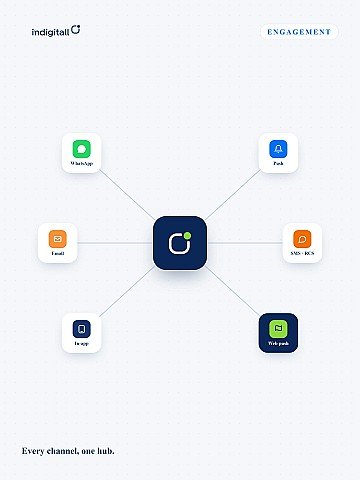
Think of it as the central nervous system for your brand’s digital ecosystem. It unifies disparate channels—from App Push Notifications and Web Push to WhatsApp Business and Mobile Wallet passes—into a single, cohesive console for creating meaningful conversations.
Crucially, a modern CEP in 2026 must handle both outbound marketing (like promotions and announcements) and inbound service (like support queries via AI Agents) seamlessly. It’s about building a continuous, two-way dialogue, not just one-way messaging.
The marketing technology landscape is crowded, and it’s easy to confuse a CEP with other critical platforms like a CRM or a CDP. Let’s clarify the distinct roles they play.
CEP vs. CRM: The System of Engagement
A Customer Relationship Management (CRM) system is fundamentally a system of record. Its primary job is to store static and historical data about your customers: who they are, their contact information, and their transaction history.
A CEP, in contrast, is the system of engagement. It is the action layer that uses the data stored in your CRM to actively and intelligently communicate with customers. If your CRM is the address book telling you who your customers are, the CEP is the entire communication suite that manages how, when, and where you talk to them.
CEP vs. CDP: The Orchestration Engine
A Customer Data Platform (CDP) specializes in data ingestion and unification. It pulls customer data from countless sources—analytics tools, point-of-sale systems, website behavior—to build a comprehensive, 360-degree view of each user and create powerful audience segments.
The CEP is the execution engine that activates this data. It takes the rich profiles and segments from a CDP to design and launch hyper-personalized, automated Customer Journeys across your entire omnichannel strategy.
This is where the lines are blurring for the better. While some organizations maintain separate systems, leading platforms like indigitall integrate powerful CDP-like capabilities directly into the engagement suite. This all-in-one approach simplifies your tech stack, reduces data silos, and empowers you to act on customer insights in real-time, all from the indigitall console.
Core Pillars of a True Unified Customer Engagement Platform
Today, the term “Customer Engagement Platform” is used frequently, but often inaccurately. Many customer engagement platforms are simply collections of disparate tools stitched together, creating data silos and operational friction. A true, unified CEP is built on an integrated foundation designed for seamless orchestration.
To deliver next-generation customer experiences, a platform must be built on several core pillars. These foundational components work in concert to transform fragmented interactions into cohesive, valuable conversations.
- Unified Customer Profile: The Single Source of Truth
- The bedrock of any effective engagement strategy is a comprehensive, 360-degree view of each customer. A unified CEP ingests data from every touchpoint—web browsing behavior, mobile app interactions, WhatsApp conversations, purchase history, and more—into a single, dynamic profile. This eliminates guesswork and ensures every interaction is informed by the customer’s complete history and current context.
- True Omnichannel Orchestration
- This goes far beyond simply supporting multiple channels. It’s about the intelligent orchestration of a single conversation across the entire digital ecosystem. With a platform like indigitall, you can create a Customer Journey that starts with a Web Push notification, follows up via WhatsApp Business, and delivers a personalized coupon directly to a user’s Mobile Wallet. This is the essence of a Global Omnichannel Strategy: meeting customers on their preferred channel at the perfect moment.
- Intelligent Automation & Journey Building
- Modern marketing teams need to move at the speed of the customer. A powerful, visual Customer Journey builder is non-negotiable. Within the indigitall console, marketers can drag-and-drop triggers, conditions, and actions to design sophisticated, automated workflows without writing a single line of code. This empowers teams to launch campaigns faster, from abandoned cart reminders to complex onboarding sequences.
- AI-Powered Personalization & Optimization
- Personalization today means more than just using a first name. A true CEP leverages AI to drive relevance at scale. This includes using generative AI to help craft compelling message variations, predictive analytics to identify users at risk of churn, and automated A/B/n testing to continuously optimize messaging, timing, and channel selection for maximum impact.
- Comprehensive Analytics & Reporting
- Data is only valuable if you can act on it. A unified platform provides a centralized analytics hub to measure performance across all channels and journeys. Instead of logging into multiple systems, teams can access holistic dashboards within the indigitall console to track KPIs, understand customer behavior, and prove ROI, connecting every marketing action directly to business outcomes.
These pillars are not a checklist of features; they are an interconnected ecosystem. Choosing an all-in-one solution ensures these components are natively integrated, allowing your team to focus on strategy and creativity, not on managing a complex and fragile tech stack.
Pillar 1: Unification of Inbound & Outbound Communication
For years, the digital engagement landscape has been fragmented. Companies were forced to operate with a split-brain approach, using separate platforms for different sides of the customer conversation. This is the fundamental challenge that indigitall was built to solve.
Traditionally, you have two distinct categories of tools:
- Outbound-focused Marketing Clouds: Platforms like Braze or Insider excel at pushing campaigns out to users via push notifications, email, and SMS. Their goal is to drive acquisition and conversion through proactive marketing.
- Inbound-focused Service Clouds: Tools like Zendesk are masters of reactive communication. They manage support tickets, inquiries, and customer service conversations, aiming to resolve issues efficiently.
The problem? These systems rarely talk to each other. This creates a dangerous blind spot in the Customer Journey. A marketing team, unaware that a customer just filed a complaint about a faulty product, might send them a cheerful “Buy one, get one free!” promotion. This isn’t just a missed opportunity; it’s a brand-damaging, tone-deaf interaction that erodes trust.
As we navigate the complexities of 2026, this siloed model is no longer viable. A true Customer Engagement Platform must act as the central nervous system for all interactions. indigitall unifies these inbound and outbound streams into a single, coherent conversation, providing a 360-degree view of the customer.
By breaking down these walls, brands using the indigitall console can orchestrate truly intelligent Customer Journeys. Imagine a user starting a support chat via a WhatsApp AI Agent (inbound), and based on the resolution, automatically receiving a personalized follow-up offer via a Push Notification (outbound) a day later. This is the power of a unified, Global Omnichannel Strategy, turning every touchpoint, whether service or marketing, into a cohesive and context-aware experience.
Pillar 2: Native, Deep Channel Integration (Especially WhatsApp)
In 2026, the term “omnichannel” is table stakes. Any platform can claim to send messages across a few channels. But the real transformation in customer engagement comes not from the breadth of channels, but from the depth of their integration. Surface-level connections create disjointed experiences; native integrations build a truly unified communication ecosystem.
This means moving beyond siloed tools and simple API pass-throughs. A deep, native integration ensures that data, context, and conversation history flow seamlessly between channels, all orchestrated from a single control center. This is the core of a powerful Global Omnichannel Strategy.
Nowhere is this more critical than with WhatsApp. Many platforms offer a simple “API wrapper,” which does little more than send a message. At indigitall, we’ve built a deep, native integration with the WhatsApp Business API, making it a first-class citizen within our platform. This provides the stability, scalability, and advanced features needed to move beyond simple notifications.
This foundational difference unlocks a spectrum of high-impact use cases, all managed within the indigitall console and often within a single, persistent WhatsApp conversation thread with your customer:
- Transactional Alerts: Go beyond basic SMS with rich, branded messages for order confirmations, shipping updates, and appointment reminders that users can directly reply to.
- Marketing & Promotions: Drive direct conversion with interactive product carousels, video showcases, and personalized offers sent to opted-in segments, complete with clear calls-to-action.
- Two-Way Customer Support: Deploy AI Agents for instant query resolution or seamlessly hand off conversations to human agents, maintaining full context and history within the same WhatsApp thread.
When your most critical channel is natively integrated, it becomes a powerful hub for the entire Customer Journey. It can act as a starting point for a conversation, a fallback for a non-delivered push notification, or a conversational follow-up to a web visit, demonstrating the power of a truly connected, all-in-one solution.
Pillar 3: Accessible AI for Smarter, Proactive Engagement
Artificial Intelligence is no longer a futuristic concept; it’s a foundational element of a competitive customer engagement strategy. However, many platforms treat AI as a complex add-on, requiring dedicated data science teams and lengthy integration projects to unlock its value.
We believe in a different approach: Accessible AI. The indigitall platform embeds powerful AI capabilities directly into the tools marketers and support teams use every day. This eliminates complexity and empowers your team to deploy sophisticated, data-driven tactics without writing a single line of code.
Instead of just providing data, our AI delivers actionable intelligence that enhances every Customer Journey. Here’s how our accessible AI transforms your engagement strategy:
- AI-Powered Predictive Sending: Our algorithm analyzes individual user behavior patterns to determine the absolute perfect moment to deliver a message. By sending a push notification or WhatsApp offer when a user is most likely to be active, you can dramatically boost open rates and drive immediate conversion.
- Generative Content Assistance: Overcome writer’s block and optimize your messaging directly within the indigitall console. Our AI helps you brainstorm compelling copy, suggest variations for A/B testing, and adapt your tone for different segments, ensuring your communication is always impactful.
- Intelligent Query Routing: For support and service channels, our AI instantly analyzes the intent of incoming messages. It can seamlessly route complex queries to the most qualified human agent or deploy a sophisticated AI Agent to provide instant, 24/7 resolutions for common issues, boosting efficiency and customer satisfaction.
By integrating AI into the core of our all-in-one solution, indigitall ensures that every part of your Global Omnichannel Strategy becomes smarter. This proactive intelligence allows you to move beyond reactive messaging and start anticipating customer needs, creating a truly personalized and seamless experience across every digital touchpoint.
Pillar 4: A Single, Actionable View of the Customer
Fragmented data is the biggest obstacle to meaningful engagement. A true Customer Engagement Platform dismantles data silos by creating a single source of truth for every customer: a unified, 360-degree profile that is both comprehensive and instantly actionable.
This isn’t just a static contact record. A unified customer profile is a living, dynamic entity that captures every interaction across your entire digital ecosystem. It aggregates data points from your app, website, CRM, and third-party systems, tracking behaviors, preferences, transaction history, and engagement with every channel, from Push Notifications to WhatsApp Business messages.
The power of this unified view lies in its ability to fuel dynamic segmentation. Instead of targeting broad, static lists based on demographics, you can create segments based on real-time actions. A user who abandons a shopping cart or browses a specific product category is automatically and instantly moved into a relevant segment, ready for a personalized follow-up.
This is the foundation of a Global Omnichannel Strategy. Every channel feeds intelligence back into the central profile. A click on a web push offer, an interaction with an AI Agent via WhatsApp, or the addition of a pass to a Mobile Wallet all become valuable data points that enrich your understanding and allow for more relevant, contextual communication in the future.
An all-in-one platform provides a critical advantage here. When your data collection, segmentation engine, and communication tools exist within the same environment, you eliminate the friction and delay between insight and action. With the indigitall console, you can move seamlessly from observing a customer behavior to launching a targeted Customer Journey without ever leaving the platform.
Ultimately, this single, actionable view transforms your customer data from a passive repository into the active engine that drives personalization, orchestrates sophisticated Customer Journeys, and maximizes customer lifetime value.
How to Choose the Right CEP for Your Business
Selecting a Customer Engagement Platform is a pivotal decision for your digital transformation strategy in 2026. The right partner acts as a growth accelerator, while the wrong one can lead to budget overruns, frustrated teams, and disjointed customer experiences. To cut through the noise, ask vendors these critical questions.
This evaluation checklist will help you look beyond surface-level features and assess which platform truly has the architecture to power your future growth.
- Does it truly unify inbound and outbound communication?
- Many platforms excel at sending messages out (outbound), but stumble when managing customer-initiated conversations (inbound). A truly unified CEP handles both seamlessly within a single ecosystem. This means an AI Agent on WhatsApp can resolve a query and trigger a follow-up Customer Journey without any disconnect.This unified approach ensures every interaction, whether started by you or your customer, enriches the same customer profile, providing crucial context for the next engagement.
- How deep are its key channel integrations (like WhatsApp)?
- Don’t settle for “we support WhatsApp.” Ask about the depth. A powerful integration goes beyond simple text notifications. It means full support for the WhatsApp Business API, including rich media, interactive buttons, product catalogs, and the ability to manage complex, two-way conversations.This principle applies across your Global Omn