Email marketing delivers one of the highest ROIs in digital marketing, but only when the messages are relevant, timely, and personalized. As inboxes get noisier and customer expectations rise, marketers are increasingly turning to AI-powered email subject line and content recommendation tools to enhance customer engagement, improve conversion rates, and foster long-term customer value.
This guide will show how AI is transforming every stage of email marketing, from subject lines and content to segmentation, testing, and performance analysis, so you can turn insight into measurable business impact.
Understanding AI in email subject lines and content optimization
Advanced email optimization with AI is not just automation. It is about augmenting human creativity and analytical capability with intelligent systems that learn from data to make better predictions and recommendations.
AI in email marketing refers to technologies such as machine learning, natural language processing, and predictive analytics that analyze customer data to tailor subject lines, content, timing, and segmentation for each subscriber. These systems reduce guesswork by using historical interactions and behavior patterns to anticipate what messaging will drive engagement and conversions.
Machine learning is a form of AI that detects patterns from large data sets and improves its recommendations over time without explicit programming.
Natural language processing enables computers to interpret and generate human language, which marketers use to optimize subject line wording and email copy based on tone, context, and audience preferences.
Predictive analytics uses historical and current data to forecast which content and send times are most likely to deliver responses for specific subscriber segments.
Together, these technologies have a measurable impact. Studies show AI-powered subject line tools can increase conversion rates by around 15 – 30%, while personalized subject lines can lift open rates by 41%, setting the foundation for higher downstream revenue.
H2: Step 1: Identifying and segmenting your target audience with AI
Audience segmentation is foundational to high‑performance email marketing. Without a relevant grouping of recipients, even the most thoughtful subject line and body content will fail to connect.
AI enhances segmentation by processing vast amounts of first‑party customer data, including browsing behavior, purchase history, engagement signals, and preferences. By detecting patterns that traditional manual segmentation might miss, AI enables marketers to create nuanced, dynamic segments that reflect actual customer intent and likelihood to engage.
Unlike static lists based on fixed demographic filters, AI‑driven segmentation continuously updates as new data flows in. This means that segments reflect current interests and behaviors, allowing marketers to target audiences at moments that matter most.
There are strong performance gains associated with this approach. Marketers report that AI‑enabled segmentation and personalization can significantly boost key outcomes such as open rates, click‑through rates, and conversion metrics compared with non‑personalized campaigns.
AI tools for automated segmentation and personalization
Below are platforms that excel at delivering AI‑enabled segmentation and personalization for email marketing:
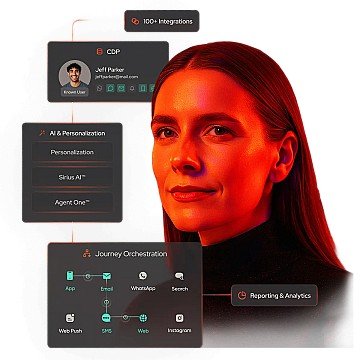
- Insider One: AI‑driven journey orchestration, dynamic segmentation at scale, and omnichannel personalization.
- HubSpot: Integrated CRM data with predictive engagement scoring and automated segmentation workflows.
- Klaviyo: Real‑time customer data segmentation tailored to ecommerce behavior.
- Omnisend: Ecommerce‑focused behavioral segmentation and personalized messaging automation.
By starting with effective AI segmentation, marketers lay the groundwork for subject line and content strategies that resonate more deeply with each audience segment.
Step 2: Choosing the right AI tools for email subject and content optimization
Selecting the right AI tools is important for turning data into measurable engagement and conversion gains. Not all platforms are the same. Some focus on predictive personalization and CRM integration, while others excel in content generation or subject line testing. To help you choose, this section compares leading AI‑powered email platforms by core capabilities, and the specific features marketers care about most.
What to look for in an AI email platform
At a high level, top AI email platforms today combine the following capabilities:
- AI subject line generator that produces high‑relevance headlines based on audience data and tested linguistic models.
- Content generation and suggestions that tailor body copy and calls to action to audience segments.
- Natural language processing (NLP) technology, which enables machines to understand, interpret, and generate human language in ways that align copy with user intent. NLP is essential for meaningful personalization rather than generic recommendations.
- CRM connectivity so that the AI has rich customer data to inform personalization and segmentation.
- Predictive analytics for send time optimization, engagement forecasting, and performance scoring.
Comparative overview of leading AI email platforms
| Platform | AI content generation | AI subject line generator | NLP-powered personalization | CRM integration | |
| Insider One | Yes (contextual content based on segments) | Yes | Behavior-based messaging & predictive journeys | Deep CRM and cross-channel data | |
| Omnisend | Yes (templates and content assistants) | Yes | Predictive workflows | Integrates with ecommerce CRM systems | |
| HubSpot AI | Yes (CRM-based content suggestions) | Yes | Personalized messaging from CRM data | Native CRM integration | |
| GetResponse | Yes (AI email and subject tools) | Yes | Basic automated personalization | Integrates with standard CRM workflows | |
| Klaviyo | Yes (predictive campaign AI) | Yes | Advanced behavioral segmentation | Strong ecommerce CRM links | |
| Braze | Yes (AI copy and triggers) | Yes | Richly personalized cross-channel journeys | Enterprise-grade CRM and CDP |
Step 3: Crafting personalized email subject lines and content using AI
Personalization is a proven driver of email engagement. Marketers who leverage AI to tailor subject lines and email content see significant gains in open rates, click-throughs, and conversions. AI enables teams to move beyond generic messages, delivering content aligned with each subscriber’s preferences, behavior, and engagement history.
How AI optimizes subject lines and content
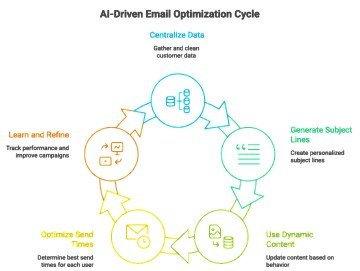
AI can dramatically improve the effectiveness of email subject lines and content by analyzing subscriber behavior and automatically generating, testing, and refining messages.
- Subject line generation: AI analyzes engagement data and linguistic patterns to suggest multiple subject line options optimized for open rates and relevance.
- Content suggestions: AI tools provide personalized copy recommendations tailored to each segment of your audience, ensuring messaging resonates with individual interests.
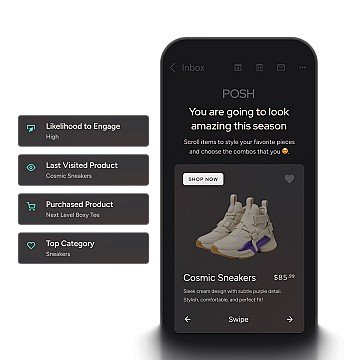
- Behavioral targeting: Automated systems can dynamically adjust email content based on subscriber interactions, such as past purchases, browsing behavior, or engagement history.
- Individualized recommendations: AI can customize product suggestions, calls-to-action, and content blocks for each subscriber, improving the likelihood of conversions.
These capabilities allow marketers to send emails that feel personal and timely, increasing both engagement and revenue without the need for manual optimization at scale.
Studies show personalized subject lines can increase open rates from 16.67% to 35.69%, representing roughly a 50% boost. Personalized content also improves click-through rates and drives higher conversions, making AI-powered personalization one of the most effective strategies for email marketing.
Take the next step: Platforms like Insider One combine AI-driven subject lines and content personalization with advanced analytics to help teams deliver highly relevant campaigns across all customer segments.
Step 4: Conducting AI-powered A/B testing for optimization
Data-driven decision-making is critical in email marketing. A/B testing, and its more advanced cousin, multivariate testing, allow teams to determine which messages perform best with their audience. AI accelerates this process by automatically generating, sending, and analyzing variants to optimize results faster.
What is A/B testing?
A/B testing in email marketing involves sending two variations of a subject line or content block to measure which performs better. AI-enhanced A/B testing expands this by:
- Generating multiple subject lines or content variations automatically
- Predicting which elements (keywords, length, tone) are likely to perform best
- Analyzing results in real time to inform the next iteration
Recommended workflow for AI-powered A/B testing
- Define goal metrics: Decide whether you are testing for open rates, click-throughs, or conversions.
- Generate variations: Use an AI tool to create multiple subject line or content variants.
- Segment audience: Split your email list randomly or according to behavior-based segments.
- Send and monitor: Deploy test emails and allow AI to track performance in real time.
- Analyze results: Let AI identify the highest-performing variant based on your chosen metrics.
- Refine and repeat: Apply the insights to future campaigns and iterate quickly.
This structured approach ensures that marketers maximize the impact of each campaign while continuously improving content relevance and engagement.
Step 5: Leveraging AI predictive analytics to optimize send times
Optimizing the timing of email sends makes campaigns more effective by increasing the likelihood that recipients open and interact with messages. Predictive analytics enables these timing decisions to be data‑driven and individualized by analyzing historical behavior data on when each subscriber is most likely to engage.
Predictive analytics uses algorithms to analyze user data and forecast the best time to send emails for each recipient. This goes beyond static “best practice” send windows and tailors delivery based on individual engagement patterns and preferences.
Many marketers now incorporate predictive send times into campaign workflows because it improves performance. For example, tools that leverage predictive analytics help brands ensure messages reach inboxes at the moments users are most receptive.
Real brand examples
- Remix: Increased first purchases by 104%
Remix used a behavior‑driven guided onboarding flow that adapted based on user actions after registration. This AI‑informed email journey helped the brand convert more first‑time users into buyers, driving a 104% increase in first purchases.
- All Nutrition: 12.67% of total revenue from automated email campaigns
All Nutrition launched personalized and automated email campaigns designed to re‑engage users and convert interest into purchases. These efforts resulted in 12.67% of total revenue attributed to email in just three months, with a strong lift in conversion rates compared to site averages.
- Riviera Maison: 4.6 X increase in email click‑through rates
Riviera Maison tailored messages to individual customer behavior and aligned send timing with engagement signals. This AI-informed approach helped the brand deliver more relevant, timely content, resulting in a 4.6 X increase in email click‑through rates compared with prior campaigns.