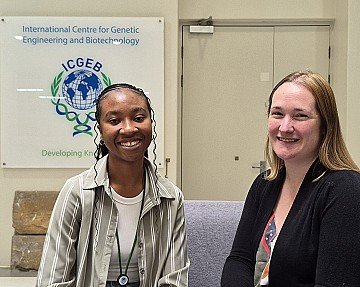
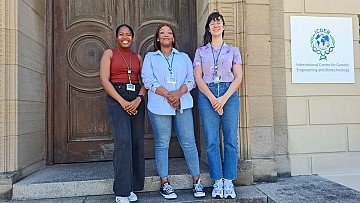
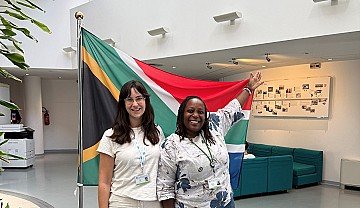
Mulalo Raphalalani and Jean Felistas Mapfumo Ntuli join Cape Town as the new SAWBP Doctoral fellows
Early 2026 sees ICGEB Cape Town welcoming two new Doctoral Fellows as part of the ICGEB South African Women in Biotechnology (SAWBP) Programme, in partnership with the South African Department of Science, Technology and Innovation.
Launched in 2022, the Programme is designed to widen participation in science fellowships for South African women in biotechnology, supporting PhD and Postdoctoral scientists to carry out research in the state-of-the-art labs at ICGEB Cape Town. A unique component of the Fellowships is that it also promotes the interaction and mobility of Fellows and the ICGEB community, including support to visit ICGEB Components in Trieste, Italy and New Delhi, India.
Congratulating the first cohort of SAWBP 2026 Doctoral Fellows, we hear about their current research as part of this proudly South African programme.
Jean Felistas Mapfumo Ntuli born in Zimbabwe, joins the ICGEB Cape Town Infectious Diseases Group from the University of Cape Town where she obtained a Bachelor of Science Honours degree and a Master of Science in Molecular and Cell Biology.
Jean’s research interests centre on the dynamic relationship between hosts and their pathogens. Her early work investigated WRKY transcription factors and the upregulation of the terpenoid phytoalexin biosynthesis pathway in maize in response to Cercospora zeina infection. She later transitioned into human virology, contributing to COVID-19 diagnostic testing during the pandemic. Most recently, she conducted research on HIV drug resistance analysis in a cohort of South African women.
As part of her SAWBP doctoral journey, her PhD research focuses on the impact of the host innate immune system on the establishment and persistence of the HIV-1 latent reservoir. She will investigate the effect of the host innate immune system on the establishment, persistence and sizing of the HIV1 latent reservoir. Her work aims to better understand how host immune responses may inadvertently facilitate HIV persistence after acquisition, and the implications for HIV cure strategies.
“I am honoured to join ICGEB, an international organisation committed to advancing scientific excellence in the Global South. I am excited to develop the skills needed to solve African scientific problems as an African scientist. This fellowship represents not only support, but a second chance to pursue my doctorate and grow into the medical virologist I aspire to become. Muzivi wenzira yepa ruware ndiye mufambi wayo. The only way to truly know a difficult road is to have walked it.”
Raphalalani Mulalo, born in a small village called Gondeni found in Limpopo, South Africa, completed her MSc in Microbiology at the University of Venda, thereafter, completing a one-year internship at the University of KwaZulu Natal offered by DIPLOMICS.
Joining the Virology: Emerging Viruses Group, her research interests are centred on viral genomics, immunogenetics and Drug discovery, particularly in exploring viral diversity and how this knowledge can be leveraged for the development of therapeutic agents. For her doctoral fellowship, her research is focused on establishing a protocol for characterising Kaposi`s sarcoma associated herpesvirus (KSHV) using Oxford Nanopore technologies (ONT), with the aim of understanding association between KSHV viral diversity and clinical outcomes.
“I am deeply honoured and excited to be a recipient of the ICGEB SAWBP fellowship. This fellowship presents an opportunity to be part of a platform that empowers scientists to contribute meaningfully to global scientific advancement while addressing health challenges that directly affect our communities.”