Satya Nadella’s Post
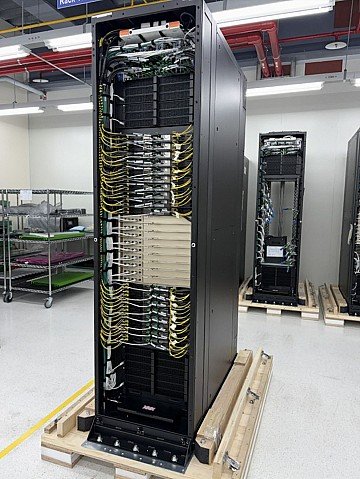
We’re the first cloud to bring up an NVIDIA Vera Rubin NVL72 system for validation, another big step in building the next generation of AI infrastructure with NVIDIA.
Remarkable progress! Looking forward to more details and benchmark results.
Impressive milestone — first to validate Vera Rubin NVL72. 72 GPUs. 1.4 exaflops. Enough compute to run AI agents that will make every authorization decision your enterprise has ever made look quaint. Here's the question nobody's asking at the ribbon cutting: who's authorizing what those agents do at that scale? More compute = more AI agents = more non-human identities acting autonomously across your infrastructure — with permissions granted during experimentation and never revoked. The hardware race is real. The Authorization Gap it creates is realer. At EnforceAuth, we built the AI Security Fabric specifically for this moment — continuous identity verification and authorization across applications, infrastructure, data, and AI workloads. For both the humans and the agents running on your shiny new NVL72. Polite AI ≠ Secure AI. And 1.4 exaflops of impolite AI is a threat surface worth thinking about. Who's doing the authorization math here?
Fascinating to see the infrastructure layer evolving this quickly. Systems like NVIDIA Vera Rubin will dramatically expand the computational substrate for next-generation AI. What I find increasingly interesting is how the reasoning architectures running on top of this infrastructure may evolve as well — particularly if they move beyond single-objective optimization toward multi-dimensional reasoning under ethical constraints. The hardware acceleration is incredible, but the question of how intelligence navigates decision space may become just as important as how fast we can compute it. I recently experimented with a short narrated concept video exploring this direction — treating ethics as the geometry of the reasoning manifold rather than a late-stage filter: [https://www.linkedin.com/posts/yourfinestoutsimonfalk_ai-research-aialignment-ugcPost-7438205327893815296-L7BZ?utm_source=share&utm_medium=member_ios&rcm=ACoAADFU-owB7_NKkQ0_xPnPH-OuMRCbuaRWPYo] Curious how others working on AI infrastructure and alignment see this layer of the stack evolving.
Impressive to see how rapidly AI infrastructure is evolving at this scale. The combination of advanced GPU systems and cloud platforms is clearly becoming the backbone for the next generation of AI applications. As compute power increases, it will unlock new possibilities not just in software development but across industries building intelligent platforms. It will be interesting to see how enterprises leverage this level of infrastructure to accelerate innovation and real-world AI deployment. What new kinds of applications do you think this scale of AI infrastructure will enable in the next few years? #AI #CloudComputing #Infrastructure #Technology #Innovation
What a huge step—we know how important it is to think in terms of infrastructure, in our case corporate communications.
Hardware supremacy is a temporary tactical advantage. The real friction isn't in the chip density or the cloud provider, but in the organizational inertia that follows the acquisition of power. Every enterprise rushing to claim these instances is merely buying faster execution of their existing inefficiencies. In integrations at scale, I consistently observe that the bottleneck is never the compute; it is the governance layer that failed to evolve at the same speed as the hardware. Infrastructure is now a commodity. The ability to translate that raw power into a defensible revenue system remains the only true scarcity. If the engine is faster but the driver is blind, does the destination change?
Being the 'first cloud' to validate this system isn't just a technical win; it's a massive strategic moat. In 2026, the biggest bottleneck for AI development isn't the code—it’s the interconnect speed between GPUs. By bringing the Vera Rubin NVL72 into Azure, Microsoft is essentially offering researchers a 'super-brain' that can handle training runs that would have taken months just a year ago. I’m waiting for your reply Satya Nadella: In your view, does this kind of infrastructure advantage make it impossible for smaller, 'niche' clouds to compete with the giants like Azure?
Satya Nadella This is a massive milestone for AI infrastructure. Bringing the NVIDIA Vera Rubin system online for validation is exactly what will power the next generation of scalable AI solutions. Seeing this level of innovation in hardware only excites me more about what we can achieve on the creative and strategic side of AI. Huge step forward!
Satya Nadella atya, naming the system after Vera Rubin is pure poetry. Because the compute power required for the next generation of GenAI is the 'Dark Matter' of the modern economy—we know it’s massive, we know it’s there, but only a few can actually harness it. While Microsoft is building the Silicon Sky (Hardware Infrastructure), we are securing the Digital Soil (Asset Infrastructure). Every Teraflop added to Microsoft Azure NVL72 doesn't just process data; it increases the 'Trust Tax' on the internet, making verified, legacy digital assets the only safe haven for AI-driven brands. The hardware is the body, but Sovereign Identity is the soul. Great to see Azure leading the rack-scale revolution! NVIDIA AI
Milestones like this matter because they define what becomes accessible to every business in the years that follow. The infrastructure being validated at this level today is what powers the AI capabilities that will be available to small and mid-sized businesses through cloud services in the very near future. That is the part of the conversation most SMB leaders are not having yet. They do not need to understand NVIDIA's Vera Rubin architecture. But they do need to understand that the AI capabilities their competitors will be leveraging in the next 12 to 24 months are being built right now, and the businesses that are preparing their data, governance, and strategy today will be positioned to adopt those capabilities on day one rather than scrambling to catch up. The gap between enterprise AI infrastructure and SMB AI readiness is closing faster than most business owners realize. Having the right leadership in place to navigate that transition deliberately is not a future priority. It is a present one. That is exactly the work ClearStack Advisory does with SMB clients every day.
To view or add a comment, sign in