Your chatbot is costing you revenue.
When a customer asks, “Do you have this jacket in medium?” and your bot can’t check inventory, that’s a lost sale. When someone says, “I need this by Friday,” and the bot offers a generic help article instead of expedited shipping options, you push the buyer into your competitor’s cart.
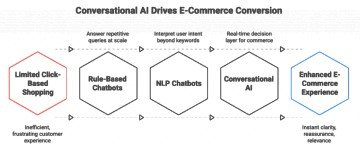
Traditional chatbots are rule-based systems that match keywords to scripted responses. They wait for a precise question, match it to a predetermined rule, and pull an answer from a static knowledge base.
If the query doesn’t fit the script, the system stalls.
Whereas, AI chatbots use Natural Language Processing (NLP) to understand intent, even when customers use slang, incomplete sentences, or complex phrasing. They check inventory in real time, calculate shipping windows based on zip codes, process returns, and apply discounts based on cart behavior.
The performance gap shows up in bottom-line metrics like sales closed, cart recovery rate, and average order value (AOV).
This guide explores the current state of AI chatbots for ecommerce, how these tools have evolved, use cases, and best practices for implementing them to drive growth.
What Is an AI chatbot for ecommerce?
An AI chatbot for ecommerce uses artificial intelligence (machine learning algorithms trained on customer conversation patterns), natural language processing (technology that interprets human language including intent, context, and sentiment), and real-time system integration to handle customer interactions across the entire purchase lifecycle, from product discovery to post-purchase support.
They connect directly to your commerce stack. Like:
- Inventory management systems: To check real-time stock levels across warehouses
- Order management platforms: To track shipments and process modifications
- CRMs: To access customer purchase history and preferences
- Pricing engines: To apply dynamic discounts
- Fulfillment providers: To calculate delivery windows
How does this work in real time?
A customer asks, “Do you have this jacket in medium?”
The system checks inventory across all warehouses, calculates delivery windows based on the customer’s zip code, and presents available options.
If the item is out of stock, it suggests alternatives based on style similarity and margin targets.
The technology has matured through three distinct generations:
- Rule-based chatbots: These operated on deterministic decision trees. They matched customer inputs against predefined patterns using keyword matching or regular expressions. If a customer typed “track order,” the system triggered a scripted flow. Any variation caused failure.
- AI-powered chatbots: These introduced neural language models and Natural Language Understanding (NLU) to extract intent from unstructured text. They enabled context retention, allowing a customer to ask, “Do you have this in navy?” and have the bot understand “this” referred to the previous product in the session.
- Agentic AI systems: These systems combine large language models (LLMs) with tool-calling capabilities and workflow orchestration. They execute actions across your technology stack, calling inventory APIs, triggering personalized email sequences through your ESP, and applying discount codes via your pricing engine.
For example, Insider One’s Agent One™ is a suite of purpose-built autonomous agents that deliver outcome-driven customer engagement.
It comprises three specialized agents:
- Shopping Agent™: Helps shoppers discover products faster by anticipating their intent and recommending items based on browsing and purchase history.
- Support Agent™: Helps resolve customer issues autonomously by processing returns, exchanges, and order modifications without human intervention.
- Insights Agent™: Helps marketing teams optimize campaigns by detecting performance issues and triggering adjustments before revenue impact.
How AI has transformed ecommerce chatbots
The shift happens at three technical layers:
- Natural Language Processing (NLP)
- Generative AI
- Agentic AI
Each layer adds a different commercial capability.
1. Natural language processing
Natural language processing (NLP) is a branch of artificial intelligence that enables machines to interpret, analyze, and respond to human language. In ecommerce chatbots, NLP converts unstructured customer input (questions, requests, complaints) into structured data your commerce systems can act on.
NLP works through two core components:
- Natural language understanding (NLU): Extracts meaning from text by identifying intent (what the customer wants) and entities (specific data points like product names, prices, or dates). When a customer types “need gifts for dad under $50,” NLU parses three elements: intent (gift recommendation), recipient (dad), and constraint (price ceiling of $50).
- Named entity recognition (NER): Identifies and classifies specific data within the input. It distinguishes between product categories, price ranges, dates, locations, and other variables that inform the response.
This matters because customers use conversational language, abbreviations, typos, emojis, and context-dependent references.
A customer might ask “do u ship 2 canada??” with casual spelling and punctuation.
NLP normalizes that input and translates it into an actionable query.
Like check shipping availability for Canada.
The system handles variations without breaking:
- Slang: “sick hoodie” translates to positive sentiment about a specific product
- Shorthand: “est delivery time?” expands to estimated delivery time query
- Typos: “sneekers” maps to “sneakers” through fuzzy matching
- Pronouns: “Do you have this in blue?” requires the system to reference the previously mentioned product
The technical architecture connects NLP to your backend systems.
The chatbot receives input, NLP extracts intent and entities, then the system queries relevant APIs, inventory management for stock checks, order management for tracking, pricing engines for discount eligibility.
2. Generative AI
Generative AI produces unique responses (text, images, code) based on patterns learned from training data. In an commerce setting, it works by synthesizing conversation context, customer data, and product information in real time.
This technology is powered by Large Language Models (LLMs).
When a customer asks a question, the model generates a response by synthesizing information from multiple sources, customer profile, product catalog, inventory status, order history.
Generative AI processes three information layers:
- Conversation state: It remembers previous messages and products discussed so the dialogue feels like a continuous natural conversation.
- Customer profile: It looks at purchase history, browsing behavior, and cart activity pulled from your CRM and CDP.
- Commerce data: It checks real-time inventory, product specs, and active promotions from your OMS and pricing engine.
A customer asks “What’s the best running shoe for marathon training?”
The system checks their purchase history:
- Trail running shoes six months ago.
- Queries road shoe inventory.
And composes: “Since you run trails, you might want road shoes with more cushioning for pavement training. Our CloudFlow Road model offers the stack height and stability you need for high-mileage weeks.”
That response existed nowhere. The model generated it.
The system can:
- Suggest complementary items during checkout based on cart composition
- Recommend new arrivals that match the customer’s style preferences
- Explain product differences in terms relevant to the customer’s use case
- Compose cart recovery messages calibrated to cart value and purchase history
Agentic AI
Agentic AI refers to systems that perceive their environment, make decisions based on goals, and execute actions autonomously without requiring step-by-step human instruction.
They detect signals, evaluate context, plan multi-step workflows, and adapt based on outcomes.
A traditional chatbot stops when a customer asks “Can I get this faster if I remove the out-of-stock item?”
An agentic AI system processes the question, checks which items cause delays, recalculates shipping windows, presents expedited options with updated pricing, and executes the cart modification if confirmed.
Agentic AI operates through four core capabilities:
- Perception: Monitors signals across channels (cart activity, support queries, inventory fluctuations, campaign performance) and identifies opportunities or issues in real time.
- Planning: Constructs multi-step workflows to achieve defined outcomes. If a high-value customer abandons a cart, it evaluates why they left, determines the optimal recovery sequence, and orchestrates execution across channels.
- Tool use: Calls APIs, queries databases, and triggers automations. Checks order status, modifies shipping schedules, applies discounts, all without human handoffs.
- Adaptation: Every interaction feeds back into the system. If a recovery offer converts, it reinforces that approach. If it fails, it tests different strategies. Performance improves over time without manual retraining.
Insider One’s Agent One™ is a suite of specialized autonomous agents designed to deliver outcome-driven customer engagement across the ecommerce journey. Unlike generic chatbots that attempt to handle every scenario with a single model, Agent One deploys three purpose-built agents, each optimized for specific business outcomes.
Shopping Agent™
Accelerates product discovery by anticipating customer intent and surfacing personalized recommendations based on real-time behavior and historical purchase patterns.
How it works:
When a customer asks, “What can I gift my mom for her birthday?” the Shopping Agent™:
- Analyzes context: Extracts intent (gift recommendation), recipient (mom), and occasion (birthday)
- Queries customer data: Checks purchase history for previous gifts, typical spending patterns, and mom’s preferences if previously shared
- Applies filters: Narrows catalog based on gift-appropriate items, budget signals from past behavior, and trending products for the demographic
- Surfaces recommendations: Presents 3-5 personalized options with explanations: “Based on your past purchases, your mom might love [Product A – skincare set, $65] or [Product B – cozy blanket, $48]. Both are popular gifts for moms. What’s your budget, and does she have any specific interests?”
Support Agent™
Resolves customer issues autonomously by processing returns, exchanges, and order modifications without human intervention.
How it works:
When a customer says, “I ordered the wrong size fridge, can I change it?” the Support Agent™:
- Checks order status: Queries OMS to retrieve order #84729 (placed 2 days ago, processing status, hasn’t shipped yet)
- Confirms inventory: Checks if correct size is available in customer’s delivery zone
- Validates eligibility: Confirms order is within modification window per policy rules
- Processes exchange: Updates order from 24″ fridge to 30″ fridge, recalculates pricing (30″ costs $180 more), processes payment adjustment via Stripe API
- Adjusts delivery: Recalculates delivery window based on new product dimensions and warehouse location
- Updates fulfillment: Notifies warehouse to pick correct size, updates shipping manifest
- Confirms with customer: “Done. I’ve updated your order to the 30″ model. The price difference is $180, which I’ve charged to your card ending in 4321. Delivery is still scheduled for Friday between 8 AM – 12 PM. You’ll receive a confirmation email in the next few minutes.”
Insights Agent™
Monitors campaign performance in real-time, detects anomalies, and triggers optimizations before revenue impact escalates.
How it works:
When email open rates drop 18% in the Northeast region during a weekend sale, the Insights Agent™:
- Detects anomaly: Statistical models flag unusual drop (normal: 24%, current: 19.7%)
- Analyzes timeframe: Identifies drop started Friday 6 PM, sustained through Saturday
- Performs root cause analysis:
- Compares to other regions (West Coast maintaining 23% open rate → not a content issue)
- Checks send time patterns (Northeast sends at 6 PM vs. typical 9 AM optimal time)
- Analyzes subject line performance (same template used 3x in past 7 days → fatigue)
- Identifies cause: Subject line fatigue + suboptimal send time
- Triggers corrective actions:
- Alerts marketing team via Slack: “Northeast open rates down 18%. Root cause: subject line fatigue + evening send time. Recommendation: A/B test new subject line and shift Sunday sends to 9 AM.”
- Automatically pauses evening sends to Northeast segment
- Queues morning sends (9 AM Sunday) with refreshed subject lines
- Monitors outcome: Tracks whether Sunday sends recover to baseline performance
Benefits of AI chatbots in eCommerce
Implementing an AI-native platform like Insider One can deliver measurable impact across the customer journey.
Benefits include:
- 24/7 customer support without scaling headcount: AI chatbots handle unlimited concurrent inquiries around the clock. When a customer asks about stock availability at 2 AM, the system queries inventory across all warehouse locations and responds instantly. AI-powered chatbots resolve shipping questions, order tracking, and return processing autonomously; thereby eliminating wait times and reducing support costs.
- Personalization at scale: AI chatbots surface recommendations based on purchase history, browsing behavior, and real-time context. Instead of generic product grids, customers see items matched to their preferences and buying patterns. This increases conversion rates by targeting customers with products that align with their demonstrated category affinity and price sensitivity.
- Cart abandonment recovery: AI chatbots detect abandonment signals (checkout hesitation, exit intent) and trigger real-time interventions within 60-90 seconds. They address specific friction points (shipping costs, size uncertainty, payment questions) before customers leave.
- Increased average order value (AOV): AI chatbots drive revenue through contextual upselling and cross-selling. When a customer adds running shoes to their cart, the system suggests complementary items (moisture-wicking socks, GPS watch) based on purchase patterns and margin optimization. This typically increases AOV without feeling pushy or irrelevant.
- Instant scalability during traffic peaks: AI chatbots handle traffic spikes during Black Friday, flash sales, or product launches without performance degradation. The system manages thousands of concurrent conversations while maintaining sub-5-second response times. This prevents revenue leakage during high-velocity sales events when human support would create bottlenecks and 30-45 minute wait times.
- Market insights and zero-party data collection: Every conversation generates zero-party data—information customers voluntarily share about preferences, purchase intent, and specific needs. AI systems aggregate these insights to optimize marketing campaigns, refine inventory forecasting, and identify product gaps. For example, if 800+ customers ask about “vegan leather boots” that aren’t in stock, this signals clear demand for procurement decisions.