Summary
AI decisioning selects the best message, channel, and timing in real time using predicted value, rules, and consent. Insider One unifies data, AI, and low-latency activation across 12+ channels. Decisioning chooses actions; automation executes them. Measure success via incremental revenue, plus constraint violations and latency for system health.
The distinction between AI decisioning, journey orchestration, and analytics is often blurred, and that confusion produces expensive tech stacks that still deliver generic experiences at scale.
AI decisioning is constrained optimization under uncertainty. The system evaluates a user’s eligibility, scores potential actions based on propensity and predicted value, applies business rules, and selects the single best action, in real time, not long after the moment has passed.
Journey automation forces users down rigid paths built in advance. Analytics looks backward at what already happened. Decisioning predicts what should happen next to maximize value across the entire lifecycle.
| Feature | Journey Automation | AI Decisioning | Journey Analytics |
| Core function | Execution of pre-set rules | Real-time optimization | Retrospective measurement |
| Timing | Trigger-based or scheduled | Real time or channel-appropriate | Post-campaign |
| Output | Sends a specific message | Selects the best message | Reports on performance |
| Logic | If/Then/Else branches | Propensity × Value − Cost | Aggregation & visualization |
Cross-channel marketing requires all three working together. Automation handles delivery logistics. Decisioning handles selection intelligence. Analytics closes the feedback loop.
Insider One is built as a single, native platform across all three layers, CDP, decisioning engine, and multi-channel activation, without middleware dependencies or stitched-together point solutions.
Why AI decisioning matters for lifecycle revenue
Consider a common scenario: your brand runs the same promotion across email, push, and paid social to the same user. You pay repeatedly to convert someone who would have bought anyway. Decisioning prevents that waste at every stage of the funnel.
- Margin protection: The system identifies users with high purchase intent and withholds discounts, serving brand content instead of promotional offers that erode long-term margin.
- Fatigue reduction: Centralized frequency caps prevent over-messaging regardless of which team owns which channel, reducing opt-outs and improving deliverability.
- CAC efficiency: When a user is active on email or app push, the system suppresses them from expensive paid audiences, improving ROAS immediately without manual exclusion lists.
- Speed-to-value: Insider One customers typically run a pilot use case within weeks of CDP data flowing, with full production deployment achievable in months, not the multi-year implementations common with legacy platforms.
How Insider One’s AI decisioning architecture works
A decisioning stack fails when any component is slow or disconnected. Stale data leads to wrong decisions. Missing constraints produce compliance risk. Slow activation misses the moment entirely. Insider One addresses all three gaps natively.
The architecture follows a continuous loop: Data Layer → Feature Store → Decision Engine → Policy Layer → Activation APIs → Measurement.
1. A warehouse-native data foundation
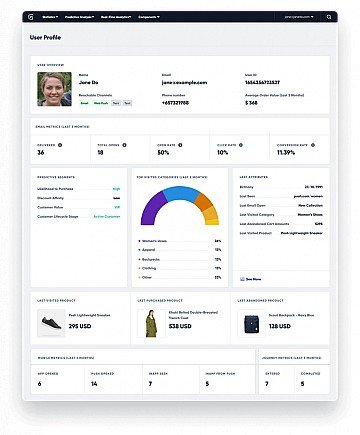
You cannot model what you cannot see. Decisioning requires a complete, unified view of user behavior: page views, product interactions, transactions, consent signals, and offline purchase events.
Insider One’s CDP (Unified Customer Data, or UCD) unifies data around stable identifiers, email, phone number, and device ID with deterministic identity resolution across devices. A search on mobile informs the offer served on desktop.
Critically, Insider One operates as a warehouse-native, composable CDP with bi-directional connectivity to Snowflake, Databricks, Google BigQuery, and Amazon Redshift. This means decisions run on complete profiles without requiring data duplication or bespoke ETL pipelines, a significant architectural advantage over platforms that require data to be copied into a proprietary silo before it can be activated.
Zero-copy segmentation allows teams to query their data warehouse directly using SQL to build audiences in Insider One without importing or duplicating data at all.
Consent signals propagate instantly. If a user opts out on the web, that signal blocks SMS outreach immediately, not on the next batch sync.
2. Sirius AI: The intelligence layer
Sirius AI is Insider One’s proprietary AI layer that powers decisioning, content generation, and agent behavior across the platform. It is not a bolted-on LLM integration, it is embedded into the core decisioning loop.
- AI Analytics Assistant: Explains Architect journey analytics in plain language and surfaces optimization recommendations without requiring data team involvement.
- Email Template Generation: Generates brand-aligned email templates based on campaign goals, audience context, and historical performance, reducing time-to-launch and maintaining design consistency at scale.
- UCD-Driven Agent Personalization: Uses behavioral, contextual, and historical data from UCD to continuously train and refine agent behavior, improving intent signal interpretation and decision quality over time.
- AI-Powered Topic Insights: Automatically identifies conversation topic clusters and tracks real-time agent resolution rates, surfacing opportunities without manual analysis.
3. Score eligibility and apply constraints
The system distinguishes between hard and soft constraints before any ranking takes place:
- Hard constraints: Legal requirements, consent status, suppression lists, evaluated first, non-negotiable.
- Soft constraints: Frequency caps, budget limits, channel preferences, applied after hard constraints pass.
Teams that reverse this order risk compliance errors and waste compute resources on users who should never have entered the decision flow. Insider One’s Architect orchestration engine allows teams to define these constraints using policy-as-code without requiring engineering tickets, a significant operational efficiency for enterprise teams.
Enterprise governance is further supported by Campaign Approval Workflows with role-based permissions, configurable approval chains, real-time notifications, and compliance audit trails. For brands operating in regulated industries, financial services, telco, and healthcare-adjacent, the constraint layer provides the specific controls these environments require: real-time consent propagation, suppression timing that meets regulatory windows, and offer eligibility rules that enforce themselves automatically rather than relying on campaign manager oversight.
4. Rank offers and channels
Once constraints filter the eligible set, the ranker scores what remains using expected value logic: EV = Probability of Conversion × Value − Cost.
Pure exploitation always selects the highest-EV option; it starves the system of new learning. Insider One uses contextual bandit algorithms to allocate a portion of traffic to explore underexposed offers, ensuring models adapt to shifting preferences without sacrificing short-term revenue.
Channel ranking follows the same logic: predicted response rate × channel cost, prioritizing owned channels (email, push, SMS, app) before paid media activation.
5. Trigger actions at channel-appropriate speed
Latency requirements differ significantly by channel. Insider One’s decision APIs are designed to match the moment, not miss it.
| Channel | Latency Target | Fallback if Missed |
| Web personalization | Very low latency | Default content |
| Push notification | Seconds-level | Queue for next window |
| In-app / conversational agent | Real-time (session-active) | Deferred push or email |
| Batch-tolerant | Include in next send | |
| Paid audience sync | Periodic | Exclude from segment |
Every decision API includes a fallback policy. If the model times out or returns an error, the system defaults to a safe, non-promotional action rather than picking randomly. This is especially important in high-traffic web personalization scenarios where latency directly affects conversion.
Real-time activation is supported across: Web, Push, Email, SMS, WhatsApp, In-App, Instagram (via AI Agent), RCS, and TikTok
Agent One: Conversational commerce as a decisioning channel
The 2025–2026 shift in cross-channel marketing is the emergence of AI agents as first-class engagement channels. Insider One’s Agent One layer extends decisioning beyond message selection into real-time, multi-turn conversations within the channels customers already use.
Instagram AI agent
Converts every Instagram ad click into a personalized shopping conversation within the Instagram app. The agent interprets open-ended messages, uncovers purchase intent, makes tailored product recommendations, and guides users toward conversion without pushing them to an external site. This keeps the entire sales journey inside Instagram, reducing friction and improving click-to-purchase rates from paid ad spend.
WhatsApp AI shopping agent
Delivers a frictionless shopping experience on WhatsApp, with a discovery process that mirrors the web experience. Powered by the Insider One product catalog, the same one used for web recommendations, the agent provides real-time, accurate product data and supports the full discovery-to-purchase flow within the messaging thread.
AI agent support in architect journeys
AI Agents are being integrated as a channel within Architect journeys. If a user abandons a conversation, Architect can automatically activate any of 12+ channels: SMS, email, push, to re-engage with abandoned product reminders or contextual follow-ups. Conversations continue seamlessly beyond the initial chat.
AI agent memory
Once a customer is identified through UCD, Agent One will retain conversation history across channels (Web and WhatsApp). Users will not need to repeat themselves across sessions, enabling truly continuous relationships rather than isolated interactions.
AI voice agent
Voice as a channel will be supported through Insider One’s Voice Agent, with knowledge base upload, voice chat initiation, and seamless handover between chat, voice, and human agents.
Why this matters for decisioning
Traditional decisioning selects a message and fires it into a channel. Agentic decisioning selects a conversation strategy and adapts in real time based on what the user says next. This is a fundamentally different — and more valuable, form of personalization. Insider One’s native integration of Agent One with the CDP, Sirius AI, and Architect means agent behavior is informed by the same unified customer profile that drives every other channel decision.
Insider MCP server: AI-native platform architecture
Enterprise AI stacks in 2025–2026 are no longer single platforms, they are orchestration layers connecting multiple AI systems. Insider One is built to participate in that architecture, not sit outside it.
The Insider One MCP (Model Context Protocol) Server is a live capability that positions Insider One as natively compatible with enterprise AI orchestration frameworks. Through MCP, external AI agents and internal Sirius AI systems interact with raw campaign performance data and analytics functions with accuracy and control.
This means Insider One can serve as both the engagement platform and the analytics interface for broader AI stacks, enabling smarter orchestration decisions, more autonomous optimization, and scalable personalization without increasing operational complexity. For enterprise buyers evaluating AI-native marketing infrastructure, MCP compatibility is now a standard technical requirement in RFPs, not a differentiator to overlook.
AI decisioning use cases that drive revenue
Each use case follows a consistent structure: Trigger → Eligibility → Ranking → Channel Sequence → Constraints → Success Metric. This structure helps teams replicate the logic rather than copy tactics.
Drive upgrades without over-discounting
Blanket discount offers train users to wait for promotions, destroying long-term margin. A decisioning engine scores users on upgrade propensity and price sensitivity simultaneously.
- High propensity + low price sensitivity: Value-focused messaging highlighting features, no discount needed.
- High propensity + high price sensitivity: Capped discount offer, within defined margin thresholds.
- Low propensity: Suppressed entirely — no wasted send.
Constraint: Suppress upgrade offers for any user who upgraded within the recent suppression window.
Win back churned users with budget guardrails
Treating all churned users equally wastes spend. Score predicted LTV post-reactivation and set a per-user budget cap tied to that LTV. Sequence owned channels first (email, push), activating paid media only if owned channels fail after a defined number of touches.
Low-LTV users below a defined threshold are suppressed from paid channels entirely, a rule enforced automatically by the constraint layer, not manually maintained lists. If no engagement occurs after repeated attempts, suppress the user for a cooling-off period. Want ready-to-use case patterns you can adapt quickly? Start in the product demo hub and skip the theory.
Intercept cancellations in real-time
Save offers that arrive via email long after a cancellation has been submitted are useless. Insider One triggers intervention at the moment of intent: entering the cancellation flow, submitting a support ticket with ‘cancel’ keywords, or a churn-risk score crossing a critical threshold.
Channel selection depends on latency and context: an in-app modal if the user is session-active, a push notification if they are mobile-first, or email if batching is acceptable. Limit save offers to an infrequent cadence per user to prevent gaming.
Personalize renewal timing and offers by account health
Sending renewal reminders uniformly far in advance ignores context. Score account health based on usage frequency, support history, and feature adoption. High-health accounts receive an early renewal nudge with an upsell option. Low-health accounts receive a retention-focused message addressing value gaps before any ask for money.
Constraint: Suppress renewal messaging during active support escalations, a rule that requires real-time propagation of support ticket data into the decision engine.
A user clicks an Instagram ad for a product. Instead