According to Deputy Director of ILGA-Europe, Katrin Hugendubel: “Spain’s number one ranking is a strong example of what becomes possible when a government makes a deliberate choice to advance equality rather than retreat from it. We see this same spirit in leaders like Zohran Mamdani in New York, who are refusing to bow to the authoritarian pressure of this moment and choosing instead to stand with their communities. Of course more needs to be done in Spain, but this is a reminder that political courage is a choice, and that governments who make it can effectively push back.”
Executive summary
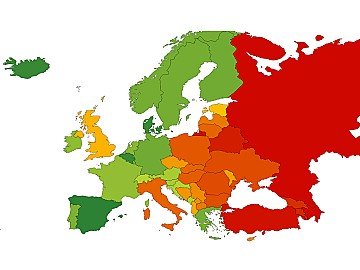
The Rainbow Map, ILGA-Europe’s annual benchmarking tool, ranks European countries on their respective legal and policy practices for LGBTI people, from 0-100%.
Produced since 2009, the Rainbow Map sets standards for laws and policies that have direct impact on the human rights of LGBTI people.
ILGA-Europe examine laws and policies in 49 countries using 76 criteria, divided between seven thematic categories: equality and non-discrimination; family; hate crime and hate speech; legal gender recognition; intersex bodily integrity; civil society space; and asylum. The 76 criteria under seven categories make up 100 points in total and they are attributed different weights based on international human rights standards and the LGBTI movement’s priorities.
ILGA-Europe collect and verify a complex set of legal data, through a consultation process involving our member organisations and more than 200 country experts across 49 countries. You can go ‘behind’ the points and see original information sources, download data sets and visuals, and compare countries on our interactive website.
- Spain reaches the top of the ranking for the first time, replacing Malta after 10 years in the lead.
- Sweden moves up three places and takes the 9th spot in the ranking.
- The average score for Europe is 43%, while the average EU score is 52%.
- Belarus drops one place in the ranking and is now 46th out of 49 countries.
- Russia has been at the bottom of the ranking since 2024.
- Romania drops one place and is now 42th out of 49 countries, remaining as the EU country with the lowest score.
Ranking
- Spain 89%
- Malta 88%
- Iceland 86%
- Belgium 85%
- Denmark 85%
- Finland 70%
- Germany 70%
- Norway 69%
- Sweden 68%
- Luxembourg 68%
- Greece 68%
- Portugal 67%
- Netherlands 64%
- Ireland 61%
- France 60%
- Austria 55%
- Slovenia 54%
- Montenegro 53%
- Croatia 51%
- Switzerland 50%
- Estonia 46%
- United Kingdom 44%
- Andorra 43%
- Albania 41%
- Moldova 38%
- Czechia 37%
- Bosnia & Herzegovina 37%
- Kosovo 35%
- Serbia 34%
- Cyprus 34%
- Liechtenstein 31%
- Latvia 30%
- North Macedonia 29%
- San Marino 29%
- Slovakia 25%
- Italy 24%
- Lithuania 24%
- Hungary 23%
- Poland 22%
- Bulgaria 20%
- Ukraine 19%
- Romania 19%
- Monaco 14%
- Georgia 12%
- Armenia 9%
- Belarus 7%
- Turkey 5%
- Azerbaijan 2%
- Russia 2%
Country summaries
Spain tops the ranking for the first time, moving up four places with a score of 89%, gaining 11 points this year. The government has followed through on its commitments set out in the 2023 LGBTI and trans laws and the 2022 law for equal treatment and non-discrimination by adopting equality action plans for LGBTI and trans rights, establishing an independent authority for equal treatment, and fully implementing the depathologisation of trans people in the healthcare system. Following federal reforms in 2023, the number of regions with LGBTI protections rose to 15 out of 17. Some regional governments attempted to roll back these protections but were blocked by the national government on the grounds of constitutional rights violations.
Malta drops one place to 2nd in the ranking with a score of 88%. While the slide in the ranking is technically due to Spain’s rise, it also reflects Malta’s stagnation and lack of continuous reform. The country still lacks a comprehensive anti-discrimination framework, which could be addressed through the Equality Bill that was tabled in 2019 and has been stalled since.
Iceland retains the 3rd place in the ranking, but gains two points, resulting in a total score of 86%. The government renewed its equality action plan, reaffirming its commitment to legal progress. Some measures set in the action plan have started being implemented, such as a training framework for asylum caseworkers in cooperation with the LGBTI organisation.
Belgium retains its score of 85% but falls to forth in the ranking, due to Spain’s rise. This shift highlights Belgium’s stagnation and the government’s lack of action.
Denmark gains five points and gets a 85% score in total, sliding to 5th in the ranking, due to Spain’s rise. The country gained points after depathologisation of trans identities in the healthcare system was fully established. The government renewed its equality action plan, signaling a commitment to continued progress in the coming years.
Finland holds 6th place in the ranking with a score of 70%, maintaining the same score and ranking as last year, reflecting a period of stagnation. A citizens’ initiative successfully collected enough signatures calling for a ban on conversion practices; however, the government has yet to take the necessary legislative action in response to this demand.
Germany scores 70% and moves up one place to 7th in the ranking, solely due to Greece’s drop. The federal government announced the completion of its equality action plan, although many measures have yet to be implemented. Several ministers have stated they will not adopt a new action plan.
Norway retains a score of 69% but moves up one place to 8th in the ranking, solely due to Greece’s fall. The country has not advanced on legal protections since 2021, when amendments to the Criminal Code introduced protections on gender identity.
Sweden moves up three places to 9th in the ranking with a score of 68%. The country’s new legal gender recognition law came into effect, simplifying procedures and removing the medical intervention requirement for anyone over 16, but fell short of introducing self-determination and keeping pathologisation of trans identities. New blood donation rules removed blanket bans on specific groups.
Luxembourg retains 10th place in the ranking with a score of 68%. In July 2025, Yuriko Backes, Minister for Gender Equality and Diversity, presented the updated National LGBTI Action Plan (PAN LGBTIQ+). The new plan does not include the depathologisation of trans identities, maintaining the requirement for trans people to obtain a psychiatric certificate to begin their transition process.
Greece drops four places to 11th in the ranking, scoring 68%. The Council of State overturned a 2022 Health Ministry decision that had lifted a ban on blood donations by gay men, citing inadequate justification of the ministerial decision. As a consequence, the blood donation ban has been reintroduced. On a positive note, the Council of State also ruled that the recognition of same-sex marriage and the right to adoption for married same-sex couples are constitutional.
Portugal drops one place to 12th with a score of 67%. The country has not passed any affirmative legislation since the 2024 conversion practices ban, while a new draft bill threatens to jeopardise existing protections, including legal gender recognition based on self-determination and the ban on forced medical interventions on intersex children.
The Netherlands retains 13th place in the ranking with a score of 64%. The government renewed its Equality Action Plan in June 2025, which will need to be implemented and monitored by the new government for future advancement. A new legislative proposal aims to add the Dutch term “geslacht”, which encompasses gender identity, gender expression and sex characteristics, to the criminal code; however, the law has not yet been debated by parliament, and it remains unclear when this will happen. Similarly, the draft bill on legal gender recognition based on self-determination has been stalled since 2021. Following elections, a majority of parties requested in December that the bill be reissued, though this had not yet happened at the time of reporting
Ireland maintains 14th place in the ranking but loses two points. ILGA-Europe were alerted by Irish civil society organisations to the impact of the Electoral Act, which prohibits international funding for campaigning or advocacy work influencing public policy. On a positive note, the Irish government adopted a new LGBTI inclusion strategy and an associated action plan, reflecting the authorities’ commitment, which will need to be put into practice in the coming years.
France retains 15th place in the ranking but loses one point, bringing its score to 60%, due to the government’s failure to properly implement its equality action plan and administrative obstacles faced by trans people seeking to change their name on identity documents. At the same time, the country gained points because the national equality body mandate (Défenseur des droits) showed systematic work on tackling discrimination on sex characteristics.
Austria maintains 16th place in the ranking while raising its score to 55%. Following a Constitutional Court decision, the Ministry of the Interior issued a new directive on civil registry, allowing non-binary people to choose from four gender markers. A parliamentary proposal to ban conversion practices remains stalled due to obstruction by the conservative party.
Slovenia retains 17th place in the ranking but gains four points, reaching a score of 54%. Before elections, the National Assembly adopted amendments to the Act on Infertility Treatment and Biomedically Assisted Fertilisation Procedures, revoking the ban on single women and women in same-sex relationships accessing fertility treatments. This followed a Constitutional Court decision requiring the government to revoke the exclusion in the act.
Montenegro moves up one place to 18th with a score of 53%. The Chief State Prosecutor’s new binding instructions for all state prosecutors on handling cases of hate crime and hate speech have created new policies tackling hatred. However, the government failed to renew the equality action plan. Although same-sex partnerships were legalised in 2020, the rights of same-sex couples are still limited. The legal gender recognition reform has also stalled, while administrative procedures for trans minors’ access to legal gender recognition have been reported to be worsening.
Croatia moves up one place to 19th in the ranking with a score of 51%. Legal gender recognition and name change procedures for trans people have been improved administratively, but still require abusive conditions such as psychological and psychiatric assessments and medical interventions. The country has lost more than 16 points over the past 10 years, reflecting a sharp decline in progress.
Switzerland drops two places to 20th in the ranking but retaining a score of 50%. While the drop is technically due to Montenegro’s and Croatia’s rise, it also reflects Switzerland’s stagnation since 2023, when the Office for Gender Equality was established with an equality body mandate.
Estonia retains the 21st place in the ranking with a score of 46%. The government launched a new equality action plan that will need to be followed by implementation and monitoring in the coming years. ILGA-Europe became aware of administrative obstacles affecting trans minors’ access to legal gender recognition procedures, even though the law stipulates no age restriction.
The United Kingdom retains 22nd place in the ranking with a score of 44%, two points less than last year. Drawing on last year’s Supreme Court decision on the definition of women and sex, a High Court ruled that trans men cannot be automatically registered as a parent of their children, causing the country to lose its point on automatic co-parent recognition.
Andorra remains 23rd in the ranking with a score of 43%, signaling a broader stagnation.
Albania moves two places up in the ranking, rising to the 24th spot with a 41% score. Albania passed a new Law on Gender Equality, specifying that less favourable treatment based on gender, gender identity, gender expression, and sexual orientation constitutes gender-based discrimination. At the same time, the Law on Protection from Discrimination was amended to strengthen protections and broaden the scope of areas covered. A referendum planned for later this year threatens to repeal the new gender equality law, which its opponents have characterised as an attack on traditional family values.
Moldova keeps its 25th place on the ranking with the same 38% score. There has been no legal advancement since the amendments to the law on ensuring equality in 2022. Although the Moldova Pride March went ahead, the Municipal Council attempted to prohibit it.
Czechia moves four places up to 26th on the ranking by gaining four points. Following Constitutional Court and ECHR judgements, the Ministry of Health issued a new methodology allowing legal gender recognition without requiring surgery or hormonal treatment. Czechia was the last EU country that legally required forced sterilisation for trans people.
Bosnia & Herzegovina drops three places to 27th in the ranking, losing three points. The federal government failed to launch a renewed action plan or extend the previous one. In May 2025, the Constitutional Court of Bosnia and Herzegovina suspended ab initio Republika Srpska’s so-called “Foreign Agent Law” and ordered that it cease to be in effect.
Kosovo maintains 28th place in the ranking with a score of 35%. The country has shown no advancement since 2020, reflecting serious stagnation and government inaction. The draft Civil Code has yet to be adopted, and reforms for legal gender recognition and civil partnerships remain stalled.
Serbia drops two places to 29th in the ranking with a score of 34%, losing one point due to inadequate protection of Pride events in smaller cities. While Belgrade Pride has been held without state obstruction since the 2022 EuroPride ban, police unlawfully banned the Pride event in the city of Kruševac. The country has not passed any affirmative legislation since 2021, when sex characteristics were included as a protected ground in the anti-discrimination legislation. Several reforms have been stalled, including legal gender recognition and the recognition of same-sex partnerships.
Cyprus maintains a score of 34% but drops one place to 30th due to Croatia’s rise. Legal gender recognition reform has been stalled since 2019, and demands for marriage equality and equal adoption rights have similarly been blocked, reflecting an ongoing stagnation in legal progress. The government is reported to be drafting an LGBTQIA+ National Strategy.
Liechtenstein moves up one place to 31st with a score of 31%, following the National Human Rights Organisation’s demonstrated systematic work on equality matters relating to sexual orientation, gender identity, and sex characteristics.
Latvia moves two places up to 32nd in the ranking with a 30% score by gaining four points. Legal gender recognition procedures have become more accessible in the administrative system.
North Macedonia dropped two places to 33rd in the ranking, keeping the same 29% score, that shows the stagnation since 2021. The legal reforms for civil partnerships and legal gender recognition have been stalled.
San Marino recorded the biggest rise in the ranking, moving up eight places to 34th with a score of 29%. This advancement is largely attributable to the country’s first LGBTI organisation, 121 Association, organising public events that demonstrated the protection of freedom of assembly. Through consultations with 121 Association, ILGA-Europe was able to examine laws and policies and allocated new points for hate crime and hate speech protections on gender identity, medically assisted insemination for couples and singles, and name change procedures for trans people.
Slovakia drops two places to 35th with a score of 25%, due to the impact of constitutional amendments that formally recognised only “two sexes”, restricted adoption rights exclusively to married heterosexual couples, and undermined the supremacy of EU law. As a result, legal gender recognition procedures have become impossible and trans people can no longer change their gender markers.
Italy drops one place to 36th in the ranking with a score of 24%. The national government continues to actively block legal and administrative protections put in place by regional governments and local courts. Meanwhile, the new security law, with its restrictive provisions on demonstrations, brings new risks for freedom of assembly, including for LGBTI public events.
Lithuania drops one place to 37th but maintains its score of 24%. The country’s long-term stagnation risks regression, with a planned referendum on amending the constitution to include a clause stating that “family legal relations arise only from the marriage of a man and a woman, motherhood and fatherhood.” The planned referendum goes against the direction of the recent court decisions. In April 2025, the Constitutional Court delivered a landmark decision, declaring that legal regulations related to civil partnerships violate the country’s constitution. In August 2025, a Vilnius district court officially recognised a same-sex couple’s partnership for the first time. The couple’s partnership is recognised but not implemented. Lithuania’s parliament has still not passed comprehensive partnership legislation.
Hungary drops one place to 38th in the ranking, maintaining a score of 27%. In last year’s edition, Hungary fell seven places following the first Pride ban in the European Union and the removal of legal protections on gender identity. In April 2026, the Court of Justice of the European Union ruled that the “anti-LGBTI propaganda” law, which had been used to criminalise Pride and its organisers, violated fundamental rights and EU values. The new government must comply with the court’s verdict and repeal the laws and amendments that restricted the rights of LGBTI people.
Poland retains 39th place in the ranking, gaining one point to reach a score of 22%, the third lowest among EU member states, just above Bulgaria (40th) a