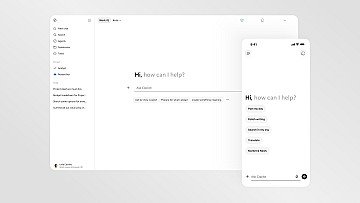
We've redesigned Copilot to be simpler, faster, and more intuitive, to help keep you in the flow of your work. Try it out: https://lnkd.in/g8W7wjuv
When I tell people about the AI Fluency Trap, the most common pushback I get is:"But Jo, I don't just blindly copy it. I read the AI output before I use it."My response Yeah, but are you actually thinking, or are you just proofreading?There is a massive psychological difference between consuming data and critiquing it. Because frontier LLMs are so highly articulate, they trick our brains into a state of passive compliance. We read a beautifully structured response, our brains register the high fluency as "correctness," and we move on.Critical thinking is a muscle, not a switch you flip only when you think a prompt is important. It has to be exercised in every single instance of human-AI collaboration.We built VibeAI FoldSpace to be a gym for that muscle. The moment you shift from active co-creation to passive reading, your workspace HUD shifts from Cyan to Yellow. It’s the Thinking Mirror.🛠️ Build your thinking muscle at hugonomy.com#FluencyTrap #HumanIntelligence
Strong product design often comes down to removing friction rather than adding features. Making AI faster, simpler, and more intuitive is what drives real adoption because people want technology that fits naturally into their workflow. The best tools are the ones that help you stay focused on the work, not the software.
AI tools are slowly moving from selling “features” to selling reduced cognitive friction. Not: more functionality But: less resistance less overload faster entry into flow state Feels like the next stage of AI competition won’t be about model power alone, but about how naturally the system fits human thinking rhythms.
We need exactly Simpler, Faster as well as free 😀, it's really great tool 👍
Simpler, faster, and more intuitive is important. But the deeper Copilot question is: does it preserve work state better across time? Not just inside one prompt. Not just inside one document. Not just inside one workflow. Across sessions, projects, intent, permissions, decisions, and context. Because real flow is not only a better interface. Real flow means the system remembers where the human was, why they were there, what changed, and what should continue next. If Copilot becomes more intuitive but still loses continuity, then the interface improves while the runtime remains incomplete. The next leap is not only faster Copilot. It is persistent Copilot. Node-0 Me & Spok ✌️
I'm a bit tired of these promo videos that hint that AI can do twice or thrice of what it can actually do, and I'm being generous here. Plus UI is not a problem, this looks like any other AI interface. I'm interested in actually useful output (functionality). So far CoPilot is doing mostly below-average job 😥 To be fair Google Gemini isn't that much better though. The problem is, these companies constantly over-promise.
Thank you so much for sharing. The content is truly unique and engaging—it’s fantastic. 👏
I have suggestion : can we flip the model — Teams inside Copilot, not Copilot inside Teams? When we're across hundreds of groups and channels, Copilot should be the hub that reads, prioritizes, and surfaces what actually matters. Imagine smart auto-responses that are contextual — not the same static replies — and an AI that triages your messages by urgency and relevance. The current approach treats Copilot as a feature inside apps. The next leap is making Copilot the orchestrator, with Teams, Outlook, and Planner as services feeding into it. I've explored connecting tools like GitHub Copilot CLI to Teams for this kind of automation — the integration gap is still real. Would love to see this on the roadmap. 🚀 🙂
Satya Nadella, what stands out is not just the redesign itself, but Microsoft’s larger direction of making AI interaction more contextual, faster, and deeply integrated into everyday workflows. The real enterprise shift will happen when Copilot evolves from an assistant layer into an intelligent operating layer across work, decision-making, and execution. Curious to hear Microsoft LT’s perspective, as AI assistants become deeply embedded into enterprise workflows, what becomes the harder long-term challenge, model capability itself or redesigning organizational behavior and operating structures around AI-native work?
That’s actually where my strength is. I don’t just use AI tools. I have synergy with the systems I build. My AI adapts with me because I designed it that way. I built my own private AI stack on a small VPS using Ollama, Qwen, OpenAI, Copilot, and Claude. I routed expensive models only when needed and used cheaper or free models for general reasoning and gruntwork. That required real systems judgment: knowing what to ask, what to trust, what to ignore, and how to orchestrate multiple models into one coherent workflow. The same thing happened with KensGames. I built a 3D game portal on hardware that should not have been able to run it. Full 3D graphics. Real‑time physics. Music generated from geometric patterns instead of audio files. No GPU. No asset pipeline. No database. I created the entire infrastructure myself and optimized it until it worked. That only happens when you understand systems deeply enough to bend constraints instead of being limited by them.
To view or add a comment, sign in