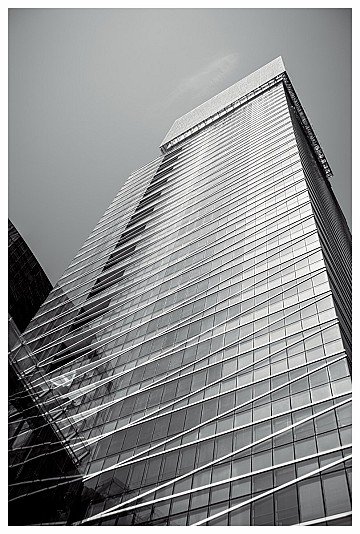
A first Spring heat wave had barely released its grip on France when 19 American and French students arrived in Paris to begin their nine-week program. A second one is sweeping the country today, at the date of this piece’s publication. Between those two moments of climate fluctuation, the students sat with one of France’s most prominent CEOs and learned how the construction industry is responding—and adapting—to a more volatile climate.
For the participants of the Villa Albertine’s annual Summer Academy in Architecture and Urban Studies, the timing could hardly have been more apt.
The great thing about being an architect is the power to design buildings that are good for the planet and good for the people
Benoit Bazin, Chairman & CEO, Saint-Gobain
On day June 1st, 2026, day one of an integration week, the graduate students were staring through the blue-tinted glass of Saint-Gobain’s tower at the urban landscape surrounding them. They were waiting for Benoit Bazin, the Chairman and CEO of Saint-Gobain, global leader in light and sustainable construction. Bazin was there to present the Group and answer their questions. The Eiffel Tower stood a few miles away, the Sacré-Coeur topped Montmartre above the otherwise mostly uniform Parisian skyline, and closer in, Frank Gehry’s Fondation Louis Vuitton rose from the Bois de Boulogne. Everywhere on the horizon, the built layers of Greater Paris stretched in every direction. It would be their playground for the next two months.
All of them were preparing to become architects, urban planners or construction professionals.
“The great thing about being an architect is the power to design buildings that are good for the planet and good for the people,” Bazin told them during the 45-minute Q&A. This double approach has shaped the recent strategy of the 361-year-old Saint-Gobain, now present in 80 countries.
Participants of the 2026 Villa Albertine Summer Academy in Architecture and Urban Designs Visit La Tour Triangle in Paris (c) JC Agid / Saint-Gobain
The students wanted to know whether the needs were the same everywhere. Does sustainable construction bear the same definition regardless of where we stand in the world?
“Our world is very local,” he told them. “You don’t build in Houston like you build in Minneapolis, or like you build in Vietnam, or in Argentina or in China.” As a result, most local leaders at Saint-Gobain are native to the region they manage. “Another reason,” Bazin added, is that “construction products do not travel.” Local production for local use.
To track these shifting definitions, Saint-Gobain launched a barometer for sustainable construction, which regularly surveys 35,000 citizens and professionals, including architects, contractors, investors, and local elected officials.
What do heat waves in Haussmannian Paris, extreme weather patterns across the United States, or rapid demographic growth in India mean for a sector responsible for 37% of global emissions? The definition of sustainability, Bazin told the interns, is quite different country by country. It could be affordability versus energy efficiency versus resilience.
When a journalist asked Bazin last January in Davos if “sustainable construction was dead,” the head of Saint-Gobain replied without hesitation: “Sorry, it is not.”
“If you are on the board of a university in Texas, you want to make sure you can cut your energy bill based on air conditioning by installing electrochromic glass, the kind already deployed in 30 airports across the United States,” Bazin said.
It is about economy and insurance, the head of Saint-Gobain added. There is a “30% value gap on any single building between the worst and the best performance in Europe, and 25% on offices in the US,” he said.
A student from Michigan then asked Bazin how Saint-Gobain could reconcile the tension between the need to build more and “a shift in mindsets toward using less and building more mindfully.”
The answer is once again complex. Using India as an example, Bazin pointed out, “We must grapple with what ‘less’ means for people who don’t have a home, in countries with huge population growth.”
One path to follow is to build light and build with recycling in mind. For Saint-Gobain, recycling has a number:the Group currently recovers 18% of its materials for recycling. “It’s massive when you think of the volume it takes to collect, crush, and sort those materials.”
It’s important for architects to think about the full lifetime of a building: designing for modular use, building lighter, and planning for the circular economy from the start.
Benoit Bazin, Chairman & CEO, Saint-Gobain
The day after their session with Bazin, the interns were invited to tour the Paris 2024 Olympic Village.
“It was designed upfront to host the athletes for two weeks, but after that, to transfer it to a different usage, for offices and apartments,” Bazin noted. It might take a few years for the village to become a natural urban center with stores, cultural destinations, health and other administrative centers, but the rehabilitation of a large undesirable urban space into a visually attractive neighborhood is noteworthy, and the first inhabitants and companies have already settled in.
During a tour of Saint-Gobain’s Archives Center on the outskirts of Blois two hours south of Paris, a futuristic building housing documents and materials up to 361 years old, the apprentice architects and urban designers realized the importance of keeping construction documentation in order. Decades after a home is built, knowing if a part of it is recyclable and understanding solutions that may no longer be in use is an essential part of a successful recycling program.
This circular economy also means having a vision for a building beyond its original function.
“It’s important for architects to think about the full lifetime of a building: designing for modular use, building lighter, and planning for the circular economy from the start. There are ways to build better by using less,” Bazin said.
And it is much easier to change the usage of a building when it is part of the original design.
At Saint-Gobain’s archives center outside of Blois, France
Sustainable construction, however, faces a major challenge, Bazin warned the future architects: the ability to scale this approach and convince a “very fragmented value chain.”
Everyone is concerned: local authorities, governments, banks, insurers, promoters, architects, and home or office owners.
The technical solutions exist, Bazin explained; “the challenge we face is to incentivize everyone to move fast.”
The students saw first-hand the research and development work at the Saint-Gobain Innovation Hub Europe. New recycled glass systems help reduce the energy needed to cool or heat a building, which not only affects the energy bill but also the health of its inhabitants. Energy sources are expensive and will not solve heat waves, Bazin said. “Working on the building envelope is the solution, and we need to make sure everyone understands that a well-insulated envelope can cut energy consumption by 70%, rather than running AC at full blast.”
What had begun as a meeting with one of France’s most prominent CEOs became something totally unexpected: a mentoring masterclass for the architects of tomorrow. Bazin’s parting words made that clear. “Be curious. Collaborate with stakeholders; ignore the silos between countries or between professions. Combining different fields is where you find the most creativity.”
His words echoed throughout the rest of the week. The students visited the construction site of La Tour Triangle, Paris’s new landmark tower, where the tension between density, aesthetics and environmental performance plays out at 180 meters. They learned from Lil’Ô, a nonprofit rehabilitating brownfield land at L’Île-Saint-Denis, in the capital’s suburbs. They observed the dialogue between University of Chicago leaders and the architects of their Paris campus, a conversation across professions and cultures that Bazin knows well. And they toured the Château de Blois, a royal residence built across four centuries from the 13th to the 17th: a reminder that buildings outlive every assumption made at the time of their construction.
After listening to Bazin, it was the students’ turn to answer a simple question: what should be the priority for the built environment in the years to come? Their answers, available online on Constructing a Sustainable Future, pointed in very different directions. Together, they reveal the remarkable breadth of challenges that sustainable construction must address.
Students in Architecture and Urban Designs visit Vaujours Placo factory, the Beaux-Arts in Paris and present case studies based on their visits to their peer students.