As Mediterranean countries face another summer of extreme heat, new research led by CMCC examines the economic costs of prolonged drought exposure. Agriculture and manufacturing — construction above all — are among the sectors paying the highest price. Things could get worse in a hotter climate, the study finds: prolonged droughts erode GDP, investment, and employment for years, and the damage doubles as temperatures rise, especially in southern Europe. The European drought of 2015–18, for example, has already cost around €439 billion.
A paper led by researchers at the CMCC Foundation and Politecnico di Milano quantifies the impact of prolonged drought on the European economy and warns that the costs will rise rapidly as the planet warms. In a summer when repeated heatwaves have brought water scarcity and drought risk in the Mediterranean back to the centre of attention, the study points out that official damage estimates for extreme events (€738 billion between 1980 and 2023, of which €208 billion in the four years 2021–24) substantially underestimate the real economic cost of drought when they fail to account for the years that follow the event itself.
Turning to the analysis of drought events, the study “Multi-Year Droughts and Their Compounding Economic Impacts in Europe” tracks for the first time the full economic impact of droughts and sets out the medium- and long-term economic repercussions across a range of sectors, bringing to light data and findings not previously available.
What are the main findings of the paper?
Drought imposes costs over a long period, well beyond its own duration. A single drought event affects GDP per capita immediately, but the largest losses accumulate over the following six years, reaching roughly one percentage point of cumulative growth foregone — far more than the first-year impact.
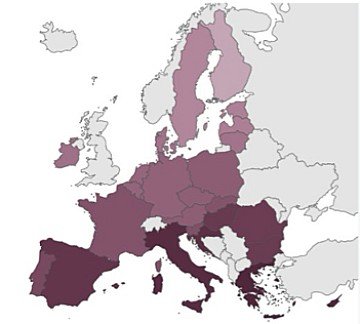
The 2015–2018 drought has already cost Europe an estimated €439 billion. It was a multi-year event — among the most severe of the past few centuries — that cut GDP per capita growth by 2.72 percentage points across the EU-27 and the United Kingdom, produced a fall in investment of more than 12% and is associated with some 5.8 million fewer jobs.
The same drought would cost almost twice as much in a hotter world: 5.21 percentage points of GDP, around €760 billion and some 10.8 million jobs affected. These are the estimates for an event similar to that of 2015–2018 under a scenario in which the planet’s average temperature is 2 °C above late-nineteenth-century levels.
For Italy, the 2015–2018 drought is associated with a loss of 1.45 percentage points of GDP per capita growth (around €24.3 billion) and 330,000 fewer jobs. In a world 2 °C warmer, losses would rise to 3.99 percentage points (around €74 billion) and some 960,000 jobs.
Southern Europe faces the steepest increase in costs. Spain, Greece, Portugal and Albania are among the countries that would suffer the heaviest losses — up to three times those incurred in 2018 — as global average temperature rises. For Spain, for example, the cost in GDP terms rises from 2.2 to 7.7 percentage points; for Greece, from 1.4 to 5.5. Parts of the Western Balkans, historically little affected, would see an equally drastic reversal.
Investment is the most exposed component of the economy, and construction and manufacturing carry the longest scars. Firms postpone and cut investment for years after a drought, well beyond the immediate shock. This is a sign that drought raises the cost of capital and discourages productive spending over the long term. Sectors also respond on different timescales. Agriculture takes the sharpest immediate hit but recovers within two or three years thanks to insurance, price adjustments and changes of crop; construction and manufacturing, by contrast, carry the longest scars, with losses that remain the deepest of any sector and intensify for years after the drought begins.
Adaptation has its limits: regions that are well adapted today are not safe in the future. The longer a drought lasts, the more economic costs mount over the years and increase in the long run. This is a sign that adaptive capacity (reservoirs, insurance, changes of crop) loses effectiveness as an event drags on. In a hotter world, where prolonged droughts would be far more damaging than they are today, adaptation measures designed for present-day temperatures would not be enough to shield socio-economic sectors from their vulnerability to extreme drought events.
What do the authors say?
“Multi-annual droughts are becoming more and more frequent, and that’s where the real risk lies. Even a single dry year causes real economic damage, but a persistent drought is different: its effects can compound across sectors and keep accumulating for years afterward. That intersection between compounding and long-lasting impacts is what conventional impact estimates tend to miss,” says Marta Mastropietro, CMCC and Politecnico of Milan, lead author of the study. “It’s the first time we track the full economic impact of prolonged drought, sector by sector, at a fine spatial resolution. That’s what lets us see something one-year estimates miss: agriculture takes the biggest initial hit but recovers within a couple of years, while manufacturing and construction keep losing ground long after the drought itself is over.”
“This research highlights the persistence of the social and economic impacts of European droughts, and the vulnerability of the whole continent in an increasingly hot climate. Europe needs to design institutions and markets for dealing with extreme climate, an opportunity to take up in its forthcoming adaptation plan,” says Prof. Massimo Tavoni, CMCC and Politecnico of Milan, senior author of the study.
Read the full paper: Mastropietro, Marta and Daumas, Louis and Kotz, Maximilian and Tavoni, Massimo, Multi-Year Droughts and Their Compounding Economic Impacts in Europe (May 18, 2026). Available at SSRN: http://dx.doi.org/10.2139/ssrn.6786478
The paper is the result of a collaboration between authors from the CMCC Foundation, the Politecnico of Milan, and the University of Potsdam.