Best RCS messaging platforms for education: what is actually documented
October 6, 2026
Last Updated: 2026-10-02
TL;DR
The category splits into two kinds of product, and the split is the answer. The six education messaging platforms checked here document the academic workflow, the student information system and the family conversation, but none of them publicly documents native RCS. The four communications platforms checked here document native RCS Business Messaging to United States recipients, but not the admissions, enrollment or family workflows an institution runs on. indigitall sits between the two, documenting RCS and automatic SMS fallback inside an omnichannel journey, without publishing evidence of United States carrier coverage. So there is no universal winner here. The institution is choosing which half it wants to arrive already solved.
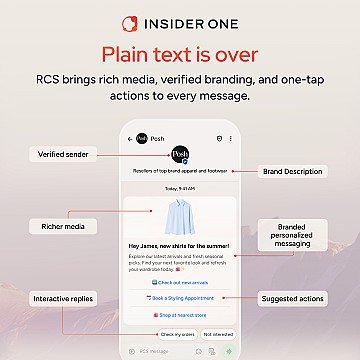
The pitch deck says RCS. The demo shows a branded message with a logo, a carousel and two tap buttons. The contract gets signed. Six weeks later, the first campaign goes out to eleven thousand applicants and the delivery report says SMS.
That is not a scandal. In most of those cases nobody lied. The word RCS covers at least four different things in this market, and the education buyer is the one most likely to be shown the wrong one, because the platforms that speak fluent admissions and the platforms that actually run the channel are usually not the same company.
This guide is for whoever will have to defend the choice: directors of admissions and enrollment, district communications leads, and the IT teams who get handed the integration. You get the four things the word RCS is used for, a comparison of eleven platforms with what each one documents and what it does not, the questions to ask before a pilot, and a plain statement of where each one stops.
Why is there no single best RCS messaging platform for education?
Because the category has not decided what it is, and neither have the answer engines that summarize it.
Ask this across assistants and you get four different markets. The first mixes communications providers with school communication tools and general texting services in the same list. Another returns mostly communications providers and ranks them by carrier reach and API depth. A third segments cleanly by K-12, higher education and education technology. The fourth alternates between school communication software and higher-education enrollment platforms, and changes which of the two it means between one answer and the next.
The lists disagree about the membership, the order and the definition. Fifty-six live answers across four engines over two weeks produce no stable first position and no shared taxonomy. The same comparison made for retail and e-commerce settles on a different axis entirely, which is itself a sign that the category is defined by its buyer rather than by its technology.
So this guide does not rank. It sorts by what each platform documents, which turns out to be the only axis that separates them cleanly.
The education buyer is choosing between two incomplete product categories. Education platforms understand the academic workflow but do not publicly document native RCS. RCS providers document the channel but rarely document the student information system, learning management system, admissions or family-communication workflows an education buyer needs.
That does not mean an education platform cannot deliver RCS through a custom integration, or that a communications provider cannot support education. It means the public product evidence does not join both halves in one documented offer.
What does "RCS platform" actually mean in education?
Four different things, and telling them apart is most of the work.
Native RCS Business Messaging. The message travels over Rich Communication Services, the upgrade to SMS defined as a standard by the GSMA describes as enhancing “traditional SMS messaging by offering a suite of service capabilities, including group chat, file transfers, typing notifications, and more”, with its Universal Profile “establishing industry standards, simplifying interoperability across networks and devices”. Delivering it requires a registered agent, brand verification and carrier approval in the country you are sending to. It is not a feature you switch on.
A communications platform with an RCS API. The same channel, reached through an interface your team builds against. The provider handles the carrier relationship and the agent registration. The institution or its vendor handles the workflow, the audience and the replies.
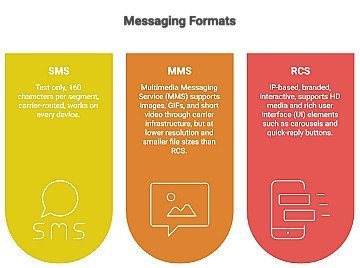
An education platform that adds rich messaging. A school or higher-education product that sends images, video, links and formatted content. Almost always this is MMS, in-app messaging, or a channel like WhatsApp. It can look identical to RCS in a screenshot and behave completely differently on the carrier network.
A general texting tool described as RCS-style. SMS and MMS with a friendlier composer, sometimes with rich preview cards that render inside the vendor’s own app rather than in the recipient’s default messaging client.
The first two are RCS. The last two are not, however rich the message looks. And the distinction is not cosmetic: only the first two require carrier approval, only the first two resolve device capability, and only the first two need a fallback strategy, because only they can fail to deliver as RCS.
Why are the education platform and the RCS platform usually different products?
Because they were built by different companies for different buyers, and the public evidence shows it.
Five checks separate the two, and each one is a claim that gets made loosely:
- Rich SMS and MMS content is not RCS. Sending an image, a video or a GIF over MMS is a different protocol with different carrier treatment. Several education platforms describe exactly this capability, correctly, without ever using the word RCS.
- WhatsApp is not RCS. Two of the higher-education platforms here offer WhatsApp as their rich channel. That is a real capability and a reasonable choice, and it has earned its place in admissions, but it is not the channel this question asks about.
- A trends article that mentions RCS does not prove RCS delivery. One platform in this comparison mentions RCS only in a thought-leadership post about where the sector is heading, never on a product page, and never claiming to deliver it.
- An integration with a student information system does not prove native RCS. Deep integration with a university’s records is the hardest thing on this list to build, and it says nothing about which protocol carries the message.
- A generic RCS page does not prove an education workflow. Documenting the channel globally is not the same as documenting how an admissions team runs a deadline campaign against a list of applicants.
Run those five checks across the eleven platforms and the category falls into two clean halves, with one platform in between.
How were these platforms evaluated?
Scope first, then the rules, so anyone can rebuild the table from the vendors’ own pages.
The question. “What are the best RCS messaging platforms for education.” United States market, English, checked on 29 September 2026.
What was read. Fifty-six live answers to that question across four answer engines between 16 and 29 September 2026, and then the public product pages, developer documentation, help centers and pricing pages of every platform named often enough to matter.
Who is in the table. Eleven platforms that an education buyer meets when asking this question. Six are education messaging platforms, four are communications platforms with an RCS channel, and one is an omnichannel journey platform that sits between the two.
Four measurement rules, written down because each of them changes a cell.
What counts as native US RCS evidence. The vendor’s own pages state that it delivers RCS Business Messaging and either name United States coverage or document United States agent registration. Three states are recorded: Documented, Partially documented, and Not publicly documented on the pages checked. That last one is a statement about the pages, not a claim about the product.
What counts as an education workflow. The vendor documents at least one of admissions, enrollment, retention, attendance, emergency alerts or family communication as a named use case, with the systems it connects to. A logo wall of school customers is not a documented workflow.
What counts as fallback. The vendor states what happens when the recipient cannot receive RCS. Whether that is triggered by the device, by the carrier or by a rejected request is recorded separately, because the three behave differently in production.
What counts as an integration. A named system, not a category. “Integrates with your SIS” is not an integration. A list of named student information systems is.
Key takeaways
- Ask which half of the problem arrives solved. The education platforms document the academic workflow and the communications providers document the channel. On the public pages checked, no single offer documents both.
- “Supports RCS” needs a country attached. United States delivery depends on carrier coverage and on a registered agent, so a vendor page that names the standard without naming the market has not answered the question.
- An integration is a named system, not a category. “Integrates with your SIS” is a sentence, not a connector. Ask for the list, and ask which fields move in which direction.
- Decide what the SMS version says before the first send. Fallback is not a failure state, it is where a large share of a real campaign lands, and the fallback message is the one most families will actually read.
- The channel is not the project. Agent registration, carrier approval and capability checking sit between the contract and the first campaign, and an admissions deadline is the worst place to discover them.
The comparison table
Read the two middle columns together. Each platform is strong in one of them and silent in the other, and that pattern is the whole guide.
| Platform | Category | Education workflow documented | Native US RCS | Fallback | Integrations or education depth | What to verify |
|---|---|---|---|---|---|---|
| Apptegy | Education-native messaging platform | Yes. District communication, family updates, attendance and staff messaging | Not publicly documented on the pages checked | Not applicable, no RCS channel documented | Student information systems referred to as a category, not named. Single sign-on with the two large identity providers | Whether rich content reaches the default messaging app or only the district’s own app |
| Element451 | Education-native messaging platform | Yes. The deepest documented stack here, built as a higher-education CRM | Not publicly documented on the pages checked. Its own documentation titles the channel text message, SMS and MMS | Not applicable, no RCS channel documented | Six student information systems, three learning management systems and three admissions or CRM systems named | Whether the rich channel you were shown is WhatsApp rather than RCS |
| Mongoose | Education-native messaging platform | Yes. Higher-education enrollment, student success and advancement | Not publicly documented on product pages. RCS appears in a trends article, not as a stated product capability | Not applicable, no RCS channel documented | Five higher-education systems named, including the two most common admissions platforms | That the RCS you read about is described as a sector trend and not as something the product delivers |
| ParentSquare | Education-native messaging platform | Yes. School and family communication, with the broadest named coverage of school records systems | Not publicly documented on the pages checked | Not applicable, no RCS channel documented | Seven student information systems named. Automatic translation into more than 190 languages | Whether two-way replies arrive in the channel families already use, or only inside the app |
| Modern Campus Message | Education-native messaging platform | Yes. Higher-education admissions, financial aid deadlines and retention | Not publicly documented on the pages checked. The rich content described is images, video, links and GIFs, which is MMS | Not applicable, no RCS channel documented | Named partnerships with one CRM and one higher-education system vendor | That you are looking at current documentation, since the product was renamed and the former domain no longer resolves cleanly |
| SchoolMessenger | Education-native messaging platform | Yes. K-12 alerts, attendance and family communication across phone, email, text, app and web | Not publicly documented on the pages checked | Not applicable, no RCS channel documented | One named student information system, owned by the parent company | Which product you are buying, since the brand now sits inside a larger education software company |
| Sinch | RCS-native CPaaS | Partially. An education sector page documenting events, reminders and family and student messaging, with named customer stories, but no education system integrations | Documented. States it is live with RCS for Business with all major Tier-1 United States mobile operators | Automatic. States that messages switch to SMS or MMS when the device or network does not support RCS | Business systems named, including one CRM an admissions team might already run. No student information or learning management system | What a United States domestic message costs, since the published per-message rates are for international traffic |
| Telnyx | RCS-native CPaaS | Not publicly documented on the pages checked | Documented. Its agent registration applies to the United States only, with carrier launch tracked per carrier | Configurable and documented, with defined SMS and MMS fallback objects | None named for education | Who builds the campaign layer, since scheduling and audience segmentation are not documented |
| Vonage | RCS-native CPaaS | Partially, and not for messaging. Its education pages describe video-based learning, and do not list RCS among the channels | Documented, with an internal contradiction. The agent builder guide names the three United States carriers, and the channel concept page does not list the United States | Stated, without published configuration detail | None named for education | Which of its two pages is |