For over 25 years, Oceana has worked to protect and restore the world’s oceans. Founded in 2001, Oceana is the largest international advocacy organization dedicated solely to ocean conservation — winning more than 350 policy victories that stop overfishing, protect habitats and threatened species, curb oil and plastic pollution, and increase transparency at sea. Below, we answer some frequently asked questions and share some of our greatest accomplishments.
What is Oceana?
Oceana is an international ocean conservation organization that wins science-based policy victories to restore ocean abundance and biodiversity. Oceana campaigns in 10 countries and the European Union, including Belize, Brazil, Canada, Chile, Ghana, Mexico, Peru, the Philippines, the United Kingdom, and the United States. We work to rebuild abundant, biodiverse seas that support coastal communities and protect the climate.
How Did Oceana Get Started?
Oceana was established in 2001 by a group of charitable foundations following a sobering discovery — less than 0.5% of all resources spent by environmental nonprofit groups in the U.S. went to ocean advocacy. To fill the gap, they created Oceana to run specific, time-bound campaigns that help protect and restore the world’s oceans through policy victories.
In 2006, Oceana conducted its first expedition in the Mediterranean on board its catamaran the Ranger, gathering scientific evidence to advocate for habitat protection. Over the last two decades, the Ranger has helped Oceana document Europe’s unique marine habitats and secure protections for 29 areas in the Mediterranean and Atlantic, plus 12 trawling bans across the region.
What Are Some of Oceana’s Biggest Victories?
Oceana has achieved more than 350 policy victories over the past 25 years. Some highlights include:
2004: Cleaner cruise ships. In one of Oceana’s first major victories, Royal Caribbean Cruise Lines, the second largest cruise line in the world at the time, agreed to install advanced wastewater treatment technology on all of its ships, greatly reducing the amount of daily ocean pollution.
2005: Protecting Alaska’s seafloor. The U.S. closed destructive commercial fishing in nearly 1 million square kilometers of north Pacific Ocean surrounding the Aleutian Islands of Alaska, an area equal to Texas and California combined. Over the next few years, Oceana achieved additional victories to stop bottom trawling in precious marine habitats across Spain, Portugal, the U.S. West Coast, the Bering Sea, and Belize.
2012: Belize says no to offshore drilling. Following threats by Belize’s government to open up its waters to offshore oil drilling, Oceana and our allies organized the nation’s first ever “People’s Referendum” in 2012. The referendum allowed the public to vote on whether or not to allow offshore oil drilling in Belize’s reef — 96% voted against it.
2013: Discovering and protecting the Desventuradas Islands. Oceana and National Geographic led an expedition to the Desventuradas Islands in Chile, uncovering extraordinary levels of biodiversity in the previously unknown seas surrounding these islands. Following the expedition, Oceana released a report on the findings and a proposal for the region’s protection. Soon after, this area became a fully-protected “no-take zone” marine park — the largest in the Americas.
2019: Modernizing Canada’s Fisheries Act. Oceana advocated to modernize one of Canada’s oldest and most outdated laws: its Fisheries Act. For the first time in the country’s history, the law now requires science-based rebuilding of all depleted fish populations.
2022: Banning the U.S. shark fin trade. Oceana has long advocated to end the global shark fin trade, helping to secure shark finning protections in Canada, Chile, the European Union, and Peru. In 2021, the U.S. passed a law to ban the buying and selling of shark fins, officially removing them from this unsustainable and cruel industry, where fins from as many as 73 million sharks end up each year.
How is Oceana Taking on the Global Plastic Pollution Crisis?
Oceana and our allies have passed policies that would eliminate the use of more than 1.5 million metric tons of unnecessary single-use plastic each year by 2033.
In 2021, Oceana and our allies developed state momentum across the U.S., achieving new policies in seven coastal states. In Chile, Oceana was also instrumental in passing one of the world’s strongest laws to combat plastic pollution.
For four years in a row, Oceana released reports estimating Amazon’s massive plastic footprint and calling on the company to reduce its use of single-use plastic packaging. In 2024, Amazon removed all plastic air pillows from its delivery packaging used at its global fulfillment centers and replaced them with recycled paper filler, a decision that would avoid nearly 15 billion plastic air pillows every year.
How Does Oceana Work with Fishing Communities?
Oceana works directly with small-scale fishers in many coastal communities to increase ocean abundance and support local livelihoods. In 2018, Oceana teamed up with artisanal fishers from Brazil’s southernmost state, Rio Grande do Sul, to pass a law banning bottom trawling along the state’s 620-kilometer coast. Prior to the ban, bottom trawling depleted fish stocks, threatened marine biodiversity, and destroyed habitat, all of which the local community relies on to support their livelihoods. Now, local fishers report many fish stocks are recovering.
In 2023, Peru’s Congress unanimously passed a law to strengthen protections for the first five miles off the country’s coast and support artisanal fishers. This coastal area is one of the most productive in the world. This victory, which was won thanks to steadfast campaigning by artisanal fishers and their allies, including Oceana, helps support ocean abundance, biodiversity, and livelihoods in Peru.
How Is Oceana Using Technology to Stop Illegal Fishing?
Oceana campaigns to increase transparency of commercial fishing in the countries where we work to ensure fishing vessels are trackable and illegal fishing can be reduced.
In 2016, Oceana, SkyTruth, and Google launched Global Fishing Watch. A first of its kind technology, this platform enables anyone with an internet connection to see global fishing activity and track commercial fishing vessels in near real-time, for free. This important innovation was designed to create more transparency at sea and help deter illegal fishing. Today, around 120,000 commercial fishing vessels — about one-third of the world’s industrial fishing fleet — can now be tracked on the Global Fishing Watch map.
What’s Next for Oceana?
Oceana and our allies are supporting an important global goal: protecting 30% of the oceans by 2030. In the Philippines, we helped create a marine protected area (MPA) around Panaon Island, an area rich with healthy corals and marine life. In Mexico, following scientific expeditions with our partner Blancpain, we helped convince the government to approve two new MPAs in the Gulf of Mexico, creating a conservation corridor that is home to more than 3,000 marine species.
The oceans and the people who depend on them are forever linked. As we continue this critical work of protecting and restoring the world’s oceans, Oceana is expanding our focus to not just who catches the most fish, but also who needs fish the most.
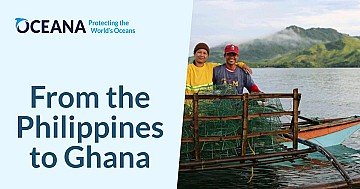
In 2026, Oceana launched its first campaign team in Ghana, one of West Africa’s most fish-reliant nations. Our new team in Accra will work in allyship with fish-reliant communities to help rebuild fisheries, boost nutrition and local access to fish, and safeguard coastal livelihoods.
Our oceans continue to face many threats. But the seas can also be a part of the solution. Restored, healthy, abundant oceans can help fight climate change, sustain livelihoods, and feed more than 1 billion people a healthy seafood meal every day, forever.
Help Oceana win the next 25 years of victories for the oceans. Join us today!