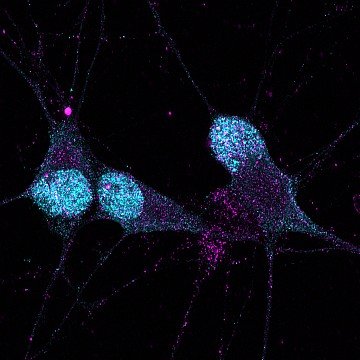
Thanks to a Temerty Foundation grant, ICGEB Trieste’s Molecular Pathology and Functional Cell Biology labs will work with Dr. Michael Strong, Western University, Ontario on a potential path toward a cure for amyotrophic lateral sclerosis (ALS).
The ICGEB Molecular Pathology Lab, headed by Dr. Emanuele Buratti, and the Functional Cell Biology Lab, headed by Dr. Luca Braga will be involved in a Temerty Foundation grant funding the team of researchers led by Dr. Michael Strong, Arthur J. Hudson Chair in ALS Research at Western University’s Schulich School of Medicine & Dentistry. A sum of 845.000 EUR will be dedicated to research at ICGEB Trieste, supporting the transitioning of the Strong team’s discovery from the bench to the clinic.
The research by Western University illustrates how protein interactions can preserve or prevent the nerve cell death that is a hallmark of ALS. Dr. Strong’s team found that targeting an interaction between two proteins present in ALS-impacted nerve cells can halt or reverse the disease’s progression – thus they identified a mechanism to make this possible.
In ALS patients, a protein called TDP-43 is responsible for forming abnormal clumps within cells, which causes cell death. In recent years, Dr. Strong’s team has discovered a second protein, called RGNEF, which also aggregates in the patient neurons but functions opposite to TDP-43.
The team’s latest breakthrough identifies a specific fragment of that RGNEF protein, named NF242, that can mitigate the toxic effects of the ALS-causing protein. The researchers discovered that when the two proteins interact with each other, the toxicity of the ALS-causing protein is removed, significantly reducing damage to the nerve cell and preventing its death. This research was recently published in the prestigious journal Brain (PMID: 38739752) and was done in collaboration with Dr. Buratti and Dr. K.S. Sonkar, ICGEB.
This interaction could be key to unlocking a treatment not just for ALS but also for other related neurological conditions, such as frontotemporal dementia.
ALS, also known as Lou Gehrig’s disease, is a debilitating neurodegenerative condition that progressively impairs nerve cells responsible for muscle control, leading to muscle wastage, paralysis and, ultimately, death. The average life expectancy of an ALS patient post-diagnosis is a mere two to five years.