Choosing the Best Workout Room Flooring: key factors to consider
When you’re planning a studio refit, flooring can feel like a background decision, until noise complaints, cleaning headaches or downtime turn it into the main act. The right workout room flooring quietly shapes everything that matters: hygiene, safety, acoustics, coaching flow, brand perception and lifetime cost. Get it right, and you’ll protect your building, speed up daily operations and lift the member experience without lifting your prices. Get it wrong, and you’ll be fighting odours, scuffs, slips and weekend closures you didn’t budget for.
This practical guide brings together what to look for, without pushing brands, so you can specify workout room flooring with confidence and a long-term view.
Hygiene & cleanability: start with what touches everyone
Gyms are sweaty, chalky, high-traffic environments. Surfaces that absorb liquids trap smells and make daily cleaning a slog; non-porous materials keep moisture on the surface, so it’s removed in minutes with neutral-pH products and a sensible routine. Beyond housekeeping, materials matter: a virgin-rubber top layer over an eco-friendly base gives you a high-grade, non-porous surface with bacteriostatic and fungicidal behaviour, helping prevent microbial growth and odours over time. That’s the difference between floors that look tired after a season and floors that stay fresh with ordinary maintenance.
Want an operator-level playbook? See Pavigym’s cleaning guidance for practical routines that fit real club timetables, from daily debris removal to periodic deep clean, written for busy teams, not lab conditions. Cleaning & maintenance.
Safety underfoot: grip, stability and modern risks
Safety starts with predictable grip in both dry and damp conditions. Quality workout room flooring balances traction and stability, so lunges feel secure, sled pushes track straight and equipment stays planted. In strength corners or mixed-use studios, denser, point-elastic systems add impact protection without the “trampoline” feel that compromises balance.
Modern facilities also face new hazards: exposed power and data cables snaking across the floor for connected cardio or strength kit. The safest approach is to route services invisibly under the surface. Look for modular systems that integrate cable management into the tile itself to reduce trip risks while meeting strict fire-safety requirements for busy clubs. If you’re exploring this path, start with Connect, a modular flooring system with built-in connectors in every tile that keeps machine cables neatly hidden and simplifies installation in live facilities.
Acoustic control: treat impact at the source
Noise and vibration are the silent killers of otherwise great gyms, especially in mixed-use buildings. Dropped weights transmit impact through the slab and radiate as vibration; group classes add music levels that, if unmanaged, can breach occupational thresholds. In the UK, the HSE sets lower and upper exposure action values at 80 and 85 dB(A) respectively, with an 87 dB(A) exposure limit value (daily/weekly average). High-intensity classes regularly hover around or above these levels, which is why acoustic strategy belongs in your flooring spec, not just your sound system.
What should you look for? Multi-layer tiles that build in a subtle “pillow effect”: they absorb impact to reduce joint stress, decouple vibration paths to protect equipment and subfloors, and lower perceived noise across the facility. In practice, that means quieter studios, happier neighbours and less structural stress on your building, especially in weight zones. For a deeper dive into options (from cost-effective underlays to all-in-one acoustic modules), see the Acoustic flooring solution overview and real-world acoustic case studies.
Durability & total cost of ownership: install once, adapt often
The cheapest floor at purchase is rarely the cheapest across its life. Think beyond material price to installation time (and lost revenue), ease of localised repair, future reconfigurations and even transport. Interlocking systems shine here: no adhesives, faster installs, same-day reopenings and single-tile replacement if damage occurs, so you fix a scuff without ripping up a room. Crucially, well-engineered modules are lighter than many recycled-rubber alternatives, trimming logistics costs before you’ve opened a single box. If you’re actively weighing approaches, this post on the advantages of interlocking gym tiles is a useful primer. PAVIGYM GYM Flooring Solutions
When a full glue-down is unavoidable (e.g., for specific turf builds), plan downtime carefully; otherwise, phase works with interlocking to keep revenue flowing. For high-footfall corridors, receptions and changing areas, consider resilient surfaces like Traffic or Traffic Clic System, both designed for wet areas and constant movement.
Design & personalisation: aesthetics that work operationally
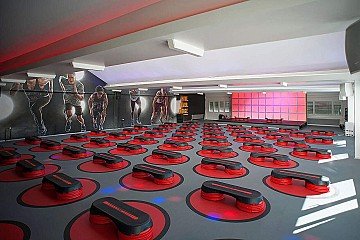
Members notice what’s underfoot, even if only subconsciously. Colour and texture affect perceived cleanliness and energy; integrated markings structure classes; and a few smart visual cues reduce instructor mic time. The gold standard is in-surface personalisation, logos, sprint lanes and targets integrated into the top layer rather than painted on, so they don’t scuff off after a season of burpees. If you’re designing coaching-led formats, combine markings with expert 2D/3D layout support so every square metre earns its keep. Have a look at real studios for ideas in our case studies page.
Sustainability & wellbeing: circularity lives in the details
Sustainability isn’t a badge, it’s a chain of decisions. Durable materials reduce replacements; modularity allows selective swap-outs instead of full refits; adhesive-free installs avoid harsh removers at end of life; and manufacturing choices influence indoor air quality. Look for flooring that’s 100% recyclable, produced through cleaner methods that avoid particle release, and supported by wellbeing credentials for air quality. Virgin-rubber systems designed for long service life and recyclability can be the surest path to a lower footprint over time, especially when combined with lighter modules that cut transport emissions.
Map surfaces to your training zones (and member journey)
Few studios use one surface wall-to-wall, and they shouldn’t. Cardio needs stability under heavy kit; functional areas benefit from controlled traction and point elasticity; free-weight corners demand dense, impact-resistant systems to protect the subfloor; turf lanes work best with the right pile and underlay. If you’re scoping from scratch, the Flooring guide is a quick way to align activities and surfaces; from there, compare density and finishes on different surfaces as you define loads and layouts. Transitions matter too: where levels change, specify bevelled edges; where programmes change, use colour or texture to “tell” people how to move.
Bringing it all together
The best workout room flooring earns its keep every day: hygienic and quick to clean; safe and consistent underfoot; quiet enough for staff, members and neighbours; durable yet flexible; brand-building without being loud; and designed for a long, repairable life. If you start with those principles, and validate them with the right data, you’ll choose a floor that supports both performance and the business behind it.
Ready to put this into action? Compare acoustic options for noisy sites, plan phased works with interlocking to minimise closures, and explore cable-free equipment layouts with Connect so safety remains invisible and members stay in flow.