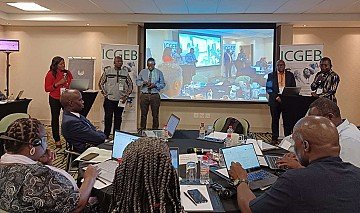
ICGEB, in partnership with CropLife Africa Middle East and the World BioProtection Forum, convened a three-day Arturo Falaschi conference on Innovative Approaches to Sustainable Pesticide Residue Mitigation.
Held from 11 to 13 November 2025 in Johannesburg, South Africa, the event brought together 50 participants from 13 countries. It provided a high-level platform for regulators, researchers, industry leaders, and policymakers to exchange knowledge, share innovations, and explore strategies for pesticide residue mitigation across Africa. The programme centred on three thematic pillars: regulatory frameworks, biological innovations, and precision agriculture technologies.
The specific objectives of the conference were to advance regulatory harmonisation for biopesticides and biological control agents in Africa; explore innovative biological and technological solutions for pesticide residue mitigation; foster public–private partnerships and cross‐border collaboration; and launch the Africa Bioproducts Community of Practice (CoP).
The conference generated several key outcomes and recommendations. Countries participated in piloting the Biological Crop Protection Products Access (BioCOPPA) Index, a tool designed to measure and track progress in biopesticide access and regulation. Technology adoption emerged as a critical area, with drones and AI-driven pest management highlighted as potentially game-changing solutions for residue reduction, though dependent on standardised SOPs, operator certification, and regulatory clarity. The Bioproducts CoP, launched during the event, will be supported by an initial 12-month work plan including webinars, policy briefs, and pilot training programmes across selected countries, establishing a long-term mechanism for knowledge sharing and policy alignment.
The conference concluded with a clear call to action: Africa must now move from policy to practice. Delegates left Johannesburg not only with new knowledge and networks, but as founding members of a dynamic Community of Practice committed to sustaining momentum through shared data, harmonised guidelines, and practical field-level training. By bringing together indigenous crops and drones, microbes and markets, science and stewardship, the continent is poised to shape Africa’s biological decade – where food is produced safely, pesticide residues are minimised, and farmers thrive.