Introduction: Beyond Clicks and Opens to Real Relationships
In the saturated digital landscape of 2026, the old metrics of success are failing. Clicks, opens, and impressions are no longer enough to build a resilient brand. The true currency that determines growth is customer attention and loyalty, earned through meaningful and consistent interaction.
Digital Customer Engagement is the art and science of fostering these ongoing, value-driven relationships between a customer and your company. It’s a continuous dialogue that unfolds across your entire digital ecosystem—from your website and mobile app to dynamic channels like WhatsApp, RCS, and Mobile Wallet.
For years, the standard approach was a fragmented mess of outbound blasts. The email team worked in one silo, the app team in another, and social media in a third. This created a disjointed and often frustrating experience for the customer, who sees your brand as a single entity, not a collection of departments.
The new model is one of seamless orchestration. It replaces impersonal broadcasts with hyper-personalized, two-way conversations that are relevant to the customer’s context. This requires a Global Omnichannel Strategy, where every channel works in concert, managed from a unified platform to create a single, cohesive Customer Journey.
This guide is your complete roadmap to mastering modern digital engagement. We will explore the strategies, technologies, and best practices you need to move beyond transactional interactions and build a powerful engine for customer retention, loyalty, and lifetime value.
Why Digital Customer Engagement is Non-Negotiable for Growth
In the competitive landscape of 2026, viewing customer engagement as a “soft” metric is a critical mistake. It has evolved from a simple marketing tactic into the primary engine for sustainable growth, directly impacting your bottom line. A well-orchestrated engagement strategy isn’t just about sending messages; it’s about building a resilient business.
Let’s move beyond the abstract and look at the tangible, high-impact ROI that a mature digital engagement model delivers.
Increased Customer Loyalty and Retention
It’s a well-established fact: acquiring a new customer is five times more expensive than retaining an existing one. Strong engagement turns one-time buyers into loyal advocates. According to research from Bain & Company, even a 5% increase in customer retention can boost profitability by a staggering 25% to 95%.
When customers feel seen and valued through personalized, relevant communications, they build an emotional connection to your brand. They are more likely to forgive minor issues, less sensitive to price changes, and more inclined to become vocal supporters who drive word-of-mouth growth.
Higher Customer Lifetime Value (CLV)
Loyalty is the foundation, and CLV is the skyscraper you build upon it. Each positive interaction is an investment that yields future returns. An engaged customer is far more likely to make repeat purchases, explore new product lines, and upgrade services.
Think of a perfectly timed push notification with a relevant offer, or a helpful post-purchase update via WhatsApp. These aren’t isolated events; they are strategic touchpoints in a larger Customer Journey designed to systematically increase the value of each customer relationship over time.
A Powerful Competitive Differentiation
Your competitors can copy your products, match your pricing, and mimic your advertising. What they cannot easily replicate is a superior customer experience built on deep, consistent engagement. This becomes your strategic moat.
A seamless, omnichannel experience—where a user can browse on the web, get an alert in their app, and complete a query on WhatsApp without friction—creates a powerful lock-in effect. This sophisticated orchestration requires a unified platform, making it a high barrier for competitors to overcome.
Richer, More Actionable Customer Data
In an era of increasing data privacy regulations, the value of consensual, first-party data has skyrocketed. Every digital interaction is an opportunity to learn more about your customer, ethically and transparently.
A well-crafted engagement strategy allows you to collect not just first-party data (behavioral insights, like which pages they visit) but also invaluable zero-party data (information customers willingly share, like their preferences in a poll). This rich data is the fuel for hyper-personalization, creating a virtuous cycle where every interaction makes the next one smarter and more effective.
The 3 Pillars of a Winning Digital Engagement Strategy
To build an engagement framework that delivers measurable results in 2026, you need to move beyond sporadic campaigns and adopt a structured, holistic approach. True digital transformation in customer communication isn’t about using more channels; it’s about using them more intelligently. This is where a strategic foundation becomes critical.
At indigitall, we’ve identified three interconnected pillars that form the bedrock of every successful digital engagement strategy. Mastering these will empower you to create meaningful, valuable, and consistent experiences that drive loyalty and maximize customer lifetime value (LTV).
1. Omnichannel Orchestration
Your customers don’t see channels; they see a single brand. A winning strategy ensures their experience is seamless and consistent, whether they’re on your app, your website, or messaging you on WhatsApp. Omnichannel Orchestration is the art of unifying these touchpoints into one cohesive Customer Journey.
- A Single Customer View: True orchestration requires a central hub where data from every channel converges. This eliminates silos and provides a complete picture of user behavior, enabling smarter, more relevant communication.
- Seamless Channel Transitions: A user might see a product on a Web Push Notification, add it to their cart, and later receive an abandoned cart reminder via App Push or WhatsApp. The goal is to make this flow feel natural and helpful, not disjointed.
- Consistent Brand Voice: From a formal banking alert to a promotional retail message, your brand’s tone must be consistent across the entire ecosystem, building trust and recognition at every step.
2. Hyper-Personalization at Scale
Generic, one-size-fits-all messages no longer cut it. Hyper-personalization is about using deep customer insights to deliver messages that are not just customized, but truly contextual and relevant to each individual. It’s the difference between speaking at your audience and having a conversation with each customer.
- Behavior-Driven Segmentation: Go beyond simple demographics. Group users based on real-time actions like purchase history, app usage, content viewed, or location to ensure every message resonates with their current needs and interests.
- Dynamic Content: Power your communications with content that adapts to the user. An airline, for example, can send a single flight reminder template that dynamically populates the correct gate number, flight time, and destination for thousands of individual travelers.
- Trigger-Based Messaging: Automate communications based on specific user actions. Whether it’s a welcome message after a first app open or a special offer triggered by browsing a specific product category, these timely interactions drive massive engagement.
3. Intelligent Automation & AI
The final pillar is about leveraging technology to deliver these personalized, omnichannel experiences efficiently and proactively. Intelligent automation, powered by AI, allows you to scale your strategy, respond in real-time, and anticipate customer needs before they even arise.
- Automated Customer Journeys: Using a visual workflow builder, like the one found in the indigitall console, allows you to design and deploy complex, multi-step Customer Journeys. These flows can nurture leads, onboard new users, and re-engage dormant customers automatically.
- Generative AI Agents: Deploy intelligent AI agents on channels like WhatsApp to provide instant 24/7 support, answer common questions, and even guide users through transactions. This frees up human agents to focus on high-value, complex interactions.
- Predictive Analytics: Use machine learning models to predict future behavior. Identify customers at risk of churn and proactively send a retention offer, or pinpoint users most likely to convert and target them with a personalized promotion.
These three pillars do not operate in isolation. They form a powerful, integrated ecosystem where a unified platform is key. By orchestrating channels, personalizing content, and automating delivery, you create a self-reinforcing cycle of positive engagement that drives sustainable business growth.
Pillar 1: Unified Inbound & Outbound Communication
For too long, digital engagement has been a tale of two separate functions: proactive marketing (outbound) and reactive support (inbound). This traditional separation creates a disjointed and often frustrating experience for customers who see your brand as a single entity, not a collection of siloed departments.
To succeed in 2026, brands must tear down this wall. A truly effective digital strategy hinges on unifying these two communication streams into a single, continuous conversation.
Outbound Engagement: The Proactive Push
Outbound engagement includes all the messages your brand proactively sends to your audience. This is your chance to drive action, share value, and stay top-of-mind. Think of it as starting the conversation.
- Promotional Campaigns: Sending a push notification about a flash sale.
- Lifecycle Messaging: Triggering a WhatsApp message to re-engage a dormant user.
- Transactional Alerts: Notifying a customer via their mobile wallet that their order has shipped.
Inbound Engagement: The Reactive Response
Inbound engagement is initiated by the customer. It’s when they reach out to you with a question, a problem, or feedback. How efficiently and contextually you handle these interactions defines their perception of your brand.
- Customer Support: A user replying to a marketing email with a product question.
- Direct Inquiries: A customer starting a live chat on your website to ask about return policies.
- AI Agent Conversations: Interacting with a bot on WhatsApp to check an account balance.
The indigitall Advantage: A Single, Seamless Thread
Herein lies a crucial differentiator. Most platforms manage outbound and inbound in separate systems. The indigitall platform is engineered to unify them. This creates a powerful, context-aware ecosystem where every interaction builds upon the last, forming a true Global Omnichannel Strategy.
Imagine this Customer Journey: A user receives a push notification about a new subscription plan (outbound). They tap it, but have a question, so they reply directly via the integrated WhatsApp channel. This reply instantly initiates a conversation with an AI Agent or a human support agent (inbound), all within the same conversational thread. The agent in the indigitall console sees the full history—the exact promotion they received and their subsequent query—allowing for a fast, personalized, and frictionless resolution.
Pillar 2: True Omnichannel Presence
In the digital landscape of 2026, the terms “multichannel” and “omnichannel” are often used interchangeably, but they represent fundamentally different strategies. Simply being present on multiple channels is no longer enough; the real power lies in orchestrating them into a single, unified experience.
Multichannel marketing means you communicate with customers across various platforms—an app, a website, email—but these channels operate in silos. An omnichannel strategy, by contrast, integrates these touchpoints, allowing the customer to move seamlessly between them as part of one continuous conversation.
Consider this powerful Customer Journey: A user browses a pair of running shoes on your website but doesn’t buy. An hour later, they receive a rich push notification on their phone with an image of the shoes. They tap it, but get distracted. The next day, a message arrives via WhatsApp: “Still thinking about those shoes? Complete your purchase now for 10% off.” This cohesive, intelligent flow is the essence of omnichannel engagement.
To build a truly global omnichannel strategy, you need to integrate the key channels where your customers are most active. This digital ecosystem includes:
- Web and App Push Notifications: For timely, high-visibility alerts that drive immediate action.
- In-App Messages: To engage users with contextual content while they are actively using your application.
- WhatsApp Business: For conversational, high-trust interactions, from support to transactional updates.
- SMS & Email: The foundational channels for reaching the widest possible audience with critical information and promotions.
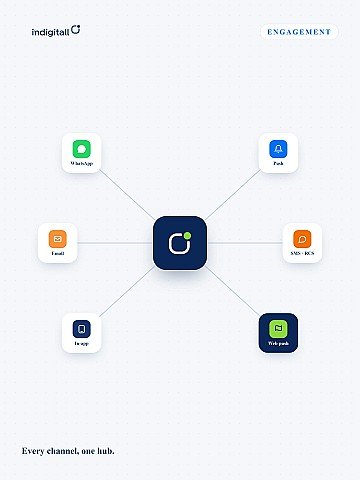
Orchestrating these journeys manually across different platforms is inefficient and prone to error. A unified customer engagement platform like indigitall acts as the central hub, allowing you to design, automate, and analyze these complex Customer Journeys from a single console, ensuring a consistent and personalized experience at every step.
Pillar 3: Accessible, AI-Powered Personalization
For years, personalization in digital marketing meant little more than inserting a [first_name] tag into an email blast. By 2026, that standard is completely obsolete. Today’s customers expect brands to understand their individual needs, anticipate their next move, and communicate with them on a true 1:1 basis.
The engine driving this new reality is Artificial Intelligence. However, traditional AI and machine learning models have been notoriously complex and resource-intensive, requiring dedicated teams of data scientists and engineers to build and maintain. This created a significant barrier, leaving powerful predictive capabilities out of reach for most marketing teams.
This is precisely the gap indigitall’s platform is designed to close. We believe in Accessible AI—integrating sophisticated predictive and generative capabilities directly into the indigitall console. This empowers marketing, CRM, and support teams to leverage advanced AI without writing a single line of code or requiring a PhD in data science.
Instead of being a complex, separate tool, our AI works seamlessly within your campaign creation and Customer Journey orchestration. Here’s how it transforms your engagement strategy:
- Predictive Sending: Our AI analyzes individual user behavior patterns to determine the exact moment each person is most likely to open a push notification, email, or WhatsApp message. This moves beyond simple time-zone scheduling to deliver communications for maximum impact, boosting open rates and conversions.
- AI-Powered Content Generation: Overcome creative blocks and accelerate campaign development. The indigitall platform uses generative AI to help you draft compelling headlines, body copy, and calls-to-action tailored to different segments and channels, enabling rapid A/B testing and optimization.
By embedding AI directly into an All-in-One platform, these personalized triggers become a natural part of your Global Omnichannel Strategy. An AI-optimized push notification is not an isolated event; it’s a perfectly timed touchpoint in a larger, cohesive Customer Journey that spans across your app, website, and other digital channels.
Choosing Your Technology: The Unified Platform Advantage
Once your digital engagement strategy is defined, you face the most critical implementation decision: choosing the technology that will bring it to life. The tools you select will either become a powerful engine for growth or a complex bottleneck that hinders your team’s agility. For brands serious about success in 2026, this choice is foundational.
Historically, companies followed a ‘point solution’ approach, stitching together separate tools for each channel. One provider for email, another for app push notifications, and yet another for web messaging or chat. This fragmented ecosystem creates significant challenges:
- Data Silos: Customer data is scattered across platforms, making a single, coherent view of the user impossible.
- Inconsistent Experiences: Orchestrating a seamless, omnichannel Customer Journey is a manual, error-prone nightmare when systems don’t talk to each other.
- High Technical Overhead: Managing multiple vendors, APIs, and data integrations consumes valuable developer resources that could be spent o