OHB ITALIA AND ESA SIGN THE CONTRACT FOR THE RAMSES MISSION
Europe faces for an unprecedented challenge in Planetary Defence
Noordwijk, February 10, 2026 – The contract for the development of the joint ESA-JAXA Ramses mission (Rapid Apophis Mission for Space Safety) was signed today at the European Space Research and Technology Centre (ESTEC) of the European Space Agency (ESA). The programme, of strategic relevance, is dedicated to the close-up study of asteroid 99942 Apophis during its flyby on 13 April 2029 and to the strengthening of Europe’s capabilities in the field of planetary defence. OHB Italia, acting as Prime Contractor with the support of OHB System and GMV, is leading the implementation of the mission, which features a significant Italian industrial and scientific contribution.
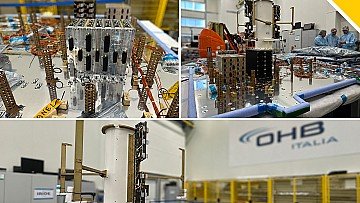
Developed at OHB Italia’s facility in Milan, the joint ESA-JAXA Ramses mission highlights Italy’s central role in delivering complex, high-criticality space programmes. With its solar arrays stowed, the space probe measures 2 × 2 × 2 metres and has a launch mass of about 1,250 kg, including roughly 650 kg of propellant. The vehicle is designed for a high level of operational flexibility, enabled by a substantial velocity margin that allows speed changes of up to approximately 1,650 m/s.
The mission will collect detailed data on asteroid Apophis using an advanced suite of scientific instruments, including two CubeSats out of which one would attempt landing on the asteroid surface. A CubeSat was designed by Tyvak International with support from Politecnico di Milano and INAF, further strengthening cooperation between industry, academia and advanced space research.
Supported by OHB Italia’s technical and engineering know-how, the payload will be integrated to operate under optimal observation conditions. From a distance of about 1 km, the probe will monitor in real time how Apophis changes during the flyby, delivering a unique “before and after” view and improving scientific understanding of asteroid dynamics.
The instruments on board include optical and spectroscopic cameras to analyse the asteroid’s surface and chemical composition, along with a plasma spectrometer to study interactions between the solar wind and Apophis’ surface. Observations will be carried out prior to, during and following the flyby.
This mission is unique in terms of both timeline and objectives. The launch is scheduled for April 2028, with a rendezvous with Apophis planned for February 2029, approximately two months before its close approach to Earth. The spacecraft will accompany the asteroid until August 2029, , in order to observe in detail how Earth’s tidal forces modify its shape, rotation, orbit and surface characteristics.
The initiative also benefits from strong international cooperation. The Japan Aerospace Exploration Agency (JAXA), drawing on its well-established expertise in asteroid science, will contribute by providing launch service onboard an H3 rocket, the spacecraft’s solar arrays and a Thermal Infrared Imager, further reinforcing the project’s global dimension.
“Ramses is a mission that represents a true race against time,” said Roberto Aceti, Managing Director of OHB Italia. “There is no margin for contingencies: the entire development must be completed in less than four years (one of which has already been completed) in order not to miss an unrepeatable opportunity. We accepted this challenge thanks to the experience gained with the Hera mission, which allowed us to consolidate fundamental skills in the management of sophisticated programmes with extremely demanding schedules. Ramses is also a concrete planetary defence exercise. If one day an asteroid were to pose a real threat to Earth, we must be able to organise a rapid-response mission to deflect it. Apophis offers us the opportunity to prepare, by testing technologies, decision-making processes and operational capabilities in a real scenario.”
Apophis, discovered in 2004 by a telescope at the Kitt Peak Observatory in Arizona, was difficult to observe for a long time due to its frequent proximity to the Sun, which limited its visibility from ground-based telescopes. Initially included in the risk list of the International Astronomical Union, the asteroid was removed from that list in 2021 following improvements in orbital predictions. Its name recalls the ancient Egyptian god of chaos and evil, reflecting its initial perception as a potential threat.
With a diameter of about 375 metres, an estimated mass of 61 million tonnes and a speed of roughly 40,000 km/h, an impact by Apophis would release an energy equivalent to around 65,000 Hiroshima bombs. This stark comparison underlines the strategic importance of missions like Ramses for future planetary safety.
Through this mission, Europe takes a decisive step towards an autonomous and operational capability to address space hazards, while reinforcing the contribution of Italian industry and research to the protection of Earth and to a deeper understanding of the origins of our Solar System.