Road Friction Estimation: Why Real-Time Edge Computing Is Redefining Autonomous Vehicle Safety in 2026
Road friction estimation is the real-time calculation of the tire-road friction coefficient (μ)—a dimensionless value that quantifies the available grip between a vehicle’s tires and the road surface. This coefficient directly determines braking distance, lateral stability, and traction limits, making it one of the most safety-critical parameters in Advanced Driver Assistance Systems (ADAS) and autonomous driving.
Unlike static road surface measurements taken by infrastructure sensors or weather stations, modern road friction estimation systems operate dynamically within the vehicle itself. They continuously analyze data from wheel speed sensors, inertial measurement units (IMUs), steering angle sensors, and vehicle dynamics to determine whether the car is driving on dry asphalt, wet pavement, compacted snow, or ice. The goal is to provide safety systems—such as Automatic Emergency Braking (AEB), Electronic Stability Control (ESC), and traction control—with accurate, millisecond-level awareness of grip conditions.
In 2026, the technical debate has shifted from whether vehicles need friction estimation to how they should implement it: through local edge computing platforms that process data onboard, or through cloud-based systems that aggregate data from connected vehicle fleets.
What Has Changed in 2025-2026?
The road friction estimation landscape has undergone significant transformation driven by three converging forces: stricter safety regulations, the emergence of edge computing architectures, and the maturation of hybrid sensor fusion methodologies.
Regulatory Pressure Intensifies
The Euro NCAP 2026 protocols have introduced more demanding requirements for AEB performance on low-friction surfaces. Vehicles aiming for five-star safety ratings must now demonstrate that their systems can differentiate between dry asphalt and icy conditions—effectively mandating robust tire-road friction coefficient estimation. According to Euro NCAP’s strategic roadmap, the updated protocol emphasizes earlier activation of crash avoidance systems when drivers are inattentive, particularly under challenging grip conditions.
Similarly, the EU General Safety Regulation (GSR II) is tightening requirements for Automated Lane Keeping Systems (ALKS). The 2027 revision is expected to mandate friction-aware speed adaptation, as UN Regulation 157 already requires ALKS to adjust vehicle behavior based on environmental conditions—implicitly requiring knowledge of available grip.
Edge Computing Challenges Cloud Dominance
The previous generation of surface friction software relied heavily on cloud-based “crowdsourced” data aggregation. These platforms were built on the principle of collecting telemetry from millions of connected vehicles—including wheel speed differentials, traction control activations, and ABS intervention events—uploading it to centralized servers, and generating aggregated “grip maps” for entire road networks. By processing fleet-wide data statistically, these systems created probabilistic models of road surface conditions across thousands of road segments.
However, this architecture introduces a fundamental limitation: latency. While cloud systems excel at identifying patterns—such as “Highway A tends to freeze at night in January”—they cannot deliver the millisecond-level responsiveness required for immediate safety interventions like ESC activation during an unexpected slip event.
This gap has accelerated the adoption of edge computing platforms that perform friction estimation locally within the vehicle’s electronic control unit (ECU). Systems like Easyrain’s DAI (Virtual Sensor Platform) exemplify this approach, processing vehicle dynamics in real time without reliance on cloud connectivity, internet data, or tire-specific calibration. These platforms can detect aquaplaning, snow, ice, and irregular terrain in milliseconds with independent side-sensing capabilities.
Hybrid Fusion Becomes the Standard
Academic research in 2025-2026 has validated that neither purely model-based nor purely vision-based approaches are sufficient alone. According to recent SAE technical papers, the state-of-the-art now combines three methodologies:
- Model-based estimation using Kalman Filters (Extended or Unscented) with vehicle dynamics models to infer friction from wheel slip, yaw rate, and lateral acceleration.
- Vision-based prediction using Convolutional Neural Networks (CNNs) to analyze road texture and color from camera feeds, enabling look-ahead friction classification before the tire contacts a potentially hazardous surface.
- Acoustic sensing analyzing tire noise via accelerometers or microphones to detect surface changes in real time.
Notable 2025 research includes the “Data-enforced Unscented Kalman Filter” (DeUKF), which adaptively corrects vehicle dynamics models using historical driving data, and “RoadFormer,” a transformer-based model for visual road surface classification presented in June 2025.
Why Road Friction Estimation Matters Now
The precision requirements for friction estimation have reached a critical threshold. According to safety analyses cited by NHTSA, improved pavement friction perception can reduce total crashes by up to 30%. Yet the margin for error is equally stark: for friction-adaptive AEB systems to comply with ISO 26262:2018 functional safety standards (ASIL B/C classification), the permissible estimation error must remain below approximately 35%—otherwise, overestimating available grip can lead to catastrophic under-braking.
This precision requirement exposes the architectural weakness of cloud-dependent systems. While aggregated fleet data provides valuable “average” friction for road segments—useful for navigation and route planning—it cannot capture localized micro-patches of black ice or sudden aquaplaning zones that emerge and dissipate within seconds. A vehicle relying solely on cloud updates may receive friction information that is outdated by the time it reaches the hazard.
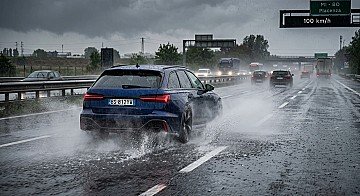
Consider the case of aquaplaning detection. A cloud system might flag a 500-meter road segment as “high aquaplaning risk after heavy rain,” but it cannot determine whether an individual vehicle is currently experiencing full aquaplaning, partial aquaplaning on one wheel, or no aquaplaning—distinctions that depend on that vehicle’s specific speed, tire condition, load distribution, and the exact water depth at that moment. For this, the vehicle must “sense” the road directly through its own dynamics.
This is where active safety systems like Easyrain’s AIS (Active Safety System) demonstrate the value of edge-based friction awareness. By detecting aquaplaning in real time and preemptively eliminating the water layer ahead of the tires through pressurized fluid spray, such systems can restore grip before control is lost—an intervention that requires millisecond-level local processing, not cloud communication.
Key Data Points (2026)
- ISO 26262 Requirement: Friction-adaptive AEB systems must maintain estimation error below ~35% (positive error) to avoid Severity S1/S2 safety violations.
- Crash Reduction Potential: Up to 30% reduction in total crashes with improved friction awareness (NHTSA/Euro NCAP analyses).
- Euro NCAP 2026 Protocol: Stricter AEB testing on low-mu surfaces; five-star ratings require demonstrated grip differentiation capabilities.
- GSR II (2027 Revision): Expected to mandate friction-aware speed adaptation for automated lane-keeping systems under UN Regulation 157.
- Cloud-Based Architecture Limitations: Traditional cloud-aggregated friction mapping systems process fleet-wide telemetry to generate statistical road surface models; while valuable for route planning and fleet optimization, their primary limitation remains communication latency incompatible with real-time safety interventions.
- Edge Computing Advantage: Millisecond-level detection vs. cloud latency; critical for safety-critical interventions like ESC or AEB during active slip events.
- SAE Technical Activity: 2025-2026 papers focus on multivariate time-series models, CNN-based acoustical friction estimation, and fusion frameworks combining vision + dynamics.
The Broader Context: Architecture Philosophy
The technical debate between cloud-based and edge-based friction estimation reflects a broader transformation in automotive architecture philosophy. Cloud systems excel at large-scale pattern recognition and long-term predictive analytics—identifying seasonal trends, mapping infrastructure conditions, and enabling fleet-level optimization. They are inherently valuable for applications like route planning, predictive maintenance scheduling, and infrastructure monitoring.
However, they cannot replace the instantaneous, vehicle-specific detection required for active safety. The laws of physics impose inherent limits: even with 5G connectivity, the round-trip time for cloud communication (vehicle → tower → cloud server → processing → tower → vehicle) introduces latency measured in tens to hundreds of milliseconds—an eternity when ESC must react within 20-50 milliseconds to stabilize a vehicle entering a skid.
This is why hybrid architectures are emerging as the industry standard. Cloud platforms like Easyrain’s ERC (Cloud Infrastructure) serve a complementary role: collecting and sharing aggregated road intelligence for fleet-level predictive maintenance and route optimization, while edge platforms handle the microsecond-level safety-critical decisions. ERC, for instance, creates live road maps highlighting low-grip areas, worn surfaces, and emerging hazards—data that informs long-term maintenance planning and navigation systems, not real-time brake modulation.
The distinction is operational: cloud for prediction, edge for protection.
What to Expect Through 2028
The trajectory for road friction estimation is converging toward several definitive trends:
Regulatory Mandates Will Become Explicit
While current regulations implicitly require friction estimation (by demanding AEB performance on low-mu surfaces), the 2027 GSR revision is expected to make this explicit. The regulatory language is shifting from “Does the car brake?” to “Does the car know how hard it can brake considering the road?” This makes robust, real-time surface friction software a de facto requirement for all new vehicles equipped with advanced ADAS or Level 3+ autonomous capabilities.
Sensor Fusion as Standard
No single methodology—model-based, vision-based, or acoustics-based—is sufficient alone. The industry is converging on multi-modal architectures that combine:
- Vehicle dynamics analysis for real-time feedback during driving
- Camera-based surface recognition for look-ahead prediction
- Acoustic sensing for texture classification
- Weather data fusion for context validation
Platforms that integrate these modalities while maintaining real-time performance will dominate.
Virtual Sensors Replace Hardware
Weight, cost, and complexity pressures are driving OEMs toward “virtual sensor” platforms that derive multiple safety-critical parameters from existing vehicle dynamics signals without additional hardware. Systems that can detect not only friction but also tire pressure (iTPMS), tire wear (0.5mm tread depth accuracy), wheel misalignment, loose wheels, and rumble strip communication from the same dynamics analysis—like Easyrain DAI‘s suite—offer compelling scalability advantages.
Edge + Cloud Symbiosis
Rather than replacing cloud systems, edge-based friction estimation will coexist with them in specialized roles. The vehicle’s edge system handles immediate safety decisions; the cloud system handles pattern recognition, infrastructure mapping, and fleet optimization. Vehicles will perform local, real-time grip detection for ESC/AEB while contributing anonymized data to cloud platforms for long-term analytics.
AI-Enhanced Prediction
With the integration of artificial intelligence, next-generation systems will transition from reactive (detecting current friction) to predictive (anticipating grip loss based on weather forecasts, road type, historical patterns, and seasonal trends). This aligns with the broader industry movement toward “self-learning” vehicle intelligence that improves over time.
The fundamental question facing autonomous vehicle development is no longer “Can we build self-driving cars?” but rather “Can we build self-driving cars that know when not to drive autonomously?” Accurate, real-time tire-road friction coefficient estimation is the technology that enables this critical discernment.
Frequently Asked Questions
Q: What is the main difference between edge-based and cloud-based road friction estimation systems, and why does it matter for safety-critical applications?
A: Edge-based systems perform friction estimation locally within the vehicle’s electronic control unit (ECU), processing data from wheel speed sensors, IMUs, and other dynamics inputs with millisecond-level latency. This enables immediate safety interventions such as ESC activation or AEB triggering during unexpected slip events. Cloud-based systems aggregate data from connected vehicle fleets to generate “grip maps” for road segments, which is valuable for route planning and fleet management but introduces communication latency (tens to hundreds of milliseconds) that is incompatible with real-time safety-critical decisions. For applications like preventing aquaplaning or stabilizing a vehicle entering a skid—where response time is measured in 20-50 milliseconds—edge computing is not merely preferable but physically necessary.
Q: How do current safety regulations like ISO 26262 and Euro NCAP 2026 impact road friction estimation requirements for ADAS and autonomous vehicles?
A: ISO 26262 classifies friction-adaptive systems (such as advanced AEB) as safety-critical components requiring ASIL B or C certification. To comply with Severity S1/S2 injury classifications, these systems must limit positive friction estimation error (overestimating available grip) to approximately 35%—exceeding this threshold risks catastrophic under-braking on low-mu surfaces like ice or heavy wet conditions. The Euro NCAP 2026 protocols impose stricter AEB performance testing on low-friction surfaces, effectively requiring vehicles to distinguish between dry, wet, and icy conditions to achieve five-star ratings. The upcoming 2027 revision of the EU General Safety Regulation (GSR II) is expected to mandate friction-aware speed adaptation for Automated Lane Keeping Systems, making accurate real-time surface friction software a de facto requirement for all new vehicles with advanced ADAS.
Q: What are the main technical approaches for estimating the tire-road friction coefficient, and why are hybrid fusion methods becoming the industry standard?
A: The 2025-2026 state-of-the-art employs hybrid sensor fusion combining three methodologies: (1) Model-based estimation using Kalman Filters (Extended or Unscented) with vehicle dynamics models to infer friction from wheel slip, yaw rate, and lateral acceleration—this provides real-time feedback but requires vehicle “excitation” (movement/slip) to converge; (2) Vision-based prediction using Convolutional Neural Networks to analyze road texture and color from cameras, enabling look-ahead classification before tire contact—effective for prediction but sensitive to lighting and weather; (3) Acoustic sensing analyzing tire noise via accelerometers to detect surface changes—complementary but limited in resolution. Hybrid fusion outperforms single-modality approaches because it leverages the strengths of each method while compensating for individual weaknesses, particularly under varying weather, lighting, and road conditions critical for Level 3+ autonomous driving.