Satya Nadella’s Post
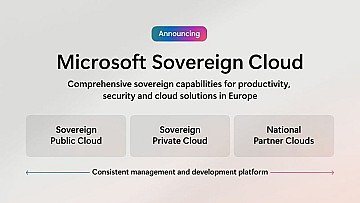
We’re building the most comprehensive digital sovereignty platform to help countries and organizations meet their regulatory, security, and operational needs. Today in London, we announced new capabilities across Microsoft Sovereign Cloud that enable customers to bring core productivity workloads and AI models into fully disconnected sovereign environments, with more choice and greater local control. https://lnkd.in/gFYsatji
Nice to see this direction from #Microsoft. Digital sovereignty and secure AI environments are becoming really important as technology keeps evolving.
Strategic sovereignty in cloud architecture is rapidly becoming a board-level priority, not just a technical consideration. At Microsoft, this latest evolution of Sovereign Cloud reflects a disciplined response to regulatory fragmentation, geopolitical risk, and the growing demand for trusted digital infrastructure. Satya Nadella, your leadership continues to position Microsoft at the intersection of innovation & governance — balancing scale with accountability. As data localization, AI governance, and national security considerations increasingly shape procurement decisions, sovereign capabilities will likely become a structural differentiator in public sector and critical industry contracts. Organizations that can embed compliance, transparency, and resilience into their core architecture — rather than bolt it on — will command long-term trust premiums. Microsoft’s approach signals more than product enhancement; it reflects strategic anticipation of how digital infrastructure underpins economic sovereignty and capital confidence. The next phase of cloud leadership will be defined by trust, resilience. #Leadership #GlobalStrategy #DigitalSovereignty #CloudComputing #Innovation #CapitalMarkets #Governance #LongTermValue
Sorry but unfortunately the Cloud Act still applies to Microsoft, regardless of where physical servers are located. The data located in a US company's premises can still be accessed by the US government regardless of the fact that it is connected to the internet. And you know this well because the Cloud Act was created in response to the 2016 "United States v. Microsoft" case, in which a Court ruled that the Stored Communications Act (SCA) did not authorize the U.S. government to require disclosure of data stored abroad. Now the Cloud Act does.
Is it still owned by Microsoft Corp? If yes it is not a sovereign capability
Satya Nadella. The move toward disconnected sovereign environments is such a critical shift. It solves the ultimate dilemma for highly regulated industries: how to innovate with AI without compromising on local data control. This is a massive step for digital trust.
The ability to run productivity and AI models in sovereign clouds changes the procurement conversation. How are you thinking about trust signals certifications, transparency, and continuous compliance reporting?
It’s a good idea, and it sounds persuasive when framed this way—but only if it came from a company without a history of abusing user trust or exploiting monopoly power. Moreover, the governance, decision‑making, interests, and levers of influence are rooted in the United States—aligned with U.S. business and political objectives and with an ethical framework that diverges from Europe’s.
Defining sovereignty through the lens of regulatory compliance and operational security addresses the "where" of data, but it overlooks the "why" of the human element. A platform that prioritizes disconnected environments and local control serves the institution’s need for safety, yet often fails to address the creative solvency of the people within it. The challenge with these high-level compliance tools is that they stabilize the status quo while potentially stifling the original design. True sovereignty requires more than a secure space for productivity workloads; it requires a structural environment where a culture's unique needs and individual agency are the primary drivers, not just the data being managed. If the architecture of the platform only exists to meet regulatory and security needs, it becomes a sophisticated container for compliance. Real innovation occurs when the technology stops being a vault for compliance and starts being a space that structurally requires the sovereign creativity of its people to function.
"sovereign" and "cloud" do not belong in one sentence. PERIOD. No wonder people call it slop if you guys work with LANGUAGE models but don't even know definitions of words in YOUR language. Bringing cloud infrastructure to local while demanding accounts, connections and billing. No thank you. I can build my own "local cloud" when YOUR cloud is just a server rack somewhere in the states
To view or add a comment, sign in