High-volume gym flooring: how to keep large projects predictable
Large gym projects rarely fail because someone chose the “wrong colour”. They fail when outcomes stop being predictable: deliveries vary, installation becomes harder than planned, wear appears too soon, or the floor starts generating complaints once the club is open.
That is why flooring decisions for high-traffic clubs should be framed around control, not just cost. Budgets matter, of course. But what operators really need is a surface strategy that stays consistent across large areas, and across repeated deliveries, without overspecifying every square metre.
In this article we’ll break down what “smart, cost-effective” should mean in a commercial gym, where recycled rubber gym flooring is a strong fit, and how Pavibasic Solid supports high-volume projects under the Pavigym umbrella.
What “cost-effective” should mean in a gym
Many clubs still treat flooring as a background item: find something “strong enough”, keep an eye on price, move on. In reality, the floor influences far more than aesthetics. It affects:
- day-to-day member comfort and grip
- equipment stability and long-term wear
- maintenance workload
- noise perception in shared buildings
So instead of chasing the lowest price per square metre, a better definition is this:
Cost-effective gym flooring delivers the essential performance a club needs, durability, stability, safety and a professional finish, while reducing avoidable risk (inconsistency, repairs, downtime and early replacement).
This is where a defined recycled rubber range makes sense. Pavibasic exists for exactly that purpose: a family of rubber gym floor tiles designed for high-volume areas where results must remain controlled and repeatable.
Where recycled rubber flooring works best (and where it doesn’t)
Not every area of a club has the same demands. The most reliable approach is to zone the facility and specify accordingly.
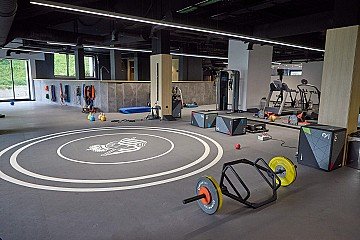
- Cardio and machine areas: Cardio and machine zones need a stable, durable surface that handles constant footfall, sweat and frequent cleaning, plus heavy static loads from equipment. In most cases, they do not require the same impact specification as heavy free-weights. This is where rubber flooring is often a practical choice: stable under machines, comfortable underfoot, and easy to maintain.
- Functional training with controlled loads: Functional spaces vary. If the area is built around bodyweight work, accessories and moderate loads, recycled rubber can deliver the right baseline: grip, resilience and a consistent feel. The key is choosing a product designed for sport and repeatable installation, not a repurposed industrial mat.
- Secondary strength spaces and circuits: Many clubs have a “hero” strength zone, plus secondary areas where dumbbells are lighter and drops are less frequent. Those spaces often benefit from a more cost-effective rubber surface, provided it is appropriate for the loads and the daily movement of equipment.
- Where recycled rubber is not the right answer: There are areas where simplifying the specification is usually a false economy: heavy free-weights with repeated drops, dedicated weightlifting platforms, highly sensitive acoustic environments, or signature studios where performance and design are part of the concept. Those are the places where premium systems earn their keep.
Why recycled rubber is the foundation of high-volume flooring
Recycled rubber is common in large gym projects for a reason. It offers a practical mix of properties for high-traffic environments:
- resilience underfoot for everyday training
- reliable grip, even when conditions are slightly damp
- density and stability to support machines and benches
- robust wear behaviour in busy zones
There is also a sustainability benefit: using recycled rubber supports a more circular approach to materials. But in a professional facility, the priority remains suitability and long-term reliability, especially when you are planning hundreds of square metres, not a small studio fit-out.
The trade-off is straightforward: recycled rubber ranges will not offer the same design flexibility or advanced performance features as premium systems. The smart approach is to use recycled rubber where it performs best, and reserve premium solutions for the zones that genuinely demand them.
Pavibasic in a controlled flooring strategy
The main risk in large projects is not choosing a “basic” surface. The risk is mixing unrelated products with unknown behaviour and inconsistent tolerances. That is when installation becomes unpredictable, visual results vary between deliveries, and long-term performance becomes harder to manage.
Pavibasic sits within the Pavigym portfolio to keep that under control. It supports high-volume areas with a recycled rubber solution that follows a defined product logic, and it allows you to keep premium performance where it matters most.
In simple terms:
- Pavibasic is designed for large, high-traffic areas where the priority is durability, stability and repeatable delivery.
- Pavigym solutions remain the right choice for heavy lifting zones, performance-driven studios and acoustically sensitive spaces.
Working within one flooring partner also helps keep transitions, thickness planning and installation outcomes more consistent, which protects both timeline and final result.
A quick checklist for large gym projects
Before selecting any “cost-effective” range, pressure-test the basics:
- Define zones first (cardio, functional, strength, circulation, studios).