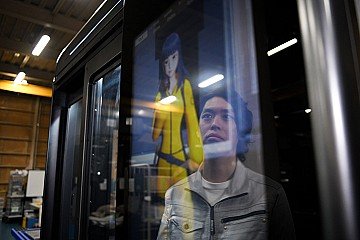
It’s been 20 years since Takayuki Hirayama set up metal parts manufacturer ARUM Inc from his kitchen table in Kanazawa, Japan. In that time, he’s built a complementary business developing fully automated manufacturing systems for the precision parts industry. Over 200 companies in Japan now use ARUM’s in-house software ARUMCODE, while dozens of its fully automated milling machine TTMC have been shipped. But this CEO has bigger plans in store.
What triggered ARUM’s move from making precision parts to developing AI machining solutions?
When the company was first founded in 2006, we were an ODM (original design manufacturer), designing and making precision parts for auto and semiconductor companies. The work we were doing was very difficult, but the profits were very limited.
Then in 2008, after the global financial crisis, many of our partners – parts manufacturers also engaged in metal processing – went bankrupt and disappeared. So, we thought, there will be demand for our technology if we build it.
We were also facing an industry-wide issue: A major decline in the number of skilled workers who could work in metal processing.
So, we decided to work towards full automation using AI.
What was the idea behind ARUMCODE and TTMC?
Our original concept was to automate metal processing, which consists of 12 processes. Programming (via ARUMCODE) covered the first three processes. And it was just the natural flow to develop TTMC to automate the remaining nine processes.
Initially, ARUMCODE was a software that could not produce anything. We did tens of thousands of tests, and we continued to brush up and let it learn. By 2020, it was usable to a certain extent. And then I was confident: This will sell, we can sell this, we can go with it.
How has ARUM’s business changed since then?
With the development of ARUMCODE and TTMC, if we were to compare the company now and back then, the profit has increased eight- to ten-fold.
And because we were originally an ODM, it was very rare then that our company name got any exposure. Now ARUMCODE and TTMC carry our company name, so our brand is out there and known worldwide.
We now consider ourselves a fabless company, focusing on design and development. And we leave the manufacturing of precision parts to our partner companies.
What’s next?
Before the end of the year, we hope to link more than 100 TTMCs throughout the country in various locations, all running as part of a procurement network. This network can be controlled in a consolidated manner on Microsoft Azure.
Let’s say that Tohoku, in northeast Japan, has a major earthquake. If the plant there stops operations, then a TTMC in the south, maybe Kagoshima, can take over and produce the parts.
On top of that, TTMC can be used in various industries, like automotive, semiconductors as well as defense. And all the design data, and processing formulas are automatically collected and can be used for further machine learning. And because we operate the cloud network which connects all these TTMCs, we will be the so-called manufacturing infrastructure vendor to serve these industries.
If all goes to plan and we get the necessary approvals, we hope to export TTMCs to the US, South Korea and India by August 2027.
How has Microsoft technology helped?
When we implement GPT-5 (OpenAI’s large language model available via Azure OpenAI in Microsoft Foundry), the machines can be operated using natural language. So, you can immediately operate the machine on your first day at the plant. And while this is now programmed in Japanese, you can easily translate into other languages using AI.
Our plans to create the procurement network and become a manufacturing infrastructure vendor will be realized by using Microsoft’s Azure cloud platform.
Where do you think ARUM would be today if you did not pivot to developing AI solutions?
For fiscal year 2026, our target is sales revenue is 7 billion yen ($44.4 million), and a net profit of 2 billion yen ($12.7 million), with a workforce of 40 people. We plan to list the company in 2030.
Without ARUMCODE or TTMC, I would assume that our sales would have been just 1 billion yen ($6.4 million), and the profit maybe 50 million yen ($318,000). And just stop at that. And we would not picture ourselves doing business with the rest of the world.
I believe we would have survived even without ARUMCODE or TTMC. We are still subcontractors, and so we have regular jobs coming in. We would survive, but without any big dreams.
What are you proudest of?
ARUM was born from my idea. I am the original inventor and now I’m able to provide this to the world and get appreciation from the customers. This, I think, is my greatest joy and pride.
Lim Ai Leen reports on AI for Microsoft Source, focusing on how it’s improving lives in Asia. Ai Leen was formerly associate foreign editor at The Straits Times in Singapore and still pens an occasional weekend column. Contact her on LinkedIn.