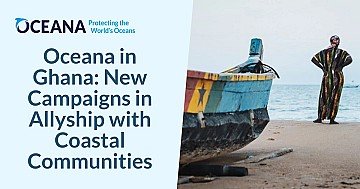
A few weeks ago, I stood on two very different shores — one in the Philippines and one in Ghana — where the ocean sustains entire communities. I met with fishers launching boats into the sea, women smoking fish at busy coastal markets, and families whose livelihoods depend on healthy fisheries. I left both countries feeling deeply hopeful about what Oceana is doing and the future we are building together.
With colleagues from our Manila office, I traveled to the island of Samar in the Eastern Visayas, where Oceana is partnering with local governments and fishing communities to stop illegal fishing and reduce the loss of fish between capture and consumption. We visited four different coastal villages and heard how these communities are working to recover dwindling fish populations, combat malnutrition, and improve monitoring of their catches.
I also spent time on the ocean — one of my favorite places to be. The team met with Aning and Gemilyn (pictured below), who, like many other couples in the area, spend their days fishing side by side. We were also welcomed by the Yangta Fisherfolk Association, the Mayor of Daram in Samar, and a group of women who, with Oceana’s help, formed a cooperative and now have a facility to preserve fish through bottling, smoking, and other means. In each conversation, we heard about the challenges these communities face, and their hopes for a more abundant future. Many shared directly how Oceana’s work is already making a difference.
The challenges we are helping to address in the Philippines are not unique. Across the world, many coastal communities face similar threats from illegal fishing, declining fish populations, and increasing competition at sea. That’s why Oceana is entering an exciting new chapter with the launch of campaigns in Ghana.
To help plan this work, colleagues and I spent a week meeting with government officials, researchers, and members of coastal communities. We walked along a bustling beach in Abandze (pictured below) and the nearby Elmina fish market, where colorful wooden canoes arrive from the sea and fish move quickly from boats to market stalls and smoking racks.
Canoe owners shared their concerns about the dangers they face on the water. Large industrial vessels sometimes run them over or snag artisanal fishers’ nets and drag their canoes. As fish populations decline, competition for space at sea increases — and so does conflict.
Throughout our many conversations (on beaches, in offices, and over meals of fresh fish), one theme was unmistakable: healthy fisheries are essential for family wellbeing and community resilience. We heard how overfishing, illegal fishing, and destructive practices threaten both livelihoods and food security. We also heard optimism about Ghana’s new Fisheries Act, which represents an important step toward combating illegal fishing and restoring declining fish stocks.
I am also pleased to share that Sonia Kwami has officially joined Oceana as our Vice President in Ghana. She will oversee our work in the country and lead campaigns developed in partnership with fish-reliant communities to rebuild fisheries, strengthen food and nutrition security, and safeguard coastal livelihoods.
As Oceana marks its 25th year, launching campaigns in Ghana and opening our first office in Africa feels especially meaningful. Since our founding in 2001, Oceana’s mission has been clear: to achieve tangible victories that protect and restore the world’s oceans, for people and the planet. From reducing overfishing to increasing transparency at sea to securing new marine protected areas, Oceana’s campaigns are delivering results.
Today, our global community includes more than 9.2 million supporters. Thank you for standing with us and for helping to protect our oceans, in the Philippines, in Ghana, and around the world.
James (Jim) Simon is Oceana’s CEO, stepping in to the position in July 2024 after almost 21 years as the organization’s President. Simon was instrumental in establishing Oceana as the world’s leading ocean conservation organization and has helped win more than 350 major policy victories to date. He also helped spearhead the organization’s international expansion. Today, Oceana campaigns in 10 countries and the European Union.