You have a mountain of insights sitting in your CRM, another in your POS, and a third in your mobile app.
But if those systems don’t talk to each other, ecommerce personalization becomes a series of disconnected guesses.
That’s the reason so many enterprise marketing teams are turning to Customer Data Platforms (CDP).
These systems can help them unify fragmented data across multiple sources and activate that data to create high-fidelity 1:1 customer experiences.
That being said, most evaluations start with feature lists and pricing sheets.
But the platforms that look identical in a demo can perform wildly differently when you’re processing millions of events, orchestrating multi-step journeys, or proving ROI to a CFO who needs hard numbers.
This guide compares three leading enterprise CDP solutions (Insider One, Segment, and Bloomreach) through the lens of real-world performance. We’ll examine data unification speed, cross-channel activation capabilities, AI-powered decisioning, integration ecosystems, and the metrics that actually matter when you’re trying to drive revenue.
By the end, you’ll have a clear framework for evaluating which platform fits your technical requirements and business model.
What is an enterprise CDP?
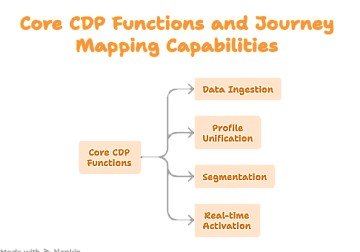
An enterprise customer data platform (CDP) is a centralized system that collects, unifies, and activates customer data from every touchpoint (web, mobile, email, SMS, in-store POS, customer service interactions, and more) into a single actionable customer profile.
Unlike basic marketing databases or CRMs that store static contact information, an enterprise CDP operates in real-time. It ingests behavioral signals as they happen, resolves identities across devices and sessions, and makes that unified data immediately available for personalization, analytics, and orchestration.
What sets enterprise CDPs apart from mid-market solutions:
- Scale: Enterprise CDPs process billions of events per month without performance degradation
- Real-time processing: Sub-second data ingestion and activation (typically 50-200 milliseconds from event capture to profile update) across all channels
- Advanced identity resolution: Deterministic matching (email, phone number, customer ID) and probabilistic matching (device fingerprinting, behavioral patterns) to unify anonymous and known users across an average of 3-5 devices per customer
- Cross-channel orchestration: Native activation across 10+ channels
- Enterprise-grade security: SOC 2, GDPR, CCPA compliance with role-based access controls
- API-first architecture: Deep integrations with existing MarTech, data warehouses, and business intelligence tools
Why enterprise CDPs matter for your business
The average enterprise has data scattered across 15+ systems.
None of them talk to each other.
The cost of fragmentation:
- In-store revenue leakage: A customer browses winter coats on your website and abandons a $450 cart. Two hours later, they walk into your physical store. Your sales associate cannot see their digital intent. While the specific coat (Navy, Size Medium) sits in the stockroom 30 feet away, the associate suggests an unrelated style. The customer leaves empty-handed. Your abandoned cart email fires six hours later, but the customer already purchased from a competitor that surfaced relevant inventory in real-time.
- Duplicate acquisition costs: Your paid search team spends $85 to acquire a new customer who is actually an existing loyalty member using a secondary email address. Your CRM fails to deduplicate the identity. The customer misses their 15% loyalty discount at checkout, forcing them to contact support for manual verification. You paid a premium to “acquire” a customer you already owned, resulting in a 2-star review and a broken brand experience.
- Data-driven channel conflict: On Thursday, your email team sends a 20% discount to 500,000 subscribers. On Friday, the SMS team sends a 15% code to 80,000 customers. With a 40,000-user overlap, customers receive conflicting offers within 24 hours. This confusion drives 6,200 support tickets, spiking queue volume by 340% and increasing weekly agent costs by $18,000. Campaign revenue underperforms by 31% because customers delay purchases to resolve the price discrepancy.
What enterprise CDPs solve:
- Unified customer view: Every team (whether its marketing, service, sales, product) operates from the same real-time profile
- Personalization at scale: Deliver 1:1 experiences across web, app, email, and SMS based on complete behavioral history
- Predictive intelligence: Use AI to anticipate churn, recommend next-best actions, and optimize send times
- Cross-channel orchestration: Trigger the right message on the right channel at the exact moment of intent
- Measurable impact: Attribute revenue to specific touchpoints and prove marketing ROI with hard data
Enterprise CDP comparison: Insider One vs Segment vs Bloomreach
1. Insider One CDP
Insider One is an AI-native customer engagement platform built for enterprises that need data unification (collecting customer data from multiple sources into a single profile), cross-channel orchestration (coordinating messages across email, SMS, app, web, and more), and personalization (tailoring content and timing to individual behavior) in a single system.
Unlike pure-play CDPs that only collect and unify data, Insider One combines its CDP with activation tools; meaning you can segment, orchestrate, and personalize without stitching together multiple vendors.
Key features:
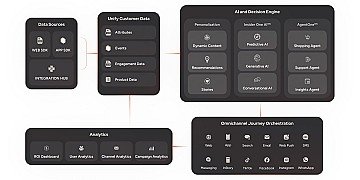
- Actionable CDP: Unifies data from 100+ sources including Salesforce, Shopify, custom APIs, Google Analytics, and in-store POS systems, processing up to 10 billion events monthly into real-time customer profiles that update in under 200 milliseconds
- Sirius AI™: Insider One’s AI-powered engine that powers predictive segmentation (identifying which customers are likely to convert, churn, or take specific actions), next-best-channel recommendations (determining whether to reach a user via email, SMS, WhatsApp, or push), and dynamic content personalization (automatically adjusting messaging based on individual preferences and behavior)
- Agent One™: Autonomous AI agents that handle tasks like answering product questions (resolving 60-70% of queries without human intervention), recommending items based on browsing history, and surfacing actionable insights from customer data
- 12+ Native Channels: Email, SMS, WhatsApp Business, RCS (Rich Communication Services), Web Push, App Push (iOS and Android), In-App Messages, InStories (mobile-first ephemeral content), On-Site Notifications, and more—all activated from a single orchestration layer without requiring separate vendor integrations
- Architect: Visual drag-and-drop journey builder that lets marketers design complex multi-branch customer journeys without writing code
- Real-time segmentation: 120+ out-of-the-box attributes (purchase frequency, average order value, last visit date, product affinity, lifecycle stage, churn risk score) with profile updates completing in 50-200 milliseconds, enabling instant campaign triggers
Pros & cons
| Pros | Cons |
| Easy to use with helpful support: Users consistently praise the intuitive interface and responsive customer support team | Steep learning curve initially: Users report the dashboard and feature set can be overwhelming at first, requiring time to gain proficiency |
| Highly personalized campaigns: AI-driven insights enable targeted customer engagement that significantly boosts conversions and product discovery | Time-consuming onboarding: Implementation process can lead to delays in launching campaigns and configuring attributes efficiently |
| Strong automation capabilities: Platform automates personalized campaigns effectively, reducing manual work while improving engagement | Complex setup: The extensive feature set and initial configuration can be difficult to navigate without dedicated training |
| Effective product discovery optimization: Users report improved customer engagement and conversion rates through personalized recommendations | Customer support challenges during setup: Some users experience slow onboarding with back-and-forth needed to resolve initial issues |
| Comprehensive feature set: Robust capabilities for campaign management, personalization, and customer engagement across channels | Integration complications: Some users face delays and technical challenges when connecting Insider One to existing systems |
G2 (4.8/5 stars):
“Insider One’s AI powered recommendation engine is extremely impressive. It analyzes our customers’ behavior and predicts what they might be interested in, making it easy to recommend the right products to the right customers.The ability to personalize content and promotions with Web Push has also been a game-changer. We have been able to send push notifications that are tailored to each customer’s interests, leading to higher engagement rates. These two products together have helped us see a 14.5% increase in conversion rate.”
2. Segment CDP
Segment (a Twilio company) is a leading CDP designed to collect, clean, and route customer data to downstream tools.
It acts as the central data layer of your tech stack, ensuring every tool (from analytics to marketing automation) receives consistent high-quality data in real-time.
Segment does not activate campaigns or send messages directly.
Instead, it integrates with your existing MarTech stack (email, SMS, ad networks) to ensure those tools operate from a single source of truth.
Key features:
- Event streaming: Real-time data collection from web, mobile, and server-side sources (Node.js, Python, Go, etc.), processing millions of events per second with latency under 500ms.
- 450+ integrations: Pre-built connectors to analytics (Amplitude, Mixpanel), marketing (Braze, Iterable), data warehousing (Snowflake, BigQuery), and advertising (Google, Meta, TikTok).
- Protocols: A data governance layer that enforces naming conventions and schema validation, blocking inconsistent or dirty data before it hits your downstream tools.
- Unify (formerly Personas): Identity resolution that merges user data across devices into a “Golden Profile” and provides an audience-building interface for complex segmentation.
- Reverse ETL: Syncs “computed traits” or segments from your data warehouse back into operational tools like Salesforce or Zendesk.
- CustomerAI: Predictive modeling features that allow teams to calculate likelihood to churn or forecast Lifetime Value (LTV) directly within the platform.
Pros & cons
| Pros | Cons |
| Easy to use and integrate: Users find the platform intuitive with straightforward setup for connecting data sources and destinations | Expensive pricing model: Users cite high costs, especially as usage scales with Monthly Tracked Users (MTUs), making it less affordable for growing businesses |
| Seamless integrations: Enables quick connections to 400+ tools without extensive coding or heavy engineering support | High learning curve: Development teams report challenges with implementation, configuration, and understanding the platform’s full capabilities |
| Developer-friendly: Strong documentation and API-first design appeal to technical teams | Poor customer support during implementation: Users experience difficulties getting timely help, making onboarding and troubleshooting challenging |
| Clean data infrastructure: Effectively tags website activity and creates clear event streams for downstream tools | Interface design issues: Users criticize the UI for hindering report creation, audience management, and navigation |
| Best-in-class data routing: Ensures consistent, high-quality data flows to analytics, marketing, and data warehousing tools | Long-term cost concerns: Users worry about expenses associated with mistakes during implementation and ongoing usage as data volume grows |
G2 (4.5/5 stars):
3. Bloomreach CDP
“I’ve been using Segment at different companies for the last 6 years and every time I’ve introduced Segment to an org, it had an immediate impact across multiple teams – marketing, growth, product, cx. Some highlights:– Flexibility to plug in new tools and replay historical data– All user data in one place (360 visibility)– Ease of use and speed of deployment of new campaigns, personalization across multiple channels– Strong product roadmap and a great support team”
Bloomreach is a commerce experience cloud that combines a CDP with product discovery, content management, and email/SMS activation. It’s built specifically for e-commerce and retail, with features like AI-powered product recommendations and visual search.
The platform positions itself as an end-to-end commerce solution—data, content, and activation in one stack.
Key features:
- Engagement CDP: Collects and unifies customer data with a focus on e-commerce behaviors (product views, cart adds, purchases)
- Loomi AI: Generative and predictive AI for content creation, product recommendations, and send-time optimization
- Discovery: AI-powered site search and product recommendations
- Content CMS: Headless content management for e-commerce storefronts
- Email & SMS activation: Native email and SMS tools for campaign execution
- Predictive models: Churn prediction, product affinity, and CLV scoring
Pros & cons
| Pros | Cons |
| Easy to use: Users find the platform intuitive, enhancing daily operations and campaign effectiveness once familiar with the system | Steep learning curve: Users consistently report difficulty navigating the platform initially, particularly challenging for new users and junior team members |
| Outstanding customer support: Users highlight quick response times, exceptional assistance, and efficiency in resolving issues from the support team |