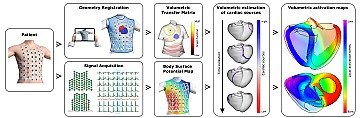
ACORYS®, the global cardiac mapping system developed by a team from the ITACA Institute of the Universitat Politècnica de València, Corify Care, and Hospital Gregorio Marañón, has been validated through publication in two leading international cardiovascular research journals: Heart Rhythm and Europace. These studies validate this technology as one of the best high-precision solutions for mapping arrhythmias, both atrial and ventricular, in a single heartbeat.
Currently, arrhythmia mapping is usually a slow process that often requires inducing unstable rhythms in the patient or relying on previously obtained radiological images. Corify Care’s technology eliminates this need. By capturing cardiac electrical activity globally and instantaneously, the ACORYS® mapping system provides crucial, actionable information even before ablation begins.
“Time and predictability are the most valuable assets in an electrophysiology lab”, says Dr. Andreu Climent, CEO of Corify Care and researcher in the COR ITACA group at UPV.
“These publications show that we can offer physicians a complete view from the very first moment, without waiting. It is a paradigm shift: moving from ‘mapping’ to ‘knowing».
In these studies, alongside the UPV and Corify Care team, medical and research staff from the Institut Clínic Cardiovascular (ICIC) of Hospital Clínic de Barcelona, the August Pi i Sunyer Biomedical Research Institute (IDIBAPS), the Biomedical Research Networking Center for Cardiovascular Diseases (CIBERCV), the Biomedical Research Networking Center for Mental Health (CIBERSAM), the Berlin Faculty of Medicine, the University Hospital of Saint-Étienne, and the German Center for Cardiovascular Research also participated.
Transforming workflow in ventricular tachycardia (VT) and atrial fibrillation (AF) ablation
The NIAVAS study, published in Heart Rhythm, shows that the technology successfully identifies the arrhythmogenic substrate of ventricular tachycardia (VT) while the patient is in normal sinus rhythm. This eliminates the need to induce hemodynamically unstable arrhythmias during the procedure. At the same time, the study in Europace validates the “imageless” approach for specific atrial arrhythmias, generating highly precise full-chamber activation maps without prior CT or MRI scans.
“We are eliminating uncertainty in complex ablations”, says Jana Reventós, Clinical Affairs Manager at Corify Care and lead author. “For the first time, specialists can visualize arrhythmia circuits instantly, without relying on external images or increasing procedural risk, allowing targeted and safe interventions from the outset.”
This clinical impact translates directly into improved patient care.“With Corify’s technology, we visualize the entire arrhythmia substrate instantly and continuously. This results in more precise ablation, shorter procedures, and lower risk for the patient”, explains Dr. Ivo Roca-Luque, head of the Arrhythmia Section at Hospital Clínic de Barcelona.
Featured at the Heart Rhythm Society (HRS) congress
The ACORYS® mapping system complies with European regulations (CE marking) and U.S. regulatory requirements, having recently obtained FDA 510(k) clearance. Corify Care, a company emerging from research conducted at UPV, will present new clinical data from these studies, along with 12 other scientific presentations, at the Heart Rhythm Society (HRS) 2026 congress, to be held in Chicago this week, from Thursday, April 23 to Sunday, April 26.
References
Jana Reventos-Presmanes, Andrea Cano, Eric Invers-Rubio, Berta Pellicer-Sendra, Jaume Serrano-Campaner, Ernesto Zacur, Till F Althoff, Ismael Hernández-Romero, Clara Herrero-Martín, Roger Borràs, Mariona Regany-Closa, Elena Arbelo, Eduard Guasch, Jose María Tolosana, Andreu Porta-Sánchez, Ivo Roca-Luque, María S Guillem, Andreu M Climent, Lluís Mont, Jean-Baptiste Guichard, Validation of an imageless electrocardiographic imaging technique for the non-invasive mapping of regular atrial tachyarrhythmias, EP Europace, Volume 28, Issue 4, April 2026. https://doi.org/10.1093/europace/euag048
Jana Reventos-Presmanes, Ismael Hernández-Romero, Berta Pellicer-Sendra, Esther Guillen-Buisan, Jaume Serrano-Campaner, Eric Invers-Rubio, Mariona Regany-Closa, Paz Garre, Roger Borràs, Adriana Costafreda, Elena Arbelo, Jose M. Tolosana, Eduard Guasch, Till F. Althoff, Jean-Baptiste Guichard, Pasquale V. Falzone, Sara Vázquez-Calvo, Elvihots Ayauja, Maria S. Guillem, Andreu Porta-Sánchez, Lluís Mont, Andreu M. Climent, Ivo Roca-Luque. Noninvasive assessment of the ventricular arrhythmogenic substrate using electrocardiographic imaging during sinus rhythm: The NIAVAS study. Heart Rhythm, Volume 23, Issue 2, 2026, Pages 249–263, ISSN 1547-5271, https://doi.org/10.1016/j.hrthm.2025.07.020