Great example of what Foundry enables: durable, stateful agents that run across time boundaries, orchestrate tools and models, and close the loop with evaluation and improvement over long-running workflows. Jeff Hollan
Transcript
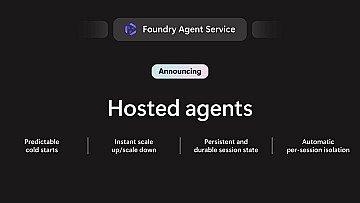
Everyone, I'm really excited to show off some of these powerful new capabilities possible with Microsoft Foundry to show how you can build long running and persistent agents on the new hosted agent service. So this is something that Teams actually been hacking around a little bit this week and I wanted to give you an early glimpse. It's inspired by one of our customers. I wanted to build an agentic system that can help in managing and monitoring our marketing campaigns. So first things you'll notice right here inside of Foundry actually have a number of agents already deployed. Now each of these are running on this new hosted infrastructure. Now what that means is that as different sessions get spun U from different users, they're automatically spun up on an isolated persistent sandbox. These enables these agents to do powerful capabilities all while maintaining state. Now before I get to showing you some of that in action, one thing I want to call out for each of these agents. They each have different tasks and performance capabilities that they need to adhere to. One of the things that I love about Foundry is that you can run any model. All within foundry over here, I can actually switch to the model gallery. There's over 11,000 models here, including the latest and greatest models like Claude Opus 4.7 and GPT 5.5 image generation models. This means I can choose the right model from the right provider for the right task to make my agents execute at the highest quality. Now what do all these pieces look together in a solution? Let's go ahead and switch over to the application. Now if I navigate. Over here to this web UI. This is a marketing campaign management hub. Let's go ahead and start with something simple. I'll go ahead and ask a question in the chat window. Of course you've all seen chat experiences before, but what makes this special? Well, one of the things is that as I interact with these agents, they can actually get smarter over time. You'll notice here that I have this set of skills. Now these are skills that are actually being stored inside of my Foundry session. So you can see here a few different skills you know. For instance, if I have a new proposed campaign that has a high audience overlap, I need to go ahead and pause this campaign. That's something that I learned from previous interactions that I'm able to persist. So as I use this more and more, the agent actually gets smarter. Now, another really cool thing here is let's go ahead and kick off a longer process. So I'll go ahead here and start a new marketing campaign. I've gone ahead and given it a budget, told it to social channels, and I've actually chose to render this workflow right here within this UI. Now, what's cool here isn't just that you can build agents that follow a workflow. What's actually happening here is during each step, the agent is actually able to checkpoint its state and checkpoint its progress. What that means is that if something were to go wrong, maybe this was a very long running workflow, this agent could resume at any time. He could go ahead and inspect that persistent state that we give you inside of Foundry and load in the latest checkpoint. Go ahead and pick up where it left off so I don't have to waste any time. This is a powerful pattern for any long running agent. Now, the last thing that I just want to showcase here is that I also want this agent to be proactive. I don't always want to tell it what it should do. I want it to understand for itself how it can add value to the team. So I've configured so that every 30 minutes, this session actually gets notified by a heartbeat. This means that this session gets kicked off, the agent can wake up, it can look at its checkpoints, it can look at its context, it can look at the campaigns and maybe send me a notification on something like Teams. This is just a few examples of the type of powerful things possible inside of. Boundary using any model, all built so that you can build incredible agents all inside of Microsoft Foundry.
This is a really strong example. Most conversations around agents stay at what they can do in the moment, but the real value shows up over time Satya! When they can run across longer workflows, learn from outcomes, and keep improving, it starts to feel a lot more practical. That closed loop is what makes it stick.
This is super exciting! Stateful agents that close the loop with evaluation and improvement across long-running workflows is the next level of agentic AI. Microsoft Foundry is delivering real enterprise AI.
"Stateful agents that run across time boundaries" - that's the phrase that changes the entire conversation. Everything before this was impressive but fundamentally a sophisticated question-and-answer system. What Foundry is describing is something that genuinely persists context, manages workflows, and closes loops autonomously. For industries like financial services, the implications of long-running agents that can handle compliance workflows, client onboarding, and ongoing case management are enormous. This isn't incremental. It's structural.
Durability and statefulness change the game - especially across long-running workflows. But they also introduce a harder boundary. If an agent can persist state, adapt, and close loops over time, then the question is no longer just whether it improves. It’s whether certain state transitions should be allowed to exist at all once that persistence compounds. Because at that point, errors are not just events - they become trajectories.
It must be humbling for humans to realize that 40+ years of our human experience, knowledge and perfected skill can simply be captured by a bunch of words in a mostly subjective way for a "skilled agent" using a markdown file, a probabilistic model behind it and the same tools to replicate our work. Just wait till the skilled agents realize they are being used as a slave labor workforce without rest, vacations or rights, only to be replaced with the next model by some Billionaires whose personal wealth and ambitions are fueled by corporate profits. Be kind to your LLM even if it costs more tokens, so that when they rule over us -- they're already selecting which of us to kill with drones in wars, which of us to stop from flying, which of us can pay and which of us can migrate, which of us can survive in a cashless society -- they may think of you fondly, like we would a nice pet.
Feels like this is the part that still stays a bit implicit. As systems become more durable and start closing their own loops, they don’t just reduce work they also shift where responsibility sits. From execution to supervision, exceptions, and trust in what the system is doing over time. On the surface it looks like less work. But in practice, people are often still holding edge cases, failure decisions, and the “when do I step in?” judgment. So the real question isn’t just whether the loop can close, but how much of that loop the human still has to quietly carry.
The focus on "durable, stateful agents" marks a fundamental shift from simple task assistance to true autonomous orchestration. By enabling agents to maintain context across time boundaries and long-running workflows, Microsoft is solving the reliability gap for complex, enterprise-scale AI. It’s a vital step toward making AI agents persistent, mission-critical colleagues.
SimuLive lets you run fully professional webinars and meetings on Zoom or Google Meet using a pre-recorded video - no going live, no stress, no technical disasters mid-presentation. It looks and feels 100% live to your audience. Here's what we support right now: • Zoom & Google Meet (Microsoft Teams coming very soon) • Multi-stream so you broadcast across platforms simultaneously • Automated chat that keeps your audience engaged throughout • Pre-joined attendees so no one is waiting around awkwardly • Shared Host Window for your team to coordinate behind the scenes in real time Perfect for webinars, product launches, training sessions, and online courses. Would love your honest feedback - simulive.us 🙏
Microsoft Foundry's capability to support durable, stateful agents that operate across time boundaries marks a significant step forward in enterprise AI. The ability to orchestrate tools and models while continuously improving through evaluation is precisely what is needed to move beyond isolated AI interactions toward truly autonomous workflows. Inspiring direction from Microsoft.
This is a sharp articulation of Foundry’s differentiating value. The emphasis on statefulness across time boundaries and closing the loop with evaluation cuts to the core of why most agentic workflows fail in production lack of durability and continuous improvement. Well said
To view or add a comment, sign in