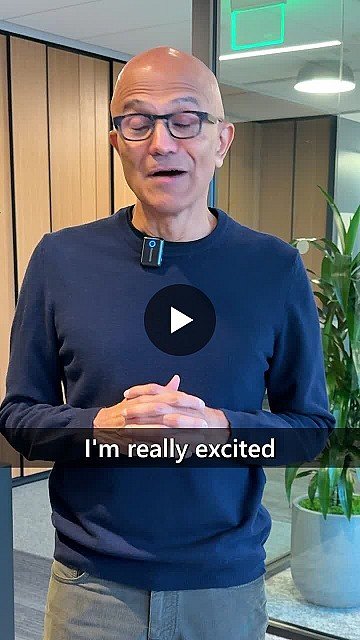
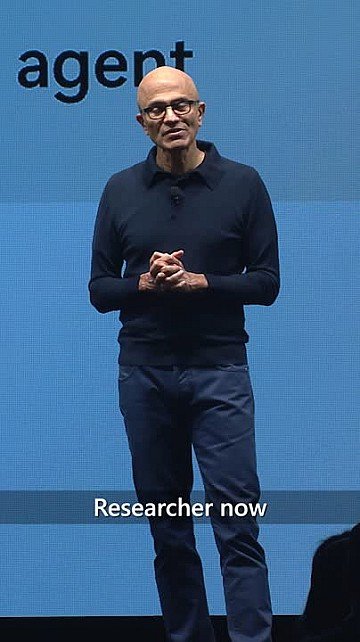
Seeing firsthand how people are using our tools to have impact in their daily lives is one of the most rewarding parts of my job. While in Sydney, I enjoyed talking with Trevor Long about the family calendar assistant he built with Copilot Studio.
Transcript
So what I did, I took Copilot Studio and I tried to create an agent for my family. So I've got 3 kids, my wife and I, and I thought about my busy life, my busy diary and we have a shared family calendar. So I wanted to demonstrate it to if I could. Cool. So you build it? Well, I use Copilot Studio and I integrated the Outlook calendars and so we've called it Charles, our family Butler. So I'll give it a quick example. What's my schedule look like on Monday? And so basically it's now going to go and check my personal schedule and see how busy my day is. But it's also because I've engaged it to always check the family calendar because I wanna know what I'm gonna be able to do and how I'm gonna help the family. So it's looking at my calendar. I think people need to understand that it's not just reading a calendar, it's trying to understand the schematics of a day. And so now it's giving me a whole output of my day, telling me what I've got on. But by default, it's telling me about the clashes and problems that I might have. So considerations and even making suggestions. Would you like me to send Amanda, my wife? A quick note about the netball pickup clash. But here it gets even better. So what I can also do is say, move my planning meeting to earlier in the afternoon and let my wife know that I can pick Victoria up for netball. So basically now it's going to change my calendar and it's going to send my wife an e-mail letting her know that I've now changed my card and I can kick U Victoria from ******. So I know it's a really simple example. It's a fantastic demo demo. I wish you had gotten you into my keynote and demo on that because I think what you just showed is like the first of all, the pride you have, the sense of empowerment you have that you built this application just like in the past, you may have built an Excel spreadsheet or a Word document. You just literally created a piece of software. And then there's an agent, there's an e-mail to my wife, which to be honest, probably not appropriate. I would normally send a text maybe, but just letting you know that I've adjusted my meeting so I can pick Victoria up from school on Monday and take it a ******. So it's a great. I feel like is that the next phase for AI to people to see real world usage of Correct. And I think you captured it well, which is what is the output that you care about in this case? You didn't sort of say, oh, well, you know, Mike, this coordination task I have around my family, I want to basically build an agent. Agentic system that just does that so that I am not sending mails or text messages or keeping track mentally and then the agent offloads all of.
This is one of the best parts of building anything meaningful Satya! It’s easy to focus on metrics and performance, but seeing how something actually fits into people’s daily lives brings a different kind of perspective. That’s usually where the real value shows up not just in scale, but in how it genuinely helps someone.
What is most powerful about Copilot Studio is not only the technology itself, but the shift it represents: moving from AI as an individual productivity tool to AI as an organizational capability. When people who deeply understand a process can build useful assistants for their real context, innovation is no longer concentrated only in technical teams. It starts to become distributed across the entire company. That may be one of the key principles of the next stage of transformation: AI close to the user, embedded in daily work, governed with discipline, and focused on tangible impact. Real transformation will not come from having more tools, but from enabling more people to solve meaningful problems with them.
Satya Nadella very interesting. The biggest thing that I like about Copilot (as opposed to other tools) is how deeply it could live in our existing daily workflows. An assistant in Word, Excel, or Outlook should be able to integrate data into critical context much easier than an external agent. Looking forward to where this goes next!
This is where AI becomes real — not in demos, but in everyday workflows. The interesting shift isn’t just capability… it’s integration into daily life. Layer 1 — Tool AI helps with isolated tasks (write, summarize, search) Layer 2 — Assistant AI starts managing workflows (calendars, reminders, coordination) Layer 3 — System AI anticipates needs, reduces decisions, and removes friction Examples: Today → You ask AI to write an email You manually schedule meetings You decide what to prioritize Next step → AI drafts + sends emails based on context Reschedules conflicts automatically Prepares your day before you even check it Future → AI understands your patterns, energy, priorities Coordinates across work + life systems Makes micro-decisions continuously without needing prompts That’s when it stops feeling like “using AI”… and starts feeling like living with it. The real shift isn’t AI getting smarter. It’s AI becoming invisible. Simple use case… but a strong signal of what’s coming next.
What stands out is not the use case itself, but what it represents: AI quietly moving into everyday decision-making. A family calendar assistant may seem simple, but it already shifts how decisions are made, coordinated, and delegated. As these systems evolve, the question is less about what AI can do and more about how we define roles between humans and systems. If AI starts to anticipate and organize more of our daily lives, the real challenge becomes ensuring that the underlying priorities and decisions still reflect human intent — not just optimized patterns.
It’s inspiring to see how Satya Nadella and Microsoft are democratizing "agentic" creation through Copilot Studio. By enabling people like Trevor Long to build bespoke AI assistants for personal use cases like family scheduling, you're proving that the future of productivity isn't just about enterprise scale—it's about empowering every individual to build their own custom AI.
This is truly inspiring, Satya! It's fantastic to see the real-world impact of Copilot Studio in personalizing daily tasks. 🤖 How do you envision this kind of AI-assisted customization evolving to support even more diverse family needs in the future? #AI #CopilotStudio
An absolute pleasure to meet you, and to talk AI. Especially fun showing you my simple little real-world AI example, genuinely loved how engaged you were in the conversation. Until next time! Cheers
Easy to miss in agent strategy: the win isn't sophistication, it's everyday fit. When AI lands inside a family routine before it lands in an org chart, the workforce rollout that follows looks very different. Consumer behaviour usually shows up at work 6–12 months later — that's the bit we keep watching at WFR.
To view or add a comment, sign in