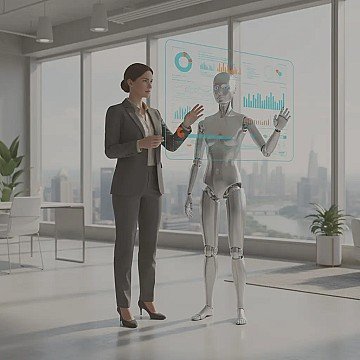
Most of the conversation about agentic AI revolves around autonomy. The idea is simple: instead of an AI system that only responds, we build one that can plan and act. That is an important shift, but it is still very human-led: the system waits patiently until we tell it what to do, then it reacts. Proactivity breaks that assumption.
A proactive AI system doesn’t just execute tasks when triggered; it notices, anticipates, and intervenes. It operates on an ongoing understanding of context to pursue its goals, and when it believes action is warranted, it acts.
This is a much bigger shift than it first appears.
Today, even many so-called agentic systems are effectively sophisticated servants. They sit idle until summoned, then optimize the task they are given. The mental model is still transactional: prompt in, outcome out. The only real autonomy lies in the degree of freedom the system has once the task has been handed over.
To be blunt, if you have to tell a system what to do all the time, it’s a good sign that it’s not really very intelligent. When you think of the smartest and most effective people you work with, they’re the “self-starters” who make things happen, not the ones who need hand-holding through every task. Humans judge intelligence not by “can this person accomplish the task I set them?”, but by “is this person self-sufficient and capable of doing what needs doing?”
Proactivity changes the relationship entirely. AI goes from being a tool you use to something that you co-exist with. It digests the environment it is responsible for, detects emerging situations, and decides when to act , escalate or ignore. That might mean flagging an operational risk before thresholds are breached, reshaping a plan because external conditions have shifted, or quietly handling routine coordination without ever being asked.
Once you start thinking this way, the implications compound quickly. Humans can stop micromanaging and start supervising. Value shifts from speed and efficiency to anticipation and resilience. AI stops being a productivity booster and starts behaving like an organizational processes.
Proactivity even changes the way we understand autonomy. Autonomy is often treated as a slider, more or less freedom. Proactivity is not just “more autonomy.” It requires different design choices: persistent world models rather than single-shot contexts; continuous evaluation loops rather than discrete tasks; explicit authority boundaries rather than implicit assumptions. It also forces us to be much clearer about intent. A proactive system must know the long-term goal, not just how to complete a task correctly.
Of course, proactive AI is also where the hard problems appear.
A system that acts without being asked introduces new risks. Unintended actions, emergent behaviors, misaligned incentives, and opaque decision-making all become more likely. Traditional human-in-the-loop patterns are often insufficient, because you cannot realistically approve every action a proactive system might take.
This is why proactivity and governance are inseparable. You cannot simply unleash proactive AI and hope to retrofit controls later. We need new operating models that define delegated authority, ethical boundaries, escalation thresholds, auditability, and graceful failure from the outset. We also need to be honest about where proactivity is appropriate and where it is not. Not every domain benefits from anticipation; in some contexts, what we really need is restraint.
Proactivity is both the most transformative and the most uncomfortable step in AI’s evolution. It challenges our sense of control, our organizational structures, and even our intuitions about responsibility. Yet without it, we risk building increasingly capable systems that are still fundamentally reactive.
Proactive AI takes the goals of agentic AI and makes them real.
The organizations that recognize this early will not just automate faster; they will rethink how work, decision-making, and accountability are structured in an AI-enabled world. Everyone else will still be asking their AI what to do next, long after it could have told them.